Service de rhumatologie , CHRU Cavale Blanche, EA 2216, INSERM ERI 29, Université de Bretagne occidentale , Brest Cedex , France.
Service de rhumatologie , Hôpitaux Universitaires Paris-Sud, Assistance Publique-Hôpitaux de Paris (AP-HP), Université Paris-Sud, INSERM U1184 , Le Kremlin-Bicêtre , France.
RMD Open. 2016 Apr 20;2(1):e000179. doi: 10.1136/rmdopen-2015-000179. eCollection 2016.
Neurological manifestations seem common in primary Sjögren's syndrome (pSS) but their reported prevalences vary. We investigated the prevalence and epidemiology of neurological manifestations in a French nationwide multicentre prospective cohort of patients with pSS, the Assessment of Systemic Signs and Evolution in Sjögren's syndrome (ASSESS) cohort.
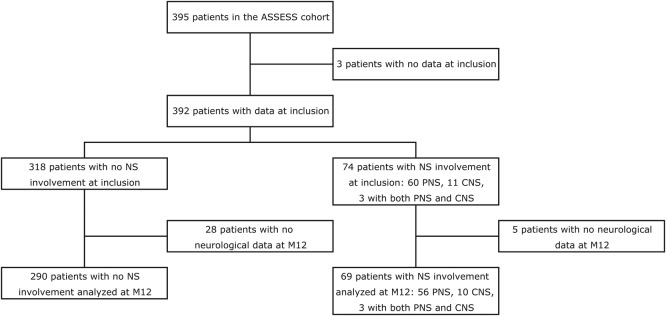
The ASSESS cohort, established in 2006, includes 395 patients fulfilling American-European Consensus Group criteria for pSS. Demographic and clinical data were compared between patient groups with and without neurological manifestations, and across patient groups with peripheral nervous system (PNS) manifestations, central nervous system (CNS) manifestations and no neurological manifestations.
Data at inclusion were available for 392 patients, whose mean age was 58±12 years. Mean follow-up was 33.9 months. Neurological manifestations were present in 74/392 (18.9%) patients, including 63 (16%) with PNS manifestations and 14 (3.6%) with CNS manifestations. Prevalences were 9.2% for pure sensory neuropathy, 5.3% for sensorimotor neuropathy, 1.3% for cerebral vasculitis and 1.0% for myelitis. Neurological manifestations were associated with greater pSS activity as assessed using the ESSDAI (9.4±6.8 vs 4.3±4.8; p<0.001) and proportion of patients taking immunomodulatory/immunosuppressive drugs (32.4% (24/74) versus 13.8% (44/318), p=0003). New neurological symptoms were more common in patients with than without prior neurological manifestations (RR=3.918 (95% CI 1.91 to 8.05); p<0.001).
Prevalences of peripheral and central neurological manifestations in pSS are about 15% and 5%, respectively. Neurological manifestations are associated with greater pSS activity. New neurological manifestations are more common in patients with prior neurological involvement.
原发性干燥综合征(pSS)患者常出现神经系统表现,但报道的发病率有所不同。我们对法国全国多中心前瞻性队列研究的患者(评估干燥综合征的系统表现和演变研究,ASSESS 队列)的 pSS 患者神经系统表现的患病率和流行病学进行了研究。
ASSESS 队列于 2006 年建立,包括符合美国欧洲共识组 pSS 标准的 395 例患者。比较有神经系统表现和无神经系统表现患者组、有周围神经系统(PNS)表现、中枢神经系统(CNS)表现和无神经系统表现患者组的人口统计学和临床资料。
纳入时可获得 392 例患者的数据,其平均年龄为 58±12 岁,平均随访 33.9 个月。神经系统表现见于 74/392(18.9%)例患者,包括 63(16%)例 PNS 表现和 14(3.6%)例 CNS 表现。单纯感觉神经病的患病率为 9.2%,感觉运动神经病为 5.3%,脑血管炎为 1.3%,脊髓炎为 1.0%。神经系统表现与 ESSDAI 评估的更高 pSS 活动相关(9.4±6.8 比 4.3±4.8;p<0.001),以及接受免疫调节/免疫抑制药物治疗的患者比例(32.4%(24/74)比 13.8%(44/318),p=0.0003)。有既往神经系统表现的患者比无既往神经系统表现的患者出现新的神经系统症状更常见(RR=3.918(95%CI 1.91 至 8.05);p<0.001)。
pSS 患者外周和中枢神经系统表现的患病率分别约为 15%和 5%。神经系统表现与更高的 pSS 活动相关。有既往神经系统受累的患者出现新的神经系统表现更常见。