McClain Ian J, Lustenberger Caroline, Achermann Peter, Lassonde Jonathan M, Kurth Salome, LeBourgeois Monique K
Department of Integrative Physiology, University of Colorado Boulder, Boulder, CO 80309, USA.
Child Development Center, University Children's Hospital Zurich, 8032 Zurich, Switzerland; Department of Psychiatry, University of North Carolina at Chapel Hill, Chapel Hill, NC 27599, USA.
Neural Plast. 2016;2016:3670951. doi: 10.1155/2016/3670951. Epub 2016 Mar 27.
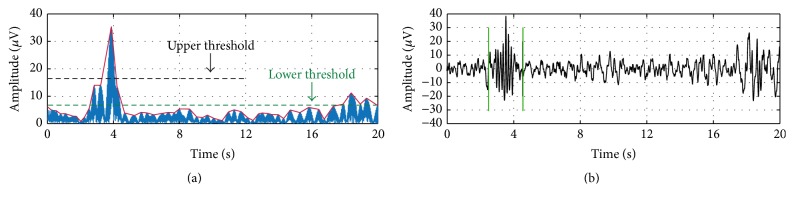
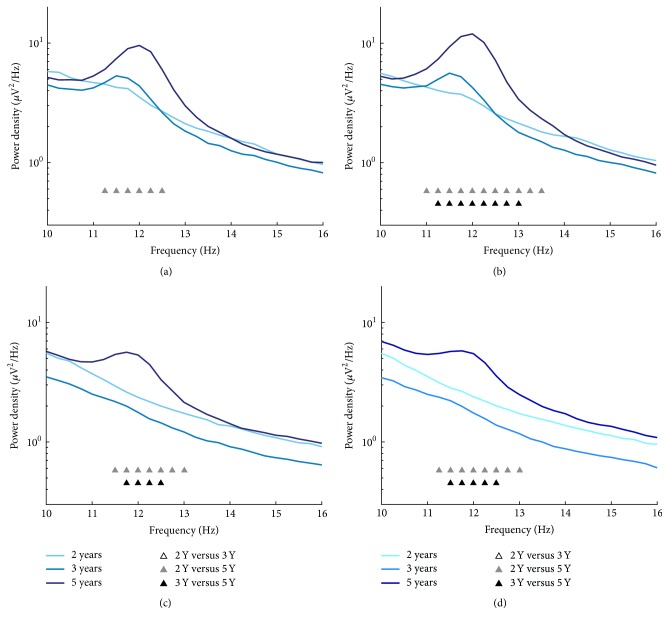
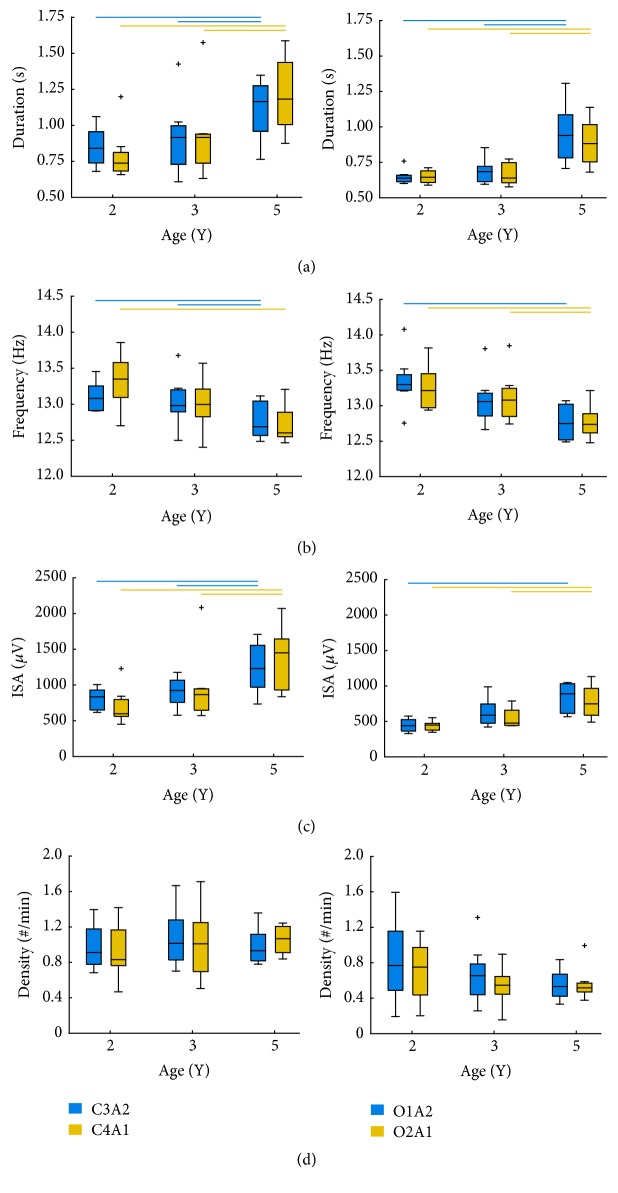
Sleep spindles, a prominent feature of the non-rapid eye movement (NREM) sleep electroencephalogram (EEG), are linked to cognitive abilities. Early childhood is a time of rapid cognitive and neurophysiological maturation; however, little is known about developmental changes in sleep spindles. In this study, we longitudinally examined trajectories of multiple sleep spindle characteristics (i.e., spindle duration, frequency, integrated spindle amplitude, and density) and power in the sigma frequency range (10-16 Hz) across ages 2, 3, and 5 years (n = 8; 3 males). At each time point, nocturnal sleep EEG was recorded in-home after 13-h of prior wakefulness. Spindle duration, integrated spindle amplitude, and sigma power increased with age across all EEG derivations (C3A2, C4A1, O2A1, and O1A2; all ps < 0.05). We also found a developmental decrease in mean spindle frequency (p < 0.05) but no change in spindle density with increasing age. Thus, sleep spindles increased in duration and amplitude but decreased in frequency across early childhood. Our data characterize early developmental changes in sleep spindles, which may advance understanding of thalamocortical brain connectivity and associated lifelong disease processes. These findings also provide unique insights into spindle ontogenesis in early childhood and may help identify electrophysiological features related to healthy and aberrant brain maturation.
睡眠纺锤波是非快速眼动(NREM)睡眠脑电图(EEG)的一个显著特征,与认知能力相关。幼儿期是认知和神经生理快速成熟的时期;然而,关于睡眠纺锤波的发育变化却知之甚少。在本研究中,我们纵向考察了2岁、3岁和5岁(n = 8;3名男性)儿童多个睡眠纺锤波特征(即纺锤波持续时间、频率、整合纺锤波振幅和密度)以及10 - 16赫兹西格玛频率范围内的功率变化轨迹。在每个时间点,在经过13小时的清醒后,于家中记录夜间睡眠脑电图。在所有脑电图导联(C3A2、C4A1、O2A1和O1A2;所有p值<0.05)中,纺锤波持续时间、整合纺锤波振幅和西格玛功率均随年龄增长而增加。我们还发现平均纺锤波频率随发育而降低(p < 0.05),但纺锤波密度并未随年龄增长而变化。因此,在幼儿期,睡眠纺锤波的持续时间和振幅增加,但频率降低。我们的数据描述了睡眠纺锤波的早期发育变化,这可能有助于推进对丘脑皮质脑连接性及相关终身疾病过程的理解。这些发现还为幼儿期纺锤波的发生发展提供了独特的见解,并可能有助于识别与健康和异常脑成熟相关的电生理特征。