Sleep and Development Laboratory, Department of Integrative Physiology, University of Colorado Boulder, Boulder, CO 80309, USA;
Institute of Pharmacology and Toxicology, Section of Chronobiology and Sleep Research, University of Zurich, 8057 Zurich, Switzerland;
Brain Sci. 2013 Nov 12;3(4):1445-60. doi: 10.3390/brainsci3041445.
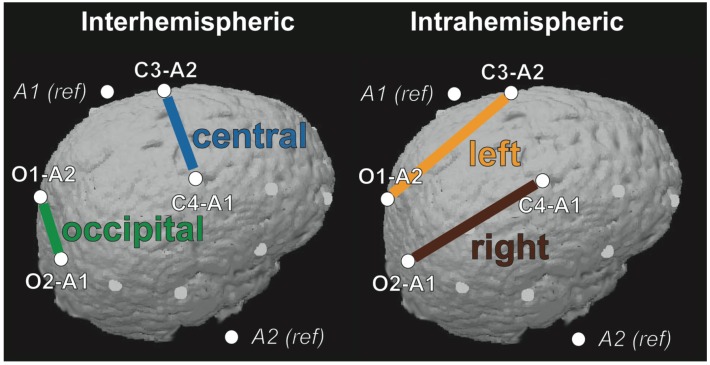
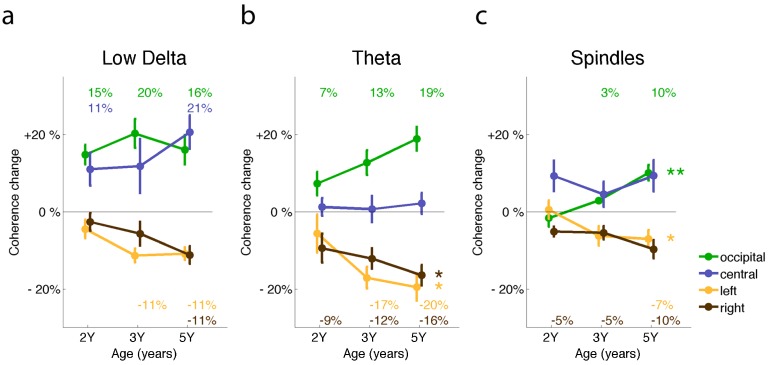
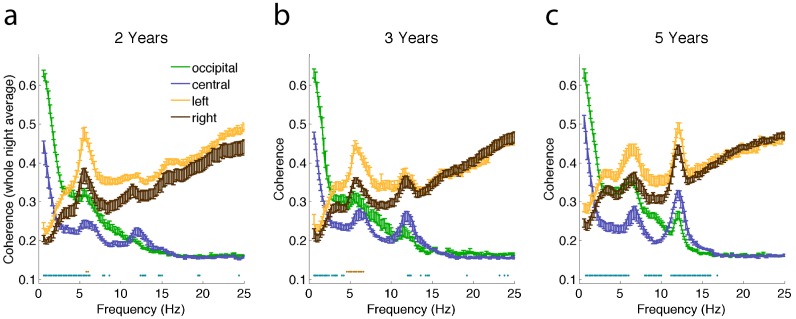
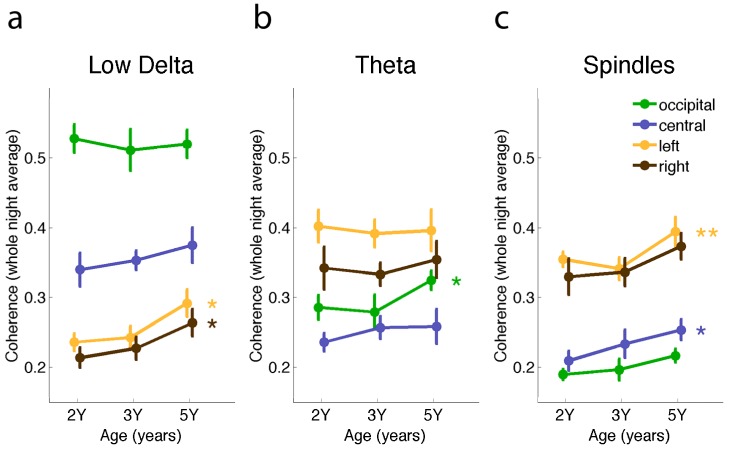
Sleep has beneficial effects on brain function and learning, which are reflected in plastic changes in the cortex. Early childhood is a time of rapid maturation in fundamental skills-e.g., language, cognitive control, working memory-that are predictive of future functioning. Little is currently known about the interactions between sleep and brain maturation during this developmental period. We propose coherent electroencephalogram (EEG) activity during sleep may provide unique insight into maturational processes of functional brain connectivity. Longitudinal sleep EEG assessments were performed in eight healthy subjects at ages 2, 3 and 5 years. Sleep EEG coherence increased across development in a region- and frequency-specific manner. Moreover, although connectivity primarily decreased intra-hemispherically across a night of sleep, an inter-hemispheric overnight increase occurred in the frequency range of slow waves (0.8-2 Hz), theta (4.8-7.8 Hz) and sleep spindles (10-14 Hz), with connectivity changes of up to 20% across a night of sleep. These findings indicate sleep EEG coherence reflects processes of brain maturation-i.e., programmed unfolding of neuronal networks-and moreover, sleep-related alterations of brain connectivity during the sensitive maturational window of early childhood.
睡眠对大脑功能和学习有有益影响,这反映在皮质的可塑性变化上。儿童早期是基本技能(例如语言、认知控制、工作记忆)快速成熟的时期,这些技能是未来功能的预测因素。目前对于在这个发育阶段睡眠和大脑成熟之间的相互作用知之甚少。我们提出,睡眠期间连贯的脑电图(EEG)活动可能为功能连接的成熟过程提供独特的见解。对 8 名健康受试者在 2、3 和 5 岁时进行了纵向睡眠 EEG 评估。睡眠 EEG 相干性以区域和频率特异性的方式在整个发育过程中增加。此外,尽管连接性主要在一夜睡眠中在半球内降低,但在慢波(0.8-2 Hz)、θ波(4.8-7.8 Hz)和睡眠纺锤波(10-14 Hz)的频率范围内发生了半球间的夜间增加,连接性变化高达一夜睡眠的 20%。这些发现表明,睡眠 EEG 相干性反映了大脑成熟的过程,即神经元网络的程序化展开,此外,在儿童早期的敏感成熟窗口期间,与睡眠相关的大脑连接性变化。