Chan Chun, Fan Jun, Messer Andrew E, Marston Steve B, Iwamoto Hiroyuki, Ochala Julien
Department of Physics and Materials Science, City University of Hong Kong, Hong Kong.
Department of Physics and Materials Science, City University of Hong Kong, Hong Kong; City University of Hong Kong Shenzhen Research Institute, Shenzhen, China.
Biochim Biophys Acta. 2016 Aug;1862(8):1453-8. doi: 10.1016/j.bbadis.2016.04.013. Epub 2016 Apr 22.
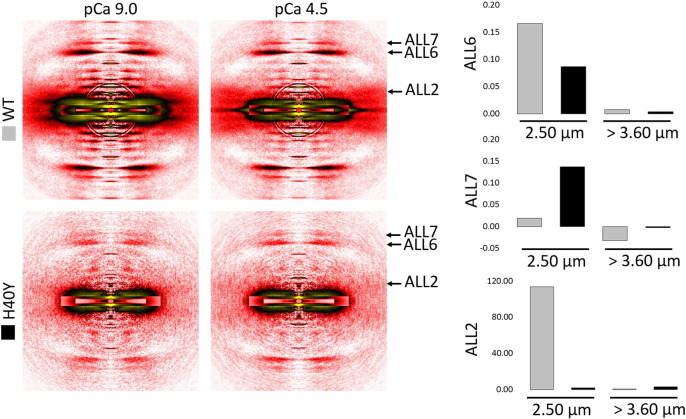
In humans, more than 200 missense mutations have been identified in the ACTA1 gene. The exact molecular mechanisms by which, these particular mutations become toxic and lead to muscle weakness and myopathies remain obscure. To address this, here, we performed a molecular dynamics simulation, and we used a broad range of biophysical assays to determine how the lethal and myopathy-related H40Y amino acid substitution in actin affects the structure, stability, and function of this protein. Interestingly, our results showed that H40Y severely disrupts the DNase I-binding-loop structure and actin filaments. In addition, we observed that normal and mutant actin monomers are likely to form distinctive homopolymers, with mutant filaments being very stiff, and not supporting proper myosin binding. These phenomena underlie the toxicity of H40Y and may be considered as important triggering factors for the contractile dysfunction, muscle weakness and disease phenotype seen in patients.
在人类中,已在ACTA1基因中鉴定出200多种错义突变。这些特定突变变得有毒并导致肌肉无力和肌病的确切分子机制仍不清楚。为了解决这个问题,我们进行了分子动力学模拟,并使用了广泛的生物物理分析方法来确定肌动蛋白中与致死和肌病相关的H40Y氨基酸取代如何影响该蛋白质的结构、稳定性和功能。有趣的是,我们的结果表明,H40Y严重破坏了DNase I结合环结构和肌动蛋白丝。此外,我们观察到正常和突变的肌动蛋白单体可能形成独特的同聚物,突变丝非常僵硬,不支持肌球蛋白的正确结合。这些现象是H40Y毒性的基础,可能被视为患者出现收缩功能障碍、肌肉无力和疾病表型的重要触发因素。