Sato Shinji, Murakami Akihiro, Kuwajima Akiko, Takehara Kazuhiko, Mimori Tsuneyo, Kawakami Atsushi, Mishima Michiaki, Suda Takafumi, Seishima Mariko, Fujimoto Manabu, Kuwana Masataka
Division of Rheumatology, Department of Internal Medicine, Tokai University, School of Medicine, Isehara 259-1193, Japan.
Medical and Biological Laboratories, Nagoya 460-0008, Japan.
PLoS One. 2016 Apr 26;11(4):e0154285. doi: 10.1371/journal.pone.0154285. eCollection 2016.
Autoantibodies to melanoma differentiation-associated gene 5 (MDA5) are specifically expressed in patients with dermatomyositis (DM) and are associated with a subset of DM patients with rapidly progressive interstitial lung disease (RP-ILD). Here, we examined the clinical utility of a newly developed enzyme-linked immunosorbent assay (ELISA) system for detecting these antibodies.
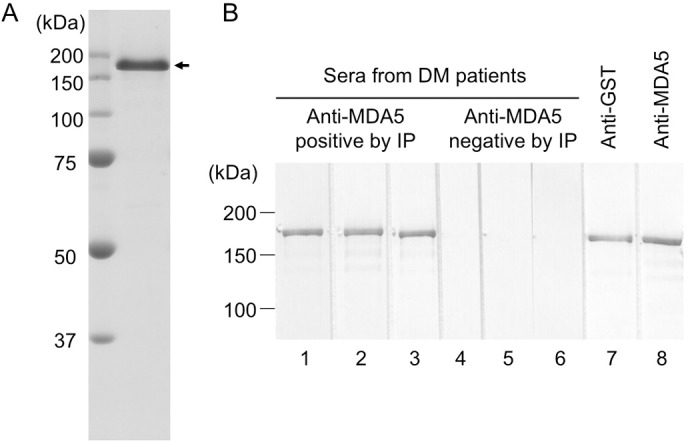
Here we developed an improved ELISA for detecting anti-MDA5 antibodies. We then performed a multicenter clinical study involving 8 medical centers and enrolled 242 adult patients with polymyositis (PM)/DM, 190 with non-PM/DM connective tissue disease (CTD), 154 with idiopathic interstitial pneumonia (IIP), and 123 healthy controls. Anti-MDA5 antibodies in the patients' serum samples were quantified using our newly developed ELISA, and the results were compared to those obtained using the gold-standard immunoprecipitation (IP) assay. In addition, correlations between the ELISA-quantified anti-MDA5 antibodies and clinical characteristics were evaluated.
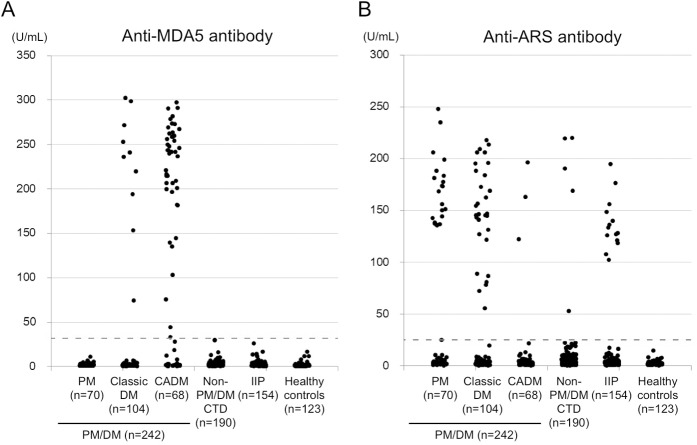
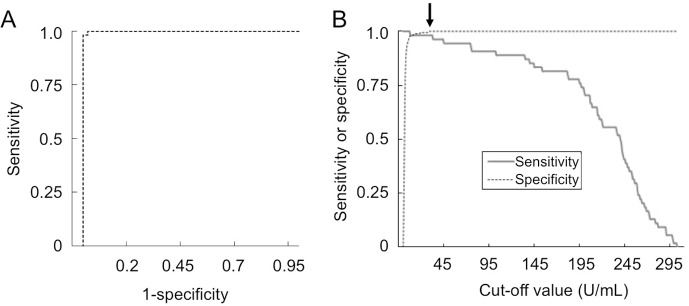
In patients with PM/DM, the anti-MDA5 antibody measurements obtained from the ELISA and IP assay were highly concordant; the ELISA exhibited an analytical sensitivity of 98.2%, specificity of 100%, positive predictive value of 100%, and negative predictive value of 99.5% (compared to the IP assay). Anti-MDA5 antibodies were detected in 22.7% of the DM patients, but not in any of the patients with PM, non-PM/DM CTD, or IIP. Clinically amyopathic DM, RP-ILD, arthritis, and fever were more prevalent in DM patients who were anti-MDA5 antibody-positive than in those who were antibody-negative (P ≤ 0.0002 for all comparisons). In addition, anti-MDA5 antibody-positive patients with RP-ILD exhibited higher antibody levels than those without RP-ILD (P = 0.006).
Our newly developed ELISA can detect anti-MDA5 antibodies as efficiently as the gold standard IP assay and has the potential to facilitate the routine clinical measurement of anti-MDA5 antibodies in patients who suspected to have DM.
黑色素瘤分化相关基因5(MDA5)自身抗体在皮肌炎(DM)患者中特异性表达,且与一部分患有快速进展性间质性肺病(RP - ILD)的DM患者相关。在此,我们检测了一种新开发的用于检测这些抗体的酶联免疫吸附测定(ELISA)系统的临床实用性。
我们开发了一种改进的ELISA用于检测抗MDA5抗体。然后我们进行了一项多中心临床研究,涉及8个医学中心,纳入了242例成年多发性肌炎(PM)/DM患者、190例非PM/DM结缔组织病(CTD)患者、154例特发性间质性肺炎(IIP)患者和123名健康对照。使用我们新开发的ELISA对患者血清样本中的抗MDA5抗体进行定量,并将结果与使用金标准免疫沉淀(IP)测定法获得的结果进行比较。此外,评估了ELISA定量的抗MDA5抗体与临床特征之间的相关性。
在PM/DM患者中,ELISA和IP测定法获得的抗MDA5抗体测量结果高度一致;与IP测定法相比,ELISA的分析灵敏度为98.2%,特异性为100%,阳性预测值为100%,阴性预测值为99.5%。在22.7%的DM患者中检测到抗MDA5抗体,但在任何PM、非PM/DM CTD或IIP患者中均未检测到。临床上无肌病性DM、RP - ILD、关节炎和发热在抗MDA5抗体阳性的DM患者中比抗体阴性的患者更常见(所有比较P≤0.0002)。此外,伴有RP - ILD的抗MDA5抗体阳性患者的抗体水平高于无RP - ILD的患者(P = 0.006)。
我们新开发的ELISA能够像金标准IP测定法一样有效地检测抗MDA5抗体,并且有潜力促进对疑似患有DM的患者进行抗MDA5抗体的常规临床检测。