Department of Rheumatology and Clinical Immunology, Graduate School of Medicine, Kyoto University, Kyoto, Japan.
Medical & Biological Laboratories Co., Ltd., Nagoya, Japan.
PLoS One. 2014 Jan 14;9(1):e85062. doi: 10.1371/journal.pone.0085062. eCollection 2014.
Autoantibodies to aminoacyl-tRNA synthetases (ARSs) are useful in the diagnosis of idiopathic inflammatory myopathy (IIM) with interstitial pneumonia (IP). We developed an enzyme-linked immunosorbent assay (ELISA) system using a mixture of recombinant ARS antigens and tested its utility in a multicenter study.
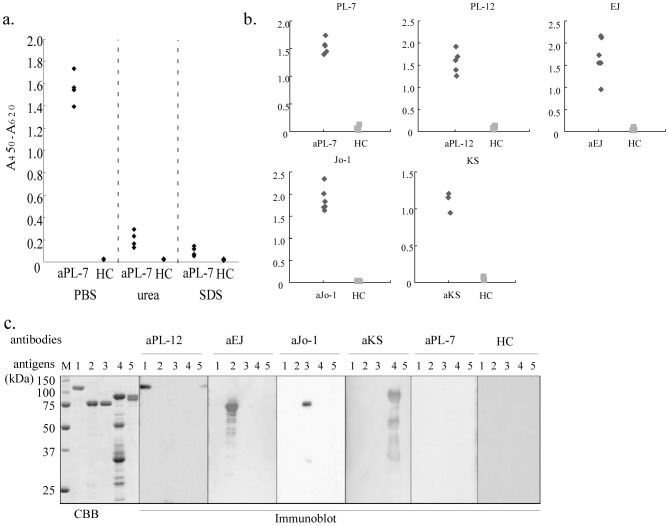
We prepared six recombinant ARSs: GST-Jo-1, His-PL-12, His-EJ and GST-KS expressed in Escherichia coli, and His-PL-7 and His-OJ expressed in Hi-5 cells. After confirming their antigenic activity, with the exception of His-OJ, we developed our ELISA system in which the five recombinant ARSs (without His-OJ) were mixed. Efficiency was confirmed using the sera from 526 Japanese patients with connective tissue disease (CTD) (IIM n = 250, systemic lupus erythematosus n = 91, systemic sclerosis n = 70, rheumatoid arthritis n = 75, Sjögren's syndrome n = 27 and other diseases n = 13), 168 with idiopathic interstitial pneumonia (IIP) and 30 healthy controls collected from eight institutes. IIPs were classified into two groups; idiopathic pulmonary fibrosis (IPF) (n = 38) and non-IPF (n = 130). RESULTS were compared with those of RNA immunoprecipitation.
Sensitivity and specificity of the ELISA were 97.1% and 99.8%, respectively when compared with the RNA immunoprecipitation assay. Anti-ARS antibodies were detected in 30.8% of IIM, 2.5% of non-myositis CTD, and 10.7% of IIP (5.3% of IPF and 12.3% of non-IPF). Anti-ARS-positive non-IPF patients were younger and more frequently treated with glucocorticoids and/or immunosuppressants than anti-ARS-negative patients.
A newly established ELISA detected anti-ARS antibodies as efficiently as RNA immunoprecipitation. This system will enable easier and wider use in the detection of anti-ARS antibodies in patients with IIM and IIP.
抗氨酰-tRNA 合成酶(ARS)自身抗体在特发性炎性肌病(IIM)伴间质性肺病(IP)的诊断中具有重要价值。我们开发了一种使用重组 ARS 抗原混合物的酶联免疫吸附测定(ELISA)系统,并在多中心研究中测试了其效用。
我们制备了六个重组 ARS:在大肠杆菌中表达的 GST-Jo-1、His-PL-12、His-EJ 和 GST-KS,以及在 Hi-5 细胞中表达的 His-PL-7 和 His-OJ。在确认其抗原活性后,除了 His-OJ 之外,我们还开发了我们的 ELISA 系统,其中混合了五种重组 ARS(不包括 His-OJ)。使用来自 526 名日本结缔组织疾病(CTD)患者(IIM n=250、系统性红斑狼疮 n=91、系统性硬化症 n=70、类风湿关节炎 n=75、干燥综合征 n=27 和其他疾病 n=13)、168 名特发性间质性肺炎(IIP)和 30 名健康对照者的血清来确认其效率,这些血清分别来自八个机构。IIP 分为两组;特发性肺纤维化(IPF)(n=38)和非 IPF(n=130)。将结果与 RNA 免疫沉淀进行比较。
与 RNA 免疫沉淀相比,ELISA 的灵敏度和特异性分别为 97.1%和 99.8%。在 30.8%的 IIM、2.5%的非肌炎 CTD 和 10.7%的 IIP(5.3%的 IPF 和 12.3%的非 IPF)中检测到抗 ARS 抗体。抗 ARS 阳性的非 IPF 患者比抗 ARS 阴性患者更年轻,更常接受糖皮质激素和/或免疫抑制剂治疗。
新建立的 ELISA 与 RNA 免疫沉淀一样有效地检测抗 ARS 抗体。该系统将使在 IIM 和 IIP 患者中检测抗 ARS 抗体变得更加容易和广泛。