Lin Yu-Kai, Lin Guan-Yu, Lee Jiunn-Tay, Lee Meei-Shyuan, Tsai Chia-Kuang, Hsu Yu-Wei, Lin Yu-Zhen, Tsai Yi-Chien, Yang Fu-Chi
From the Department of Neurology (Y-KL, G-YL, J-TL, C-KT, Y-WH, F-CY), Tri-Service General Hospital, National Defense Medical Center, Taipei, Taiwan; and School of Public Health (M-SL, Y-ZL, Y-CT), National Defense Medical Center, Taipei, Taiwan.
Medicine (Baltimore). 2016 Apr;95(17):e3554. doi: 10.1097/MD.0000000000003554.
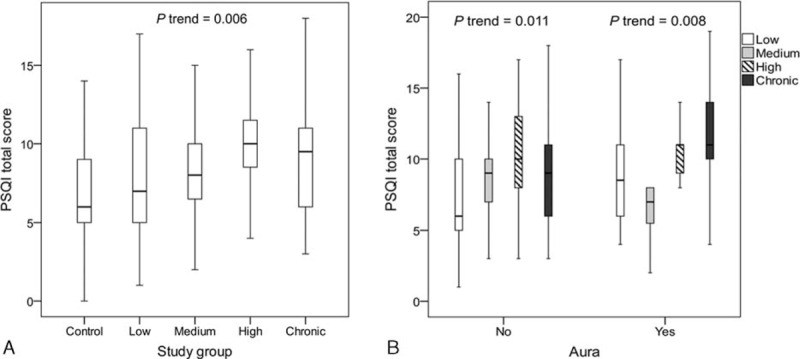
Migraine has been associated with sleep disturbances. Relationship between sleep quality and migraine frequency is yet to be determined. The present study aimed to investigate sleep disturbances among low-frequency, moderate-frequency, high-frequency, and chronic migraineurs, with and without auras, with well-controlled confounding variables.This cross-sectional controlled study included 357 subjects from an outpatient headache clinic in Taiwan. Standardized questionnaires were utilized to collect demographic, migraine, sleep, depression, anxiety, and restless leg syndrome characteristics in all participants. According to frequency of migraine attacks, patients were divided into 4 groups: with 1 to 4 migraine days per month, 5 to 8 migraine days in a month, 9 to 14 migraine days in a month, and >14 migraine days per month. The Pittsburgh Sleep Quality Index (PSQI) and subgroup items were used to evaluate sleep quality. The association between migraine frequency and sleep quality was investigated using multivariable linear regression and logistic regression.The PSQI total score was highest in patients with high frequent migraine (10.0 ± 3.4) and lowest in controls (7.0 ± 3.4) with a significant trend analysis (P for trend = 0.006). Migraine frequency had an independent effect on the items "Cannot get to sleep within 30 minutes" (P < 0.001), "Wake up in the middle of the night or early morning" (P < 0.001), "Bad dreams" (P = 0.001), "Pain" (P = 0.004), and "Quality of sleep" (P < 0.001). The result showed the effect of migraine frequency in both the aura-present (P for trend = 0.008) and the aura-absent subgroups (P for trend = 0.011).High migraine frequency correlates with poor sleep quality and a higher prevalence of poor sleepers. These associations occur in migraine with aura and without aura.
偏头痛与睡眠障碍有关。睡眠质量与偏头痛发作频率之间的关系尚待确定。本研究旨在调查低频、中频、高频和慢性偏头痛患者(有或无先兆)的睡眠障碍情况,并对混杂变量进行良好控制。这项横断面对照研究纳入了台湾一家门诊头痛诊所的357名受试者。使用标准化问卷收集所有参与者的人口统计学、偏头痛、睡眠、抑郁、焦虑和不宁腿综合征特征。根据偏头痛发作频率,患者被分为4组:每月1至4个偏头痛日、每月5至8个偏头痛日、每月9至14个偏头痛日以及每月超过14个偏头痛日。使用匹兹堡睡眠质量指数(PSQI)及其子项目来评估睡眠质量。采用多变量线性回归和逻辑回归研究偏头痛发作频率与睡眠质量之间的关联。
高频偏头痛患者的PSQI总分最高(10.0±3.4),对照组最低(7.0±3.4),趋势分析具有显著性(趋势P值=0.006)。偏头痛发作频率对“30分钟内无法入睡”(P<0.001)、“半夜或清晨醒来”(P<0.001)、“噩梦”(P=0.001)、“疼痛”(P=0.004)和“睡眠质量”(P<0.001)等项目有独立影响。结果显示,在有先兆亚组(趋势P值=0.008)和无先兆亚组(趋势P值=0.011)中,偏头痛发作频率均有影响。
高偏头痛发作频率与睡眠质量差以及睡眠质量差的患病率较高相关。这些关联在有先兆和无先兆的偏头痛中均存在。