Li Yi-Sheng, Qin Li-Xia, Liu Jie, Xia Wei-Liang, Li Jian-Ping, Shen Hai-Lian, Gao Wei-Qiang
State Key Laboratory of Oncogenes and Related Genes, Renji-Med X Stem Cell Research Center, Ren Ji Hospital, School of Biomedical Engineering & Med-X Research Institute, Shanghai Jiao Tong University, Shanghai, China.
Department of Neurology, Shanghai Renji Hospital, Shanghai, China.
Neural Regen Res. 2016 Mar;11(3):427-34. doi: 10.4103/1673-5374.179054.
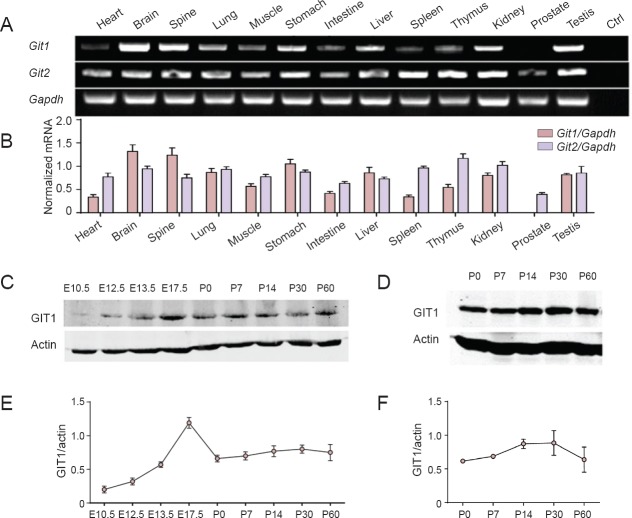
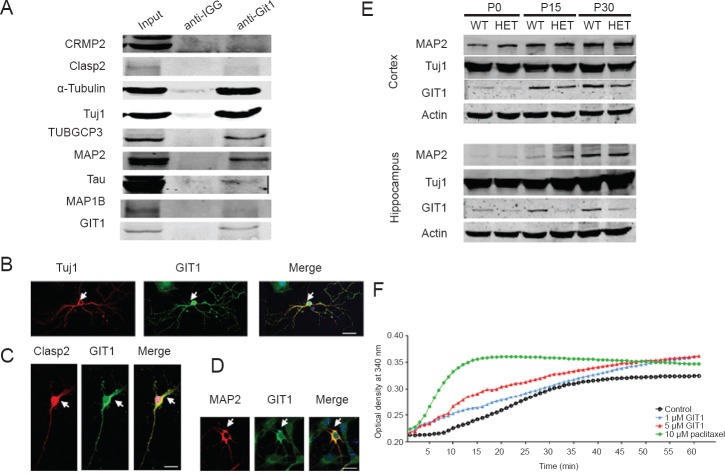
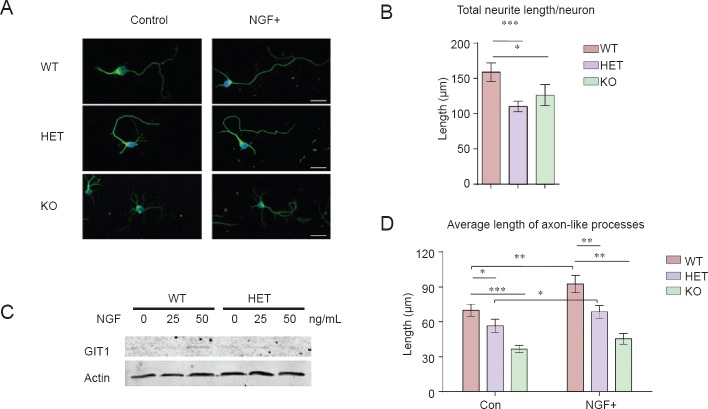
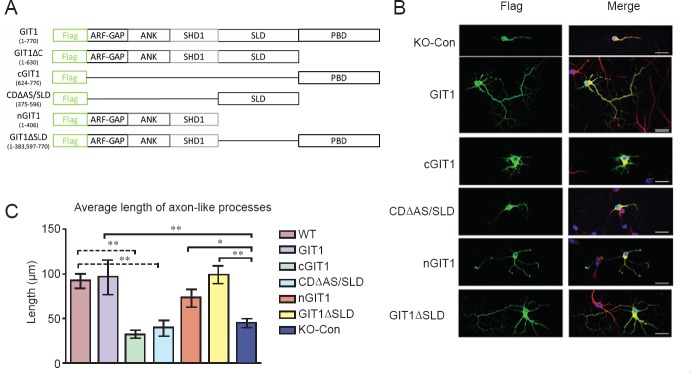
GIT1, a G-protein-coupled receptor kinase interacting protein, has been reported to be involved in neurite outgrowth. However, the neurobiological functions of the protein remain unclear. In this study, we found that GIT1 was highly expressed in the nervous system, and its expression was maintained throughout all stages of neuritogenesis in the brain. In primary cultured mouse hippocampal neurons from GIT1 knockout mice, there was a significant reduction in total neurite length per neuron, as well as in the average length of axon-like structures, which could not be prevented by nerve growth factor treatment. Overexpression of GIT1 significantly promoted axon growth and fully rescued the axon outgrowth defect in the primary hippocampal neuron cultures from GIT1 knockout mice. The GIT1 N terminal region, including the ADP ribosylation factor-GTPase activating protein domain, the ankyrin domains and the Spa2 homology domain, were sufficient to enhance axonal extension. Importantly, GIT1 bound to many tubulin proteins and microtubule-associated proteins, and it accelerated microtubule assembly in vitro. Collectively, our findings suggest that GIT1 promotes neurite outgrowth, at least partially by stimulating microtubule assembly. This study provides new insight into the cellular and molecular pathogenesis of GIT1-associated neurological diseases.
GIT1是一种与G蛋白偶联受体激酶相互作用的蛋白,据报道其参与神经突生长。然而,该蛋白的神经生物学功能仍不清楚。在本研究中,我们发现GIT1在神经系统中高度表达,并且其表达在大脑神经突发生的所有阶段都得以维持。在来自GIT1基因敲除小鼠的原代培养小鼠海马神经元中,每个神经元的总神经突长度以及轴突样结构的平均长度均显著降低,神经生长因子处理无法预防这种情况。GIT1的过表达显著促进轴突生长,并完全挽救了来自GIT1基因敲除小鼠的原代海马神经元培养物中的轴突生长缺陷。GIT1的N末端区域,包括ADP核糖基化因子 - GTP酶激活蛋白结构域、锚蛋白结构域和Spa2同源结构域,足以增强轴突延伸。重要的是,GIT1与许多微管蛋白和微管相关蛋白结合,并在体外加速微管组装。总的来说,我们的研究结果表明,GIT1至少部分通过刺激微管组装来促进神经突生长。本研究为GIT1相关神经疾病的细胞和分子发病机制提供了新的见解。