Wang Yongjun, Wang Ling, Yang Huali, Xiao Haoliang, Farooq Athar, Liu Zhonghua, Hu Min, Shi Xiaoliu
Department of Medical Genetics, 2nd XiangYa Hospital of Central South University, Changsha 410011, China.
Department of Gastroenterology, 2nd XiangYa Hospital of Central South University, Changsha 410011, China.
Toxins (Basel). 2016 Apr 26;8(5):119. doi: 10.3390/toxins8050119.
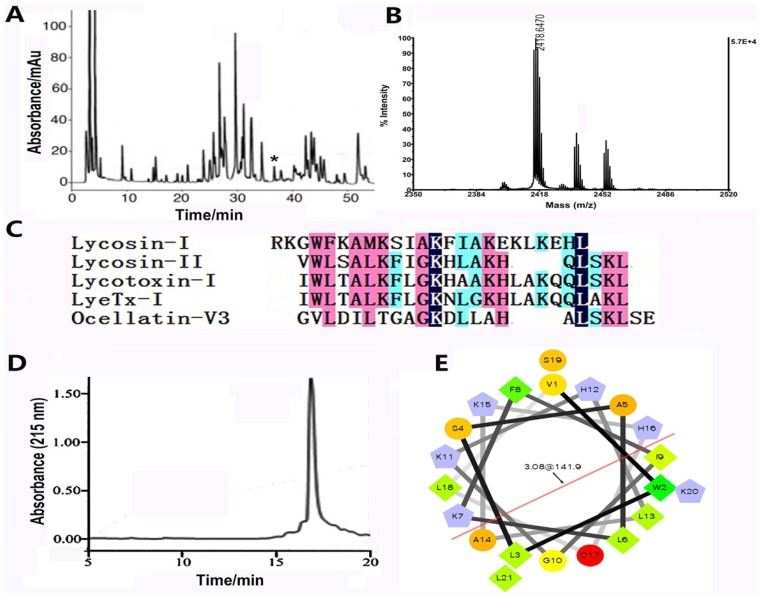
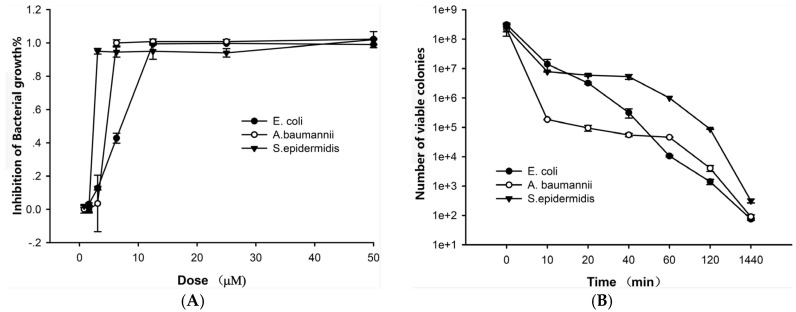
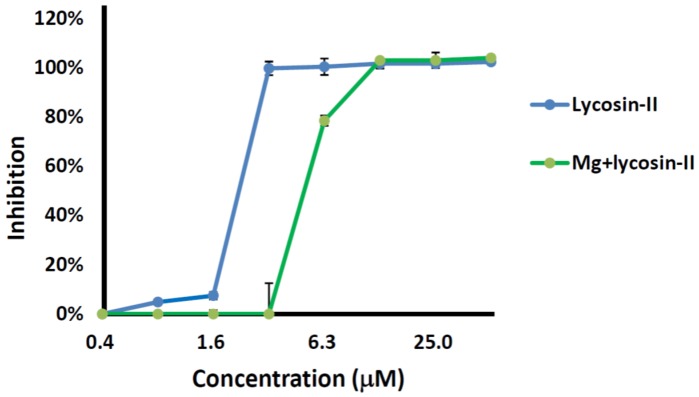
Antimicrobial peptides have been accepted as excellent candidates for developing novel antibiotics against drug-resistant bacteria. Recent studies indicate that spider venoms are the source for the identification of novel antimicrobial peptides. In the present study, we isolated and characterized an antibacterial peptide named lycosin-II from the venom of the spider Lycosa singoriensis. It contains 21 amino acid residue lacking cysteine residues and forms a typical linear amphipathic and cationic α-helical conformation. Lycosin-II displays potent bacteriostatic effect on the tested drug-resistant bacterial strains isolated from hospital patients, including multidrug-resistant A. baumannii, which has presented a huge challenge for the infection therapy. The inhibitory ability of lycosin-II might derive from its binding to cell membrane, because Mg(2+) could compete with the binding sites to reduce the bacteriostatic potency of lycosin-II. Our data suggest that lycosin-II might be a lead in the development of novel antibiotics for curing drug-resistant bacterial infections.
抗菌肽已被公认为是开发抗耐药菌新型抗生素的优秀候选物。最近的研究表明,蜘蛛毒液是鉴定新型抗菌肽的来源。在本研究中,我们从草原狼蛛(Lycosa singoriensis)的毒液中分离并鉴定了一种名为lycosin-II的抗菌肽。它含有21个氨基酸残基,不含半胱氨酸残基,并形成典型的线性两亲性阳离子α-螺旋构象。Lycosin-II对从医院患者中分离出的受试耐药菌株具有强大的抑菌作用,包括多重耐药鲍曼不动杆菌,这对感染治疗提出了巨大挑战。Lycosin-II的抑制能力可能源于其与细胞膜的结合,因为Mg(2+)可以与结合位点竞争,从而降低lycosin-II的抑菌效力。我们的数据表明,lycosin-II可能是开发用于治疗耐药细菌感染的新型抗生素的先导物。