Beran David, Aebischer Perone Sigiriya, Alcoba Gabriel, Bischoff Alexandre, Bussien Claire-Lise, Eperon Gilles, Hagon Olivier, Heller Olivia, Jacquerioz Bausch Frédérique, Perone Nicolas, Vogel Thomas, Chappuis François
Division of Tropical and Humanitarian Medicine, Geneva University Hospitals, Geneva, Switzerland.
Faculty of Medicine, University of Geneva, Geneva, Switzerland.
Global Health. 2016 Apr 29;12(1):14. doi: 10.1186/s12992-016-0156-x.
In 2007 the "Crisp Report" on international partnerships increased interest in Northern countries on the way their links with Southern partners operated. Since its establishment in 2007 the Division of Tropical and Humanitarian Medicine at the Geneva University Hospitals has developed a variety of partnerships. Frameworks to assess these partnerships are needed and recent attention in the field of public management on collaborative governance may provide a useful approach for analyzing international collaborations.
Projects of the Division of Tropical and Humanitarian Medicine were analyzed by collaborators within the Division using the model proposed by Emerson and colleagues for collaborative governance, which comprises different components that assess the collaborative process.
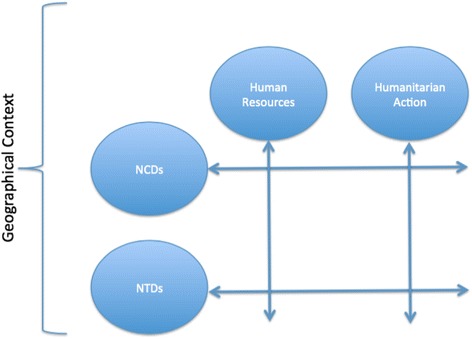
International projects within the Division of Tropical and Humanitarian Medicine can be divided into four categories: Human resource development; Humanitarian response; Neglected Tropical Diseases and Noncommunicable diseases. For each of these projects there was a clear leader from the Division of Tropical and Humanitarian Medicine as well as a local counterpart. These individuals were seen as leaders both due to their role in establishing the collaboration as well as their technical expertise. Across these projects the actual partners vary greatly. This diversity means a wide range of contributions to the collaboration, but also complexity in managing different interests. A common definition of the collaborative aims in each of the projects is both a formal and informal process. Legal, financial and administrative aspects of the collaboration are the formal elements. These can be a challenge based on different administrative requirements. Friendship is part of the informal aspects and helps contribute to a relationship that is not exclusively professional.
Using collaborative governance allows the complexity of managing partnerships to be presented. The framework used highlights the process of establishing collaborations, which is an element often negated by other more traditional models used in international partnerships. Applying the framework to the projects of the Division of Tropical and Humanitarian Medicine highlights the importance of shared values and interests, credibility of partners, formal and informal methods of management as well as friendship.
2007年一份关于国际伙伴关系的“克里斯普报告”,增加了北方国家对其与南方伙伴关系运作方式的关注。自2007年成立以来,日内瓦大学医院热带和人道主义医学部发展了多种伙伴关系。需要评估这些伙伴关系的框架,而公共管理领域最近对合作治理的关注可能为分析国际合作提供一种有用的方法。
热带和人道主义医学部的项目由该部门的合作者使用艾默生及其同事提出的合作治理模型进行分析,该模型包含评估合作过程的不同组成部分。
热带和人道主义医学部的国际项目可分为四类:人力资源开发;人道主义应对;被忽视的热带病和非传染性疾病。对于这些项目中的每一个,热带和人道主义医学部都有一位明确的负责人以及一位当地对口人员。这些人因其在建立合作中的作用以及技术专长而被视为领导者。在这些项目中,实际的合作伙伴差异很大。这种多样性意味着对合作有广泛的贡献,但也意味着管理不同利益的复杂性。每个项目中合作目标的共同定义既是一个正式过程,也是一个非正式过程。合作的法律、财务和行政方面是正式要素。基于不同的行政要求,这些可能是一个挑战。友谊是非正式方面的一部分,有助于促成一种并非完全是专业关系的关系。
使用合作治理可以呈现管理伙伴关系的复杂性。所使用的框架突出了建立合作的过程,这是国际伙伴关系中其他更传统模型常常忽略的一个要素。将该框架应用于热带和人道主义医学部的项目,突出了共享价值观和利益、合作伙伴的信誉、正式和非正式管理方法以及友谊的重要性。