
临时软性义齿衬垫材料分别储存在蒸馏水、5.25%次氯酸钠溶液或人工唾液中时对吸水率和溶解性影响的比较评估:一项体外研究。
A comparative evaluation of effect on water sorption and solubility of a temporary soft denture liner material when stored either in distilled water, 5.25% sodium hypochlorite or artificial saliva: An in vitro study.
作者信息
Garg Aditi, Shenoy K Kamalakanth
机构信息
Department of Prosthodontics, Inderprastha Dental College, Sahibabad, Uttar Pradesh, India.
Department of Prosthodontics, Yenepoya Dental College, Mangalore, Karnataka, India.
出版信息
J Indian Prosthodont Soc. 2016 Jan-Mar;16(1):53-62. doi: 10.4103/0972-4052.167931.
INTRODUCTION
Soft denture liners have a key role in modern removable prosthodontics since they restore health to inflamed and abused mucosa by redistribution of forces transmitted to the edentulous ridges. The most common problems encountered using soft denture liners are water sorption and solubility when in contact with saliva or storage media. These problems are associated with swelling, distortion, support of Candida albicans growth, and stresses at the liner/denture base interface that reduces the bond strength.
OBJECTIVE
To evaluate the water sorption and solubility of commercially available acrylic based self cure soft denture lining material (GC RELINE™ Tissue Conditioner) after immersion in three different storage media (distilled water, Shellis artificial saliva, 5.25% sodium hypochlorite disinfectant solution) at time interval of 4, 7, 11, and 15 days.
MATERIAL AND METHODS
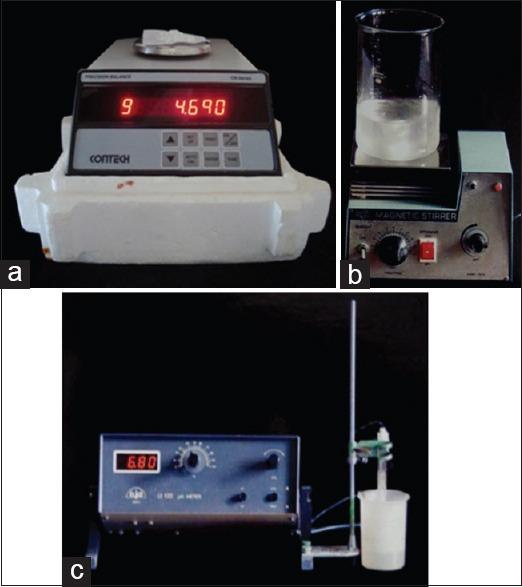
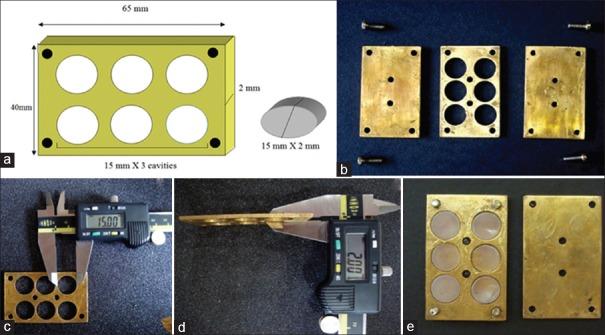
The study involved preparation of artificial saliva using Shellis formula. A total 45 standardized samples of the material (GC RELINE™) were prepared in disk form (15 mm in diameter and 2 mm in thickness). The study was divided into three groups with storage in Control (distilled water), Shellis artificial saliva, and 5.25% sodium hypochlorite. Samples were dried in a desiccator and weighed in the analytical balance to measure the initial weight (mg/cm2) of the disks (W1). The first groups (15 samples) were placed in 30 ml distilled water (Group A) at 37ºC, second group 30 ml of artificial saliva (Group B) and third group in 5.25% sodium hypochlorite (Group C). Disks were removed from disinfectant after 5 min and placed in 30 ml distilled water. On days 4, 7, 11, and 15, all samples were removed from their containers and reweighed to measure the weight (mg/cm2) of the disks after sorption (W2). The solubility was measured by placing the disks back in the desiccator after each sorption cycle and drying them to constant weight in the desiccator. These values were weight after desiccation (W3). Water sorption and solubility was calculated: 1. Sorption (mg/cm2) = (W2-W1)/Surface area 2. Solubility (mg/cm2) = (W1-W3)/Surface area.
STATISTICAL ANALYSIS
Statistical Analysis was done using one way analysis of variance and the intercomparison between each group was done using Tukey's honestly significance difference (HSD) test.
RESULTS
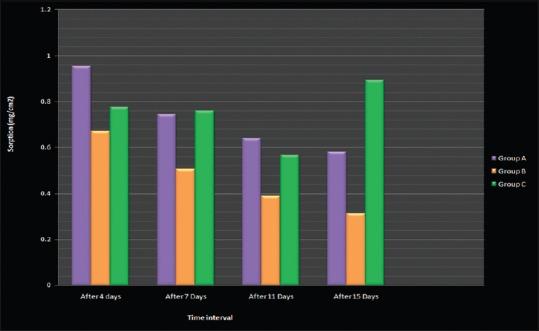
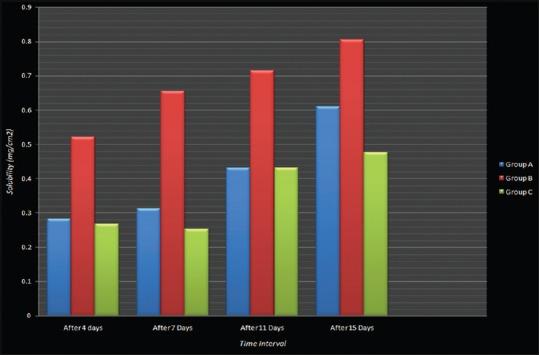
Within the limitations of this study it was concluded that water sorption of the GC RELINE™ soft denture liner material was highest in distilled water followed by 5.25% sodium hypochlorite and least in Shellis artificial saliva at 4, 7, and 11 day interval. However, on the 15th day, the results showed maximum water sorption in 5.25% sodium hypochlorite followed by distilled water and least in artificial saliva. The results on solubility showed highest solubility of GC RELINE soft denture liner in artificial saliva followed by distilled water and least in 5.25% sodium hypochlorite at 4, 7, 11, and 15 day interval.
DISCUSSION
The least water uptake of the soft liner in artificial saliva was due to its ionic properties and supports the theory that water uptake of these materials is osmotically driven. However, the solubility was highest in artificial saliva since it is a mix of various salts and other additives, so there is a possibility of interaction with soft denture lining material.
引言
软质义齿衬垫在现代可摘局部义齿修复中起着关键作用,因为它们通过重新分配传递到无牙嵴的力,使发炎和受损的黏膜恢复健康。使用软质义齿衬垫时遇到的最常见问题是与唾液或储存介质接触时的吸水和溶解问题。这些问题与肿胀、变形、白色念珠菌生长的支持以及衬垫/义齿基托界面处的应力有关,这些应力会降低粘结强度。
目的
评估市售丙烯酸基自凝软质义齿衬垫材料(GC RELINE™组织调理剂)在三种不同储存介质(蒸馏水、Shellis人工唾液、5.25%次氯酸钠消毒液)中浸泡4、7、11和15天后的吸水和溶解情况。
材料与方法
该研究涉及使用Shellis配方制备人工唾液。总共制备了45个该材料(GC RELINE™)的标准化圆盘形样本(直径15毫米,厚度2毫米)。该研究分为三组,分别储存在对照组(蒸馏水)、Shellis人工唾液和5.25%次氯酸钠中。样本在干燥器中干燥后,在分析天平上称重以测量圆盘的初始重量(mg/cm²)(W1)。第一组(15个样本)置于37℃的30毫升蒸馏水中(A组),第二组置于30毫升人工唾液中(B组),第三组置于5.25%次氯酸钠中(C组)。5分钟后从消毒液中取出圆盘,放入30毫升蒸馏水中。在第4、7、11和15天,将所有样本从容器中取出并重新称重,以测量吸附后圆盘的重量(mg/cm²)(W2)。通过在每次吸附循环后将圆盘放回干燥器并在干燥器中干燥至恒重来测量溶解度。这些值是干燥后的重量(W3)。计算吸水和溶解情况:1. 吸附量(mg/cm²)=(W2 - W1)/表面积;2. 溶解度(mg/cm²)=(W1 - W3)/表面积。
统计分析
采用单因素方差分析进行统计分析,各组间的比较采用Tukey真实显著性差异(HSD)检验。
结果
在本研究的局限性内得出结论,在4、7和11天的时间间隔内,GC RELINE™软质义齿衬垫材料在蒸馏水中的吸水最高,其次是5.25%次氯酸钠,在Shellis人工唾液中最低。然而,在第15天,结果显示在5.25%次氯酸钠中吸水最高,其次是蒸馏水,在人工唾液中最低。溶解情况的结果显示,在4、7、11和15天的时间间隔内,GC RELINE软质义齿衬垫在人工唾液中的溶解度最高,其次是蒸馏水,在5.25%次氯酸钠中最低。
讨论
软质衬垫在人工唾液中吸水率最低是由于其离子特性,这支持了这些材料的吸水是由渗透驱动的理论。然而,在人工唾液中的溶解度最高,因为它是各种盐和其他添加剂的混合物,所以有可能与软质义齿衬垫材料发生相互作用。


 Zotero 插件