Nowell Reuben W, Laue Bridget E, Sharp Paul M, Green Sarah
Institute of Evolutionary Biology, University of Edinburgh, Edinburgh EH9 3FL, UK.
Centre for Ecosystems, Society and Biosecurity, Forest Research, Midlothian EH25 9SY, UK.
Mol Plant Pathol. 2016 Dec;17(9):1409-1424. doi: 10.1111/mpp.12423. Epub 2016 Jul 15.
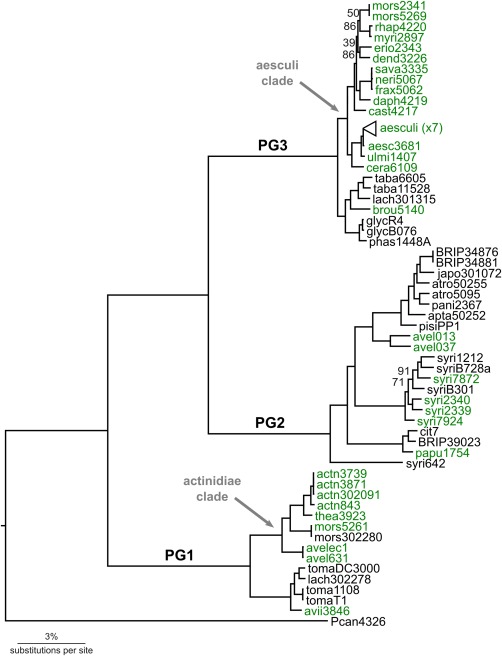
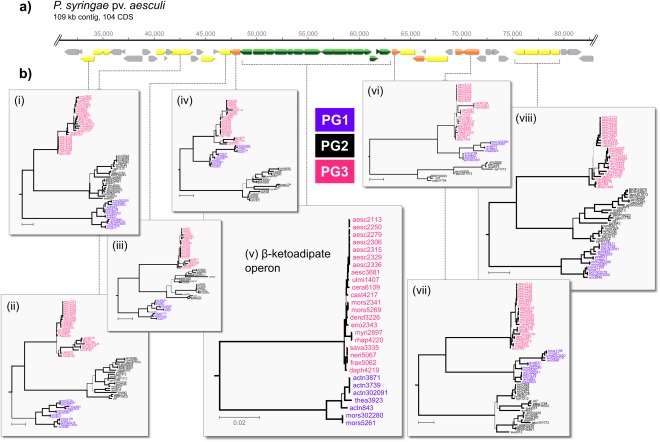
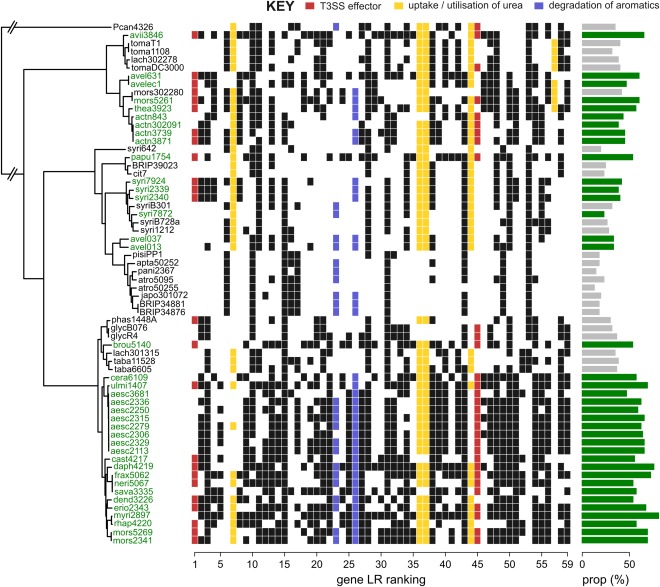
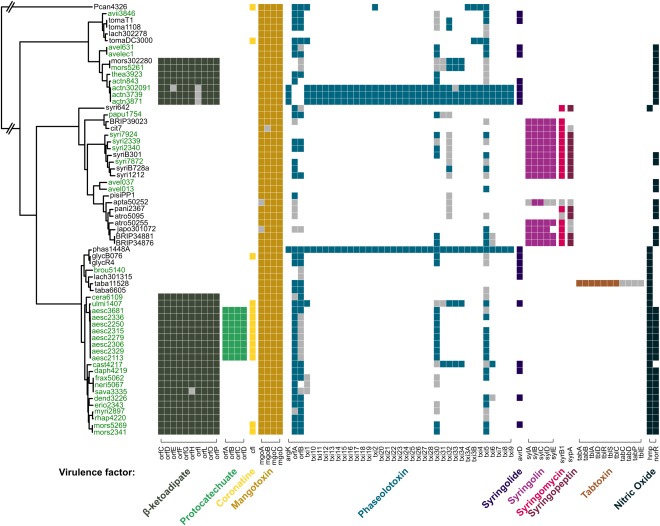
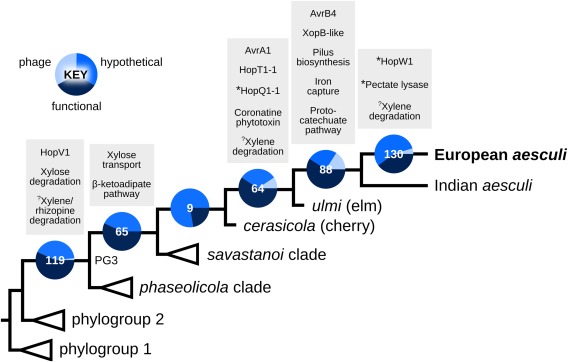
The diversification of lineages within Pseudomonas syringae has involved a number of adaptive shifts from herbaceous hosts onto various species of tree, resulting in the emergence of highly destructive diseases such as bacterial canker of kiwi and bleeding canker of horse chestnut. This diversification has involved a high level of gene gain and loss, and these processes are likely to play major roles in the adaptation of individual lineages onto their host plants. In order to better understand the evolution of P. syringae onto woody plants, we have generated de novo genome sequences for 26 strains from the P. syringae species complex that are pathogenic on a range of woody species, and have looked for statistically significant associations between gene presence and host type (i.e. woody or herbaceous) across a phylogeny of 64 strains. We have found evidence for a common set of genes associated with strains that are able to colonize woody plants, suggesting that divergent lineages have acquired similarities in genome composition that may form the genetic basis of their adaptation to woody hosts. We also describe in detail the gain, loss and rearrangement of specific loci that may be functionally important in facilitating this adaptive shift. Overall, our analyses allow for a greater understanding of how gene gain and loss may contribute to adaptation in P. syringae.
丁香假单胞菌内谱系的多样化涉及从草本寄主到多种树木的一系列适应性转变,导致了如猕猴桃细菌性溃疡病和七叶树流胶溃疡病等极具破坏性疾病的出现。这种多样化涉及高水平的基因得失,并且这些过程可能在各个谱系对其寄主植物的适应中发挥主要作用。为了更好地理解丁香假单胞菌在木本植物上的进化,我们为丁香假单胞菌物种复合体中对一系列木本物种致病的26个菌株生成了从头基因组序列,并在64个菌株的系统发育中寻找基因存在与寄主类型(即木本或草本)之间具有统计学意义的关联。我们发现了一组与能够定殖在木本植物上的菌株相关的共同基因的证据,这表明不同的谱系在基因组组成上获得了相似性,这可能构成它们适应木本寄主的遗传基础。我们还详细描述了特定基因座的获得、丢失和重排,这些基因座在促进这种适应性转变中可能具有重要功能。总体而言,我们的分析有助于更深入地了解基因得失如何促进丁香假单胞菌的适应。