McLay Kaitlin M, Nederveen Josh P, Pogliaghi Silvia, Paterson Donald H, Murias Juan M
Canadian Centre for Activity and Aging, The University of Western Ontario, London, Ontario, Canada School of Kinesiology, The University of Western Ontario, London, Ontario, Canada.
Department of Neurological and Movement Sciences, University of Verona, Verona, Italy.
Physiol Rep. 2016 May;4(9). doi: 10.14814/phy2.12772.
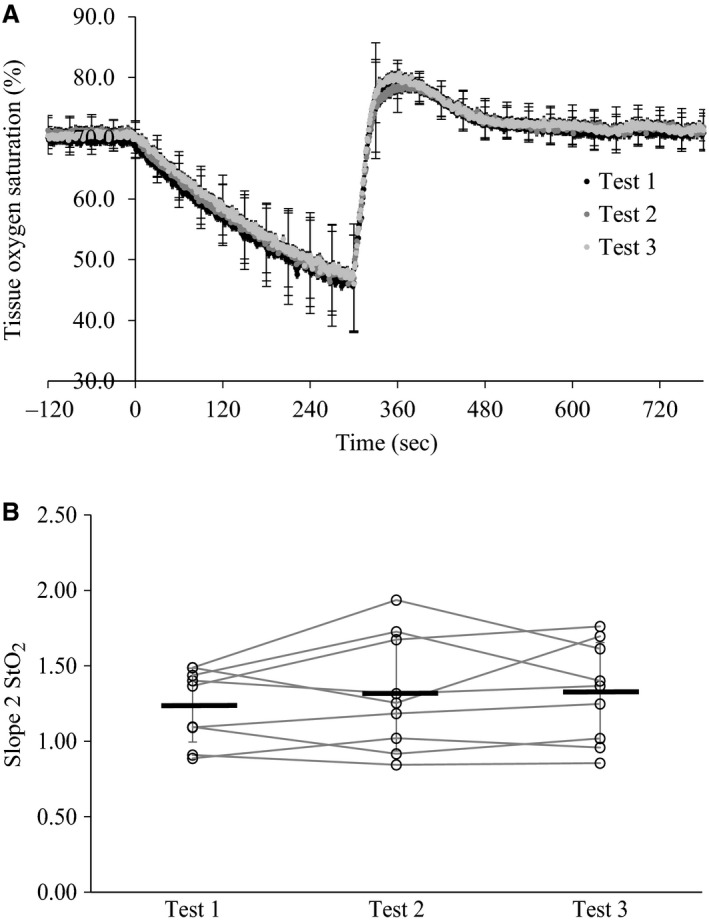
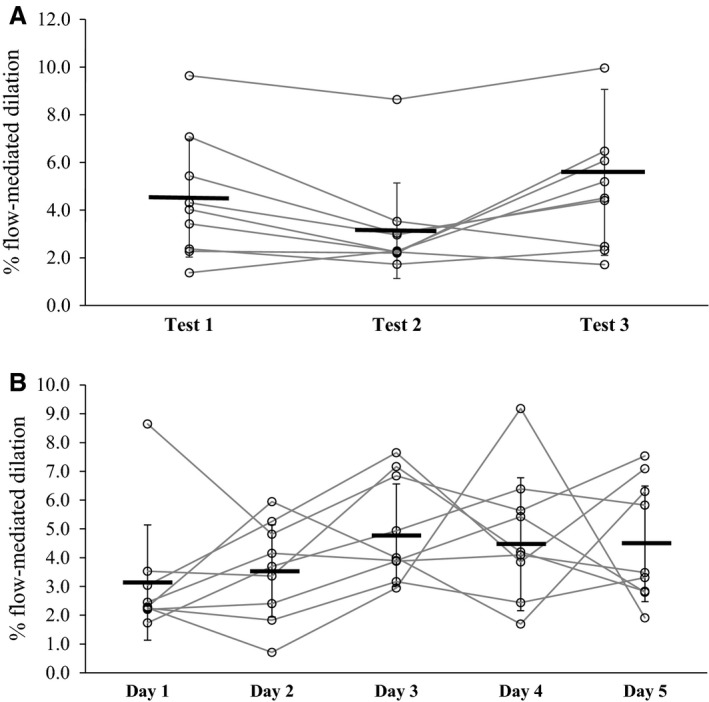
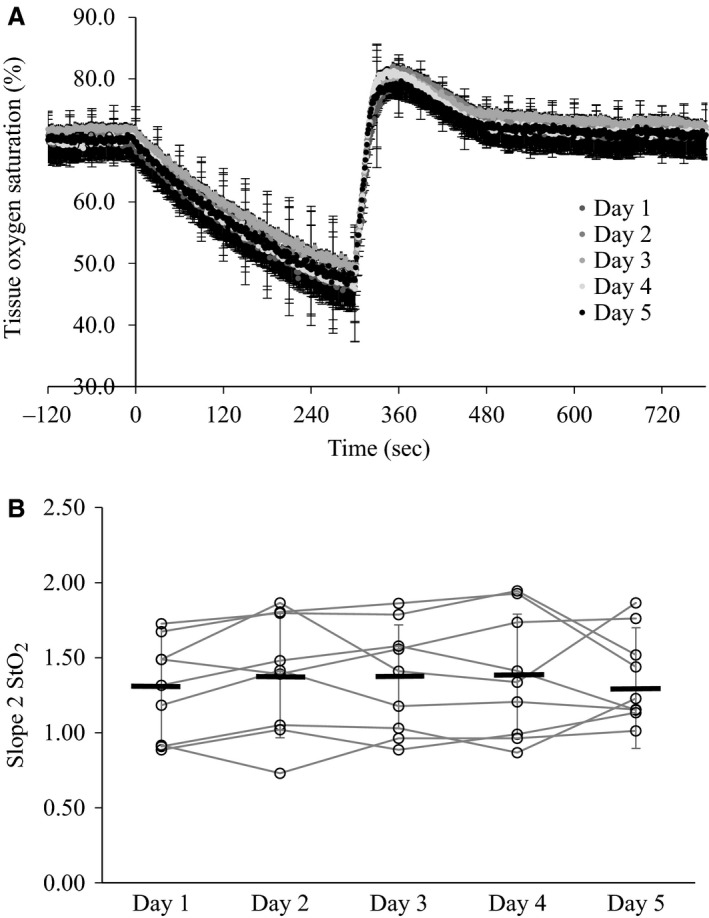
Near-infrared spectroscopy (NIRS)-derived measures of tissue oxygen saturation (StO2) have been recently shown to significantly correlate with the widely used method for noninvasively assessing vascular endothelial function, flow-mediated dilation (FMD). The purpose of this study was to examine the intraday and interday reliability of the reperfusion slope of StO2 (slope 2 StO2) and compare it to FMD Ultrasound-derived FMD was quantified following 5 min of distal cuff occlusion of the popliteal artery in nine healthy young men (26 ± 3 years). An FMD test was performed each of 4 days, with a fifth involving three tests. FMD was calculated as the greatest percent change in diameter from baseline (%FMD). StO2 was measured using NIRS throughout each test, with slope 2 StO2 being calculated as the upslope of 10-sec following cuff release. Reliability was determined using repeatability, intraclass correlation coefficients (ICC), and coefficient of variation (CV). Repeatability of slope 2 StO2 was better than %FMD for both intraday (0.43 and 5.65, respectively) and interday (0.48 and 4.82, respectively) comparisons; approximately 30% of mean values for slope 2 StO2 could be attributed to measurement error, whereas 100% of mean FMD could be for both intraday and interday comparisons. Similarly, ICC and CV values indicated stronger reliability of slope 2 StO2 compared to %FMD for both intraday (ICC 0.92 and 0.36, respectively; CV 9 ± 4% and 44 ± 24%, respectively) and interday (ICC 0.94 and 0.25, respectively; CV 14 ± 5% and 40 ± 22%, respectively) comparisons. In conclusion, NIRS-derived slope 2 StO2 can be used as a reliable measure of vascular reactivity.
近红外光谱(NIRS)测定的组织氧饱和度(StO2)最近已被证明与广泛用于非侵入性评估血管内皮功能的血流介导的血管舒张(FMD)方法显著相关。本研究的目的是检验StO2再灌注斜率(斜率2 StO2)的日内和日间可靠性,并将其与FMD进行比较。对9名健康年轻男性(26±3岁)腘动脉远端袖带闭塞5分钟后,采用超声测定FMD。在4天中的每一天都进行一次FMD测试,第五天进行三次测试。FMD计算为直径相对于基线的最大百分比变化(%FMD)。在每次测试过程中使用NIRS测量StO2,斜率2 StO2计算为袖带松开后10秒的上升斜率。使用重复性、组内相关系数(ICC)和变异系数(CV)确定可靠性。对于日内(分别为0.43和5.65)和日间(分别为0.48和4.82)比较,斜率2 StO2的重复性均优于%FMD;斜率2 StO2平均值的约30%可归因于测量误差,而FMD平均值的100%可归因于日内和日间比较。同样,ICC和CV值表明,对于日内(ICC分别为0.92和0.36;CV分别为9±4%和44±24%)和日间(ICC分别为0.94和0.25;CV分别为14±5%和40±22%)比较,斜率2 StO2的可靠性均强于%FMD。总之,NIRS衍生的斜率2 StO2可作为血管反应性的可靠测量指标。