Department of Intensive Care, Erasme University Hospital, Université Libre de Bruxelles, Route de Lennik 808, 1070 Brussels, Belgium.
Crit Care. 2009;13 Suppl 5(Suppl 5):S11. doi: 10.1186/cc8009. Epub 2009 Nov 30.
The aim of this study was to evaluate the effects of red blood cell (RBC) transfusions on muscle tissue oxygenation, oxygen metabolism and microvascular reactivity in critically ill patients using near-infrared spectroscopy (NIRS) technology.
This prospective, observational study included 44 consecutive patients hospitalized in the 31-bed, medical-surgical intensive care unit of a university hospital with anemia requiring red blood cell transfusion. Thenar tissue oxygen saturation (StO2) and muscle tissue hemoglobin index (THI) were measured using a tissue spectrometer (InSpectra Model 325; Hutchinson Technology Inc., Hutchinson, MN, USA). A vaso-occlusive test was performed before and 1 hour after RBC transfusion by rapid inflation of a pneumatic cuff around the upper arm. The following variables were recorded: THI, the StO2 desaturation slope during the occlusion (%/minute) and the StO2 upslope of the reperfusion phase following the ischemic period (%/second). Muscle oxygen consumption (NIR VO2; arbitrary units) was calculated as the product of the inverse StO2 desaturation slope and the mean THI over the first minute of arterial occlusion.
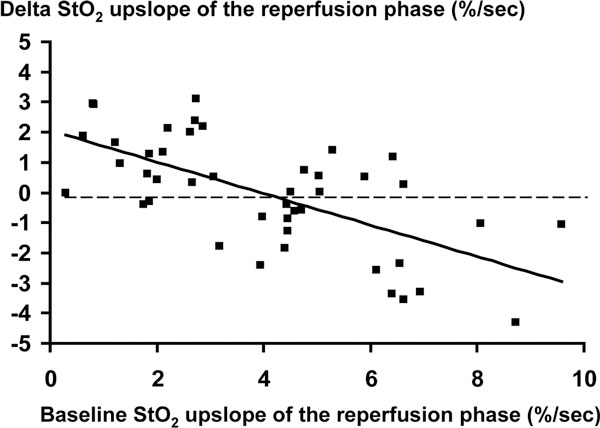
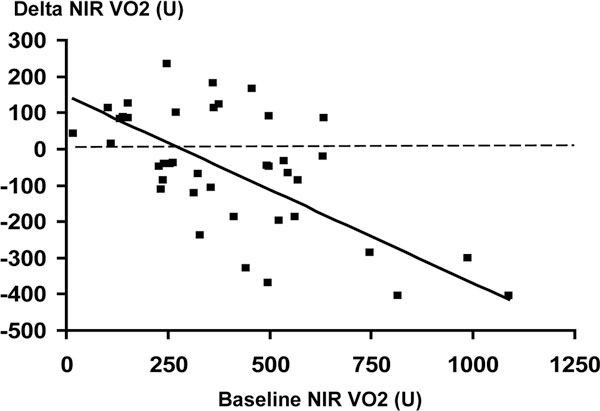
Blood transfusion resulted in increases in hemoglobin (from 7.1 (6.7 to 7.7) to 8.4 (7.1 to 9) g/dl; P < 0.01) and in oxygen delivery (from 306 (259 to 337) to 356 (332 to 422) ml/minute/m2; P < 0.001). However, systemic VO2 was unchanged. RBC transfusion did not globally affect NIRS-derived variables, but there was considerable interindividual variation. Changes in the StO2 upslope of the reperfusion phase after transfusion were negatively correlated with baseline StO2 upslope of the reperfusion phase (r2 = 0.42; P < 0.0001). Changes in NIR VO2 after transfusion were also negatively correlated with baseline NIR VO2 (r2 = 0.48; P = 0.0015). There were no correlations between RBC storage time and changes in StO2 slope or NIR VO2.
Muscle tissue oxygenation, oxygen consumption and microvascular reactivity are globally unaltered by RBC transfusion in critically ill patients. However, muscle oxygen consumption and microvascular reactivity can improve following transfusion in patients with alterations of these variables at baseline.
本研究旨在使用近红外光谱(NIRS)技术评估危重病患者输注红细胞(RBC)对肌肉组织氧合、氧代谢和微血管反应的影响。
这是一项前瞻性、观察性研究,纳入了 44 例因贫血需要输血而入住大学医院 31 张病床的内科-外科重症监护病房的连续患者。使用组织光谱仪(InSpectra Model 325;Hutchinson Technology Inc.,Hutchinson,MN,USA)测量鱼际组织氧饱和度(StO2)和肌肉组织血红蛋白指数(THI)。在输血前和输血后 1 小时通过快速充气上臂的气压袖带进行血管阻塞试验。记录以下变量:THI、阻塞期间 StO2 饱和度下降斜率(%/分钟)和缺血后再灌注阶段 StO2 上升斜率(%/秒)。肌肉耗氧量(NIR VO2;任意单位)计算为动脉闭塞后第一分钟内逆 StO2 饱和度下降斜率与平均 THI 的乘积。
输血导致血红蛋白(从 7.1(6.7 至 7.7)增加至 8.4(7.1 至 9)g/dl;P<0.01)和氧输送(从 306(259 至 337)增加至 356(332 至 422)ml/minute/m2;P<0.001)。然而,全身 VO2 没有变化。RBC 输血并未全局影响 NIRS 衍生变量,但存在相当大的个体间差异。输血后再灌注阶段 StO2 上升斜率的变化与基线再灌注阶段 StO2 上升斜率呈负相关(r2=0.42;P<0.0001)。输血后 NIR VO2 的变化也与基线 NIR VO2 呈负相关(r2=0.48;P=0.0015)。RBC 储存时间与 StO2 斜率或 NIR VO2 的变化之间无相关性。
在危重病患者中,RBC 输血不会全局改变肌肉组织氧合、氧消耗和微血管反应。然而,在基线存在这些变量改变的患者中,输血后肌肉氧消耗和微血管反应可以改善。