Rhee Jinseol, Park Seo-Hee, Kim Seul-Ki, Kim Jin-Hong, Ha Chul-Won, Chun Churl-Hong, Chun Jang-Soo
School of Life Sciences, Gwangju Institute of Science and Technology, Gwangju, Korea.
School of Biological Sciences, College of Natural Sciences, Seoul National University, Gwanak-gu, Seoul, Korea.
Ann Rheum Dis. 2017 Feb;76(2):427-434. doi: 10.1136/annrheumdis-2015-208953. Epub 2016 May 4.
The basic leucine zipper transcription factor, ATF-like (BATF), a member of the Activator protein-1 family, promotes transcriptional activation or repression, depending on the interacting partners (JUN-B or C-JUN). Here, we investigated whether the BATF/JUN complex exerts regulatory effects on catabolic and anabolic gene expression in chondrocytes and contributes to the pathogenesis of osteoarthritis (OA).
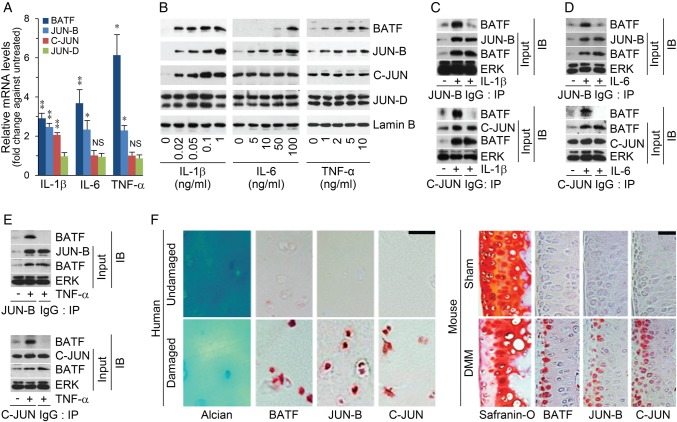
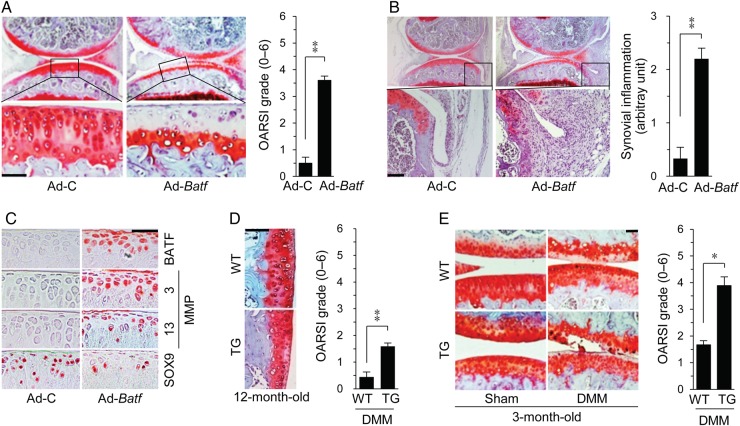
Primary cultured mouse chondrocytes were treated with proinflammatory cytokines (interleukin-1β, IL-6 or tumour necrosis factor-α) or infected with adenoviruses carrying the Batf gene (Ad-Batf). Expression of BATF and JUN was examined in human and mouse experimental OA cartilage samples. Experimental OA in mice was induced by destabilisation of the medial meniscus or intra-articular injection of Ad-Batf. The chromatin immunoprecipitation assay was used to examine the binding of BATF and JUN to the promoter regions of candidate genes.
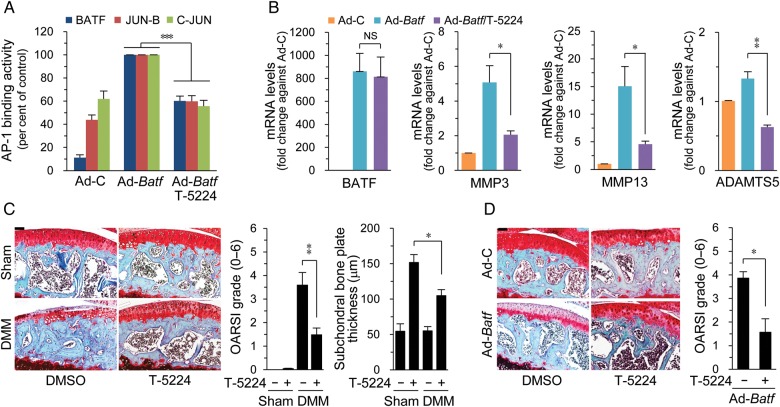
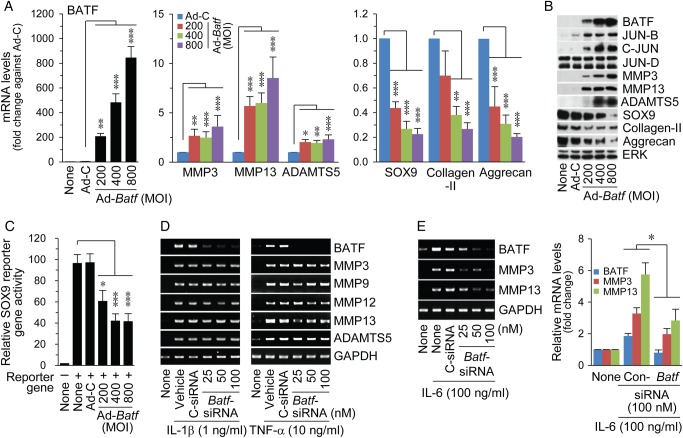
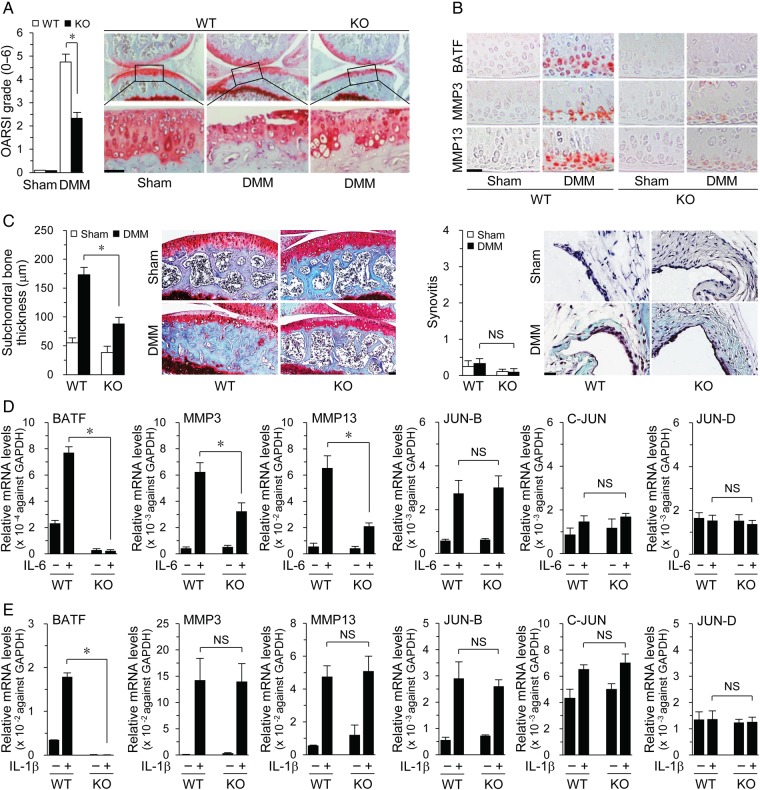
Overexpression of BATF, which forms a heterodimeric complex with JUN-B and C-JUN, induced upregulation of matrix-degrading enzymes and downregulation of cartilage matrix molecules in chondrocytes. BATF expression in mouse joint tissues promoted OA cartilage destruction, and conversely, knockout of Batf in mice suppressed experimental OA. Pharmacological inhibition of BATF/JUN transcriptional activity reduced the expression of matrix-degrading enzymes and protected against experimental OA in mice.
BATF/JUN-B and BATF/C-JUN complexes play important roles in OA cartilage destruction through regulating anabolic and catabolic gene expression in chondrocytes. Our findings collectively support the utility of BATF as a therapeutic target for OA.
碱性亮氨酸拉链转录因子,活化转录因子样(BATF),作为激活蛋白-1家族的一员,根据相互作用的伙伴(JUN-B或C-JUN)促进转录激活或抑制。在此,我们研究了BATF/JUN复合物是否对软骨细胞中分解代谢和合成代谢基因表达发挥调节作用,并参与骨关节炎(OA)的发病机制。
原代培养的小鼠软骨细胞用促炎细胞因子(白细胞介素-1β、IL-6或肿瘤坏死因子-α)处理,或用携带Batf基因的腺病毒(Ad-Batf)感染。在人和小鼠实验性OA软骨样本中检测BATF和JUN的表达。通过内侧半月板不稳定或关节内注射Ad-Batf诱导小鼠实验性OA。采用染色质免疫沉淀法检测BATF和JUN与候选基因启动子区域的结合。
BATF与JUN-B和C-JUN形成异二聚体复合物,其过表达诱导软骨细胞中基质降解酶上调和软骨基质分子下调。小鼠关节组织中BATF表达促进OA软骨破坏,相反,小鼠中Batf基因敲除抑制实验性OA。BATF/JUN转录活性的药理学抑制降低了基质降解酶的表达,并保护小鼠免受实验性OA的影响。
BATF/JUN-B和BATF/C-JUN复合物通过调节软骨细胞中的合成代谢和分解代谢基因表达,在OA软骨破坏中起重要作用。我们的研究结果共同支持BATF作为OA治疗靶点的实用性。