Xia Mingrui, Lin Qixiang, Bi Yanchao, He Yong
State Key Laboratory of Cognitive Neuroscience and Learning and IDG/McGovern Institute for Brain Research, Beijing Normal University Beijing, China.
Front Hum Neurosci. 2016 Apr 19;10:158. doi: 10.3389/fnhum.2016.00158. eCollection 2016.
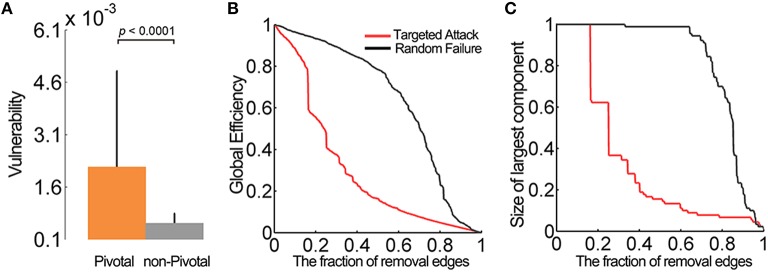
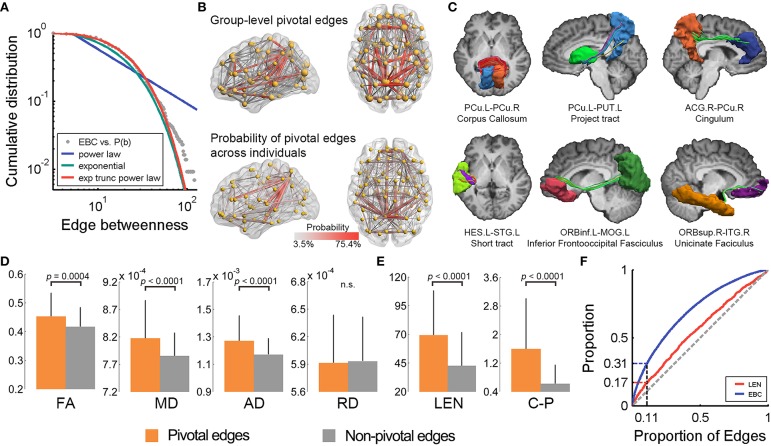
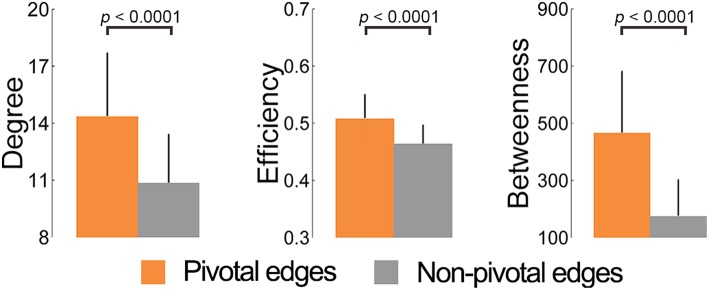
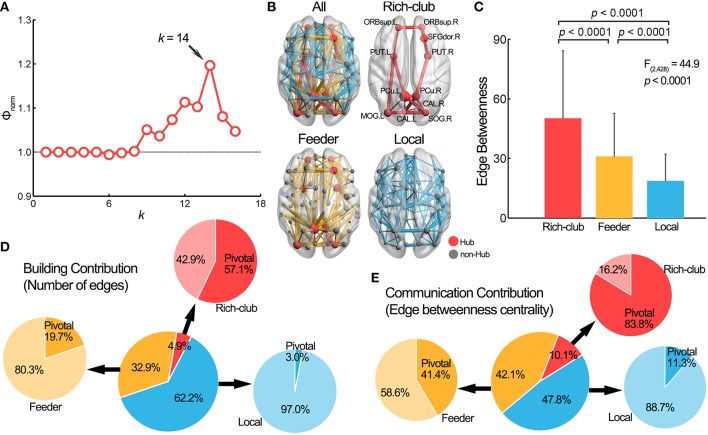
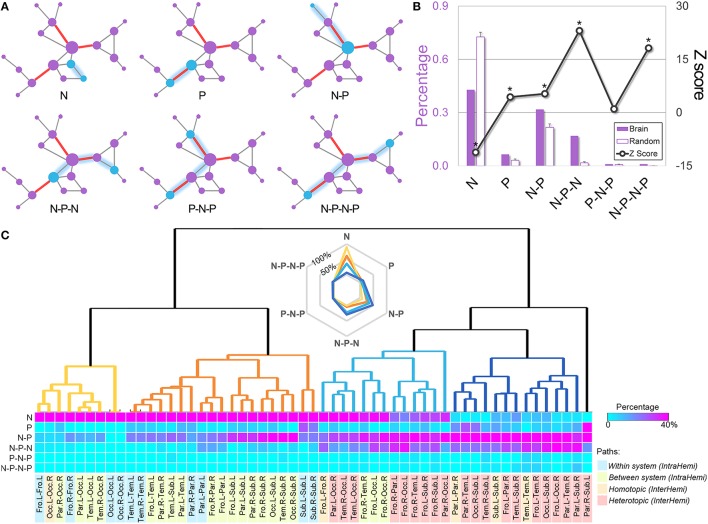
White matter (WM) tracts serve as important material substrates for information transfer across brain regions. However, the topological roles of WM tracts in global brain communications and their underlying microstructural basis remain poorly understood. Here, we employed diffusion magnetic resonance imaging and graph-theoretical approaches to identify the pivotal WM connections in human whole-brain networks and further investigated their wiring substrates (including WM microstructural organization and physical consumption) and topological contributions to the brain's network backbone. We found that the pivotal WM connections with highly topological-edge centrality were primarily distributed in several long-range cortico-cortical connections (including the corpus callosum, cingulum and inferior fronto-occipital fasciculus) and some projection tracts linking subcortical regions. These pivotal WM connections exhibited high levels of microstructural organization indicated by diffusion measures (the fractional anisotropy, the mean diffusivity and the axial diffusivity) and greater physical consumption indicated by streamline lengths, and contributed significantly to the brain's hubs and the rich-club structure. Network motif analysis further revealed their heavy participations in the organization of communication blocks, especially in routes involving inter-hemispheric heterotopic and extremely remote intra-hemispheric systems. Computational simulation models indicated the sharp decrease of global network integrity when attacking these highly centralized edges. Together, our results demonstrated high building-cost consumption and substantial communication capacity contributions for pivotal WM connections, which deepens our understanding of the topological mechanisms that govern the organization of human connectomes.
白质(WM)束是跨脑区信息传递的重要物质基础。然而,WM束在全脑通信中的拓扑作用及其潜在的微观结构基础仍知之甚少。在这里,我们采用扩散磁共振成像和图论方法来识别人类全脑网络中的关键WM连接,并进一步研究它们的布线基础(包括WM微观结构组织和物理消耗)以及对脑网络主干的拓扑贡献。我们发现,具有高度拓扑边缘中心性的关键WM连接主要分布在几条长程皮质-皮质连接(包括胼胝体、扣带和额枕下束)以及一些连接皮质下区域的投射束中。这些关键WM连接表现出由扩散测量指标(分数各向异性、平均扩散率和轴向扩散率)所表明的高水平微观结构组织,以及由流线长度所表明的更大物理消耗,并对脑枢纽和富俱乐部结构有显著贡献。网络基序分析进一步揭示了它们大量参与通信模块的组织,特别是在涉及半球间异位和极远距离半球内系统的路径中。计算模拟模型表明,攻击这些高度集中的边时,全局网络完整性会急剧下降。总之,我们的结果表明关键WM连接具有高构建成本消耗和巨大的通信能力贡献,这加深了我们对支配人类连接组组织的拓扑机制的理解。