Ye Chenyi, Xu Mingyuan, Wang Shengdong, Jiang Shuai, Chen Xi, Zhou Xiaoyu, He Rongxin
Department of Orthopedics, The Second Affiliated Hospital, School of Medicine, Zhejiang University, Hangzhou, People's Republic of China.
Department of Plastic Surgery, The First Affiliated Hospital, School of Medicine, Zhejiang University, Hangzhou, People's Republic of China.
PLoS One. 2016 May 5;11(5):e0154740. doi: 10.1371/journal.pone.0154740. eCollection 2016.
There is conflicting evidence regarding the association between decreased bone mineral density (BMD) and atherosclerosis. To this end, we performed a systematic review and meta-analysis to clarify the association.
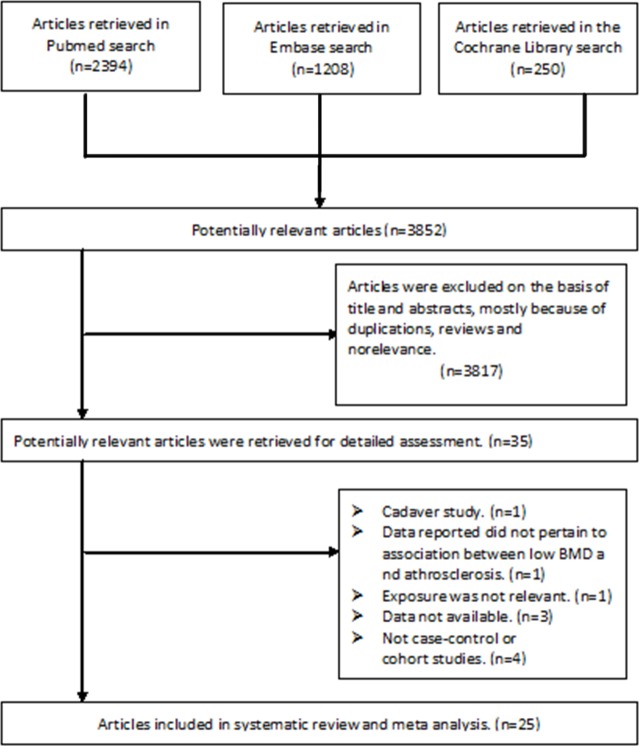
To identify relevant studies, PubMed, Embase, and the Cochrane Library were systematically searched up to November 2015. All observational and comparative studies directly investigating the relationship between decreased BMD and clinical consequences of atherosclerotic vascular abnormalities, including carotid artery calcification (CAC), cardiovascular disease (CAD), and coronary artery disease (CAD) were obtained, without limitation of language or publication year.
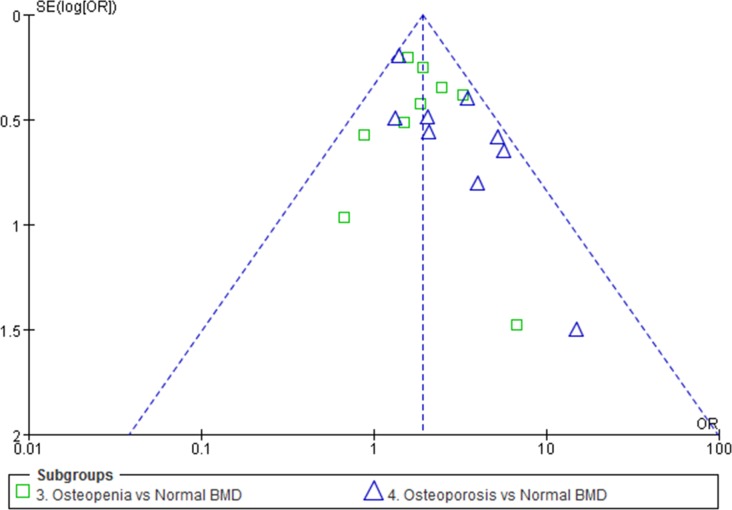
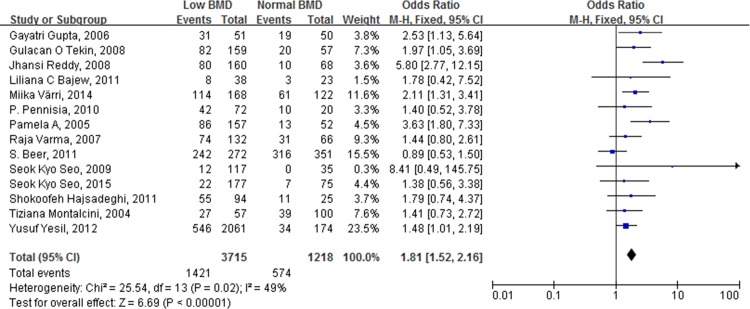
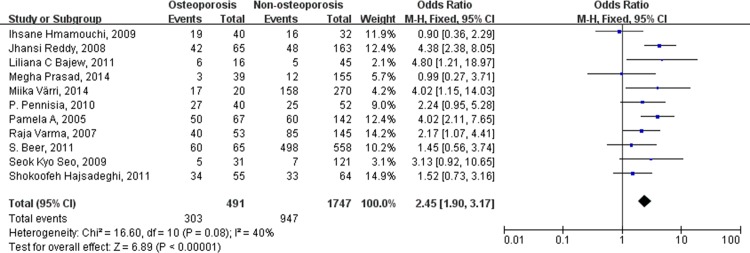
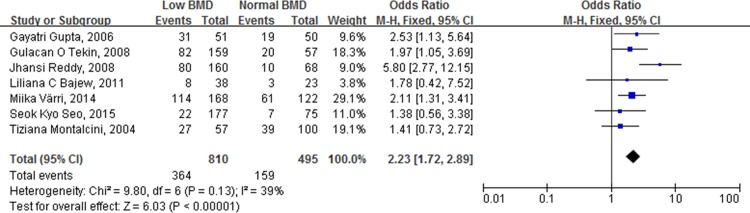
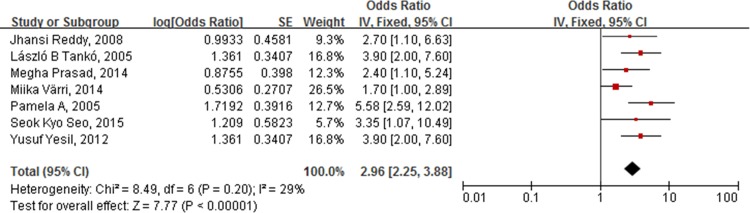
A total of 25 studies involving 10,299 patients were included. The incidence of atherosclerotic vascular abnormalities was significantly increased in low BMD patients, compared to patients with normal BMD (OR, 1.81, 95% CI [1.01, 2.19], p<0.00001)). Similar results were also observed for postmenopausal women (OR, 2.23, 95% CI [1.72, 2.89], p<0.00001). Subgroup analyses of osteopenia, osteoporosis, and normal BMD also revealed that the combined ORs for the incidence of atherosclerotic vascular abnormalities increased as BMD decreased. Of note, after adjusting for age, sex, body mass index (BMI) and other vascular risk factors, decreased BMD remained significantly associated with the incidence of atherosclerotic vascular abnormalities (OR, 2.96, 95% CI [2.25, 3.88], p < 0.00001).
Based on the results of this study, decreased BMD is an independent predictor for the development of atherosclerosis in elderly individuals. Moreover, the risk of atherosclerotic vascular abnormalities increased as BMD decreased. Future studies focusing on individuals with different severities of atherosclerosis and comorbidities are of interest.
关于骨密度(BMD)降低与动脉粥样硬化之间的关联,证据存在冲突。为此,我们进行了一项系统评价和荟萃分析以阐明这种关联。
为识别相关研究,截至2015年11月,对PubMed、Embase和Cochrane图书馆进行了系统检索。获取了所有直接研究BMD降低与动脉粥样硬化性血管异常临床后果之间关系的观察性和比较性研究,包括颈动脉钙化(CAC)、心血管疾病(CAD)和冠状动脉疾病(CAD),不受语言或出版年份限制。
共纳入25项研究,涉及10299例患者。与骨密度正常的患者相比,低骨密度患者动脉粥样硬化性血管异常的发生率显著增加(OR,1.81,95%CI[1.01,2.19],p<0.00001)。绝经后女性也观察到类似结果(OR,2.23,95%CI[1.72,2.89],p<0.00001)。对骨质减少、骨质疏松和正常骨密度的亚组分析还显示,随着骨密度降低,动脉粥样硬化性血管异常发生率的合并OR值增加。值得注意的是,在调整年龄、性别、体重指数(BMI)和其他血管危险因素后,骨密度降低仍与动脉粥样硬化性血管异常的发生率显著相关(OR,2.96,95%CI[2.25,3.88],p<0.00001)。
基于本研究结果,骨密度降低是老年个体动脉粥样硬化发生的独立预测因素。此外,随着骨密度降低,动脉粥样硬化性血管异常的风险增加。未来针对不同动脉粥样硬化严重程度和合并症个体的研究值得关注。