Kim Nam Lee, Jang Ha Min, Kim Sul Ki, Ko Ki Dong, Hwang In Cheol, Suh Heuy Sun
Department of Family Medicine, Gachon University Gil Hospital, Incheon, Korea.
J Bone Metab. 2014 May;21(2):133-41. doi: 10.11005/jbm.2014.21.2.133. Epub 2014 May 31.
Association of arterial stiffness and osteoporosis has been previously reported in women. However, this association is still controversial for men. Therefore, we investigated correlation of arterial stiffness and osteoporosis by measuring brachial-ankle (ba) pulse wave velocity (PWV) and bone mineral density (BMD).
We reviewed medical charts of 239 people (women: 128, men: 111) who visited the Health Promotion Center, retrospectively. ba-PWV was measured by automatic wave analyzer. Lumbar spine (L1-L4) BMD and femur BMD were measured by dual energy X-ray absorptiometry. Metabolic syndrome was based on the National Cholesterol Education Program (NCEP)-Adult Treatment Panel (ATPIII) definition. Body mass index (BMI)>25 kg/m(2) was used instead of waist circumference.
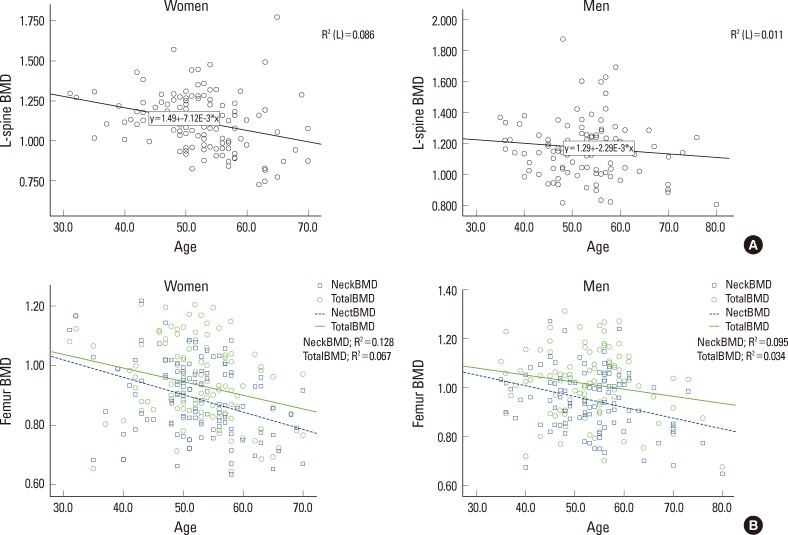
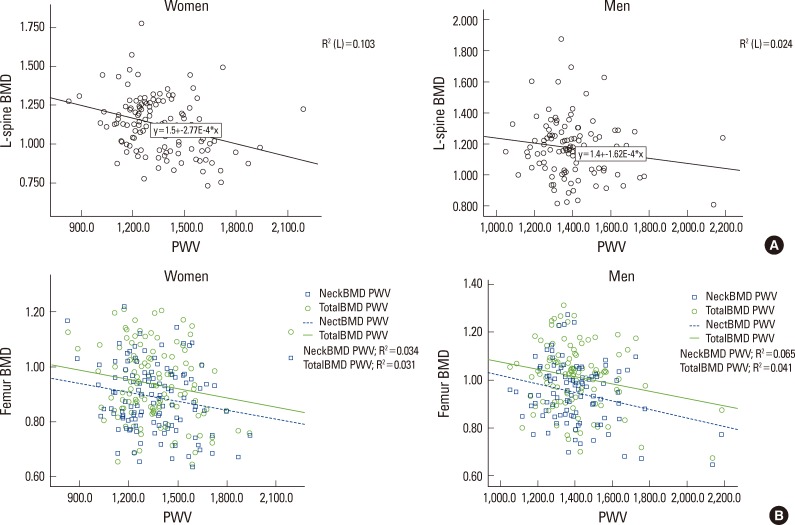
In Pearson's correlation analysis, PWV and femur BMD (Neck, total) had a significant inverse relationship in men (r=-0.254, P=0.007; r=-0.202, P=0.034). In women, PWV and the L-spine, femur (Neck, total) had a significant inverse relationship. (r=-0.321, P<0.001; r=-0.189, P=0.032; r=-0.177, P=0.046) Age and PWV showed the greatest association in both men and women (r=0.46 P<0.001; r=0.525, P<0.001) In multiple regression analysis, the L-spine BMD and PWV had an independent relationship in women after adjusting for age, metabolic syndrome, BMI, smoking, drinking and exercise. (r=-0.229, P=0.015). No independent association was found between PWV and BMD in men.
The association between arterial stiffness and BMD was confirmed in women. However, this association was not statistically significant for men.
此前已有报道称女性存在动脉僵硬度与骨质疏松症之间的关联。然而,这种关联在男性中仍存在争议。因此,我们通过测量臂踝(ba)脉搏波速度(PWV)和骨密度(BMD)来研究动脉僵硬度与骨质疏松症之间的相关性。
我们回顾性地查阅了239名前往健康促进中心就诊者(女性128名,男性111名)的病历。ba - PWV通过自动波形分析仪进行测量。腰椎(L1 - L4)骨密度和股骨骨密度通过双能X线吸收法进行测量。代谢综合征基于美国国家胆固醇教育计划(NCEP)成人治疗小组(ATPIII)的定义。采用体重指数(BMI)>25 kg/m²替代腰围。
在Pearson相关性分析中,男性的PWV与股骨骨密度(颈、全)呈显著负相关(r = -0.254,P = 0.007;r = -0.202,P = 0.034)。在女性中,PWV与腰椎、股骨(颈、全)呈显著负相关(r = -0.321,P < 0.001;r = -0.189,P = 0.032;r = -0.177,P = 0.046)。年龄与PWV在男性和女性中均显示出最强的关联(r = 0.46,P < 0.001;r = 0.525,P < 0.001)。在多元回归分析中,调整年龄、代谢综合征、BMI、吸烟、饮酒和运动因素后,女性的腰椎骨密度与PWV存在独立关联(r = -0.229,P = 0.015)。在男性中未发现PWV与骨密度之间存在独立关联。
女性中动脉僵硬度与骨密度之间的关联得到证实。然而,这种关联在男性中无统计学意义。