Seo Seok Kyo, Yun Bo Hyon, Noe Eun Bee, Suh Jong Wook, Choi Young Sik, Lee Byung Seok
Department of Obstetrics and Gynecology, Severance Hospital, Yonsei University College of Medicine, Seoul, Korea. ; Institute of Women's Life Medical Science, Seoul, Korea.
Obstet Gynecol Sci. 2015 Mar;58(2):144-9. doi: 10.5468/ogs.2015.58.2.144. Epub 2015 Mar 16.
This study aimed to assess the association between bone mineral density (BMD) and coronary atherosclerosis in healthy postmenopausal women.
We performed a retrospective review of 252 postmenopausal women who had visited a health promotion center for a routine checkup. BMD of the lumbar spine (L1-L4) and femoral neck was evaluated using dual-energy X-ray absorptiometry, and coronary atherosclerosis was assessed using 64-row multidetector computed tomography. Participants were divided into normal BMD and osteopenia-osteoporosis groups, according to the T-scores of their lumbar spine or femoral neck.
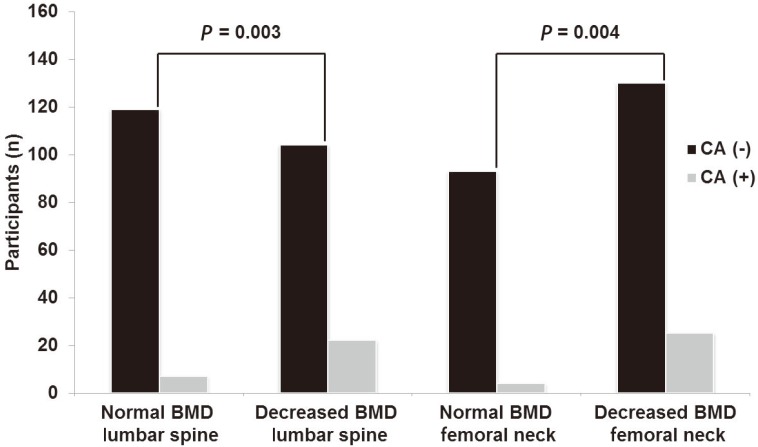
Participants with osteopenia-osteoporosis had a significantly higher proportion of coronary atherosclerosis than did those with normal BMD at the lumbar spine (P=0.003) and femoral neck (P=0.004). Osteopenia-osteoporosis at the lumbar spine (odds ratio [OR], 2.86; 95% confidence interval [CI], 1.12 to 7.27) or femoral neck (OR, 3.35; 95% CI, 1.07 to 10.57) was associated with coronary atherosclerosis, after controlling for age and cardiovascular risk factors.
Decreased BMD is associated with coronary atherosclerosis in healthy postmenopausal women, independent of age and cardiovascular risk factors. Postmenopausal women with decreased BMD may have a higher risk of developing coronary atherosclerosis.
本研究旨在评估健康绝经后女性骨密度(BMD)与冠状动脉粥样硬化之间的关联。
我们对252名到健康促进中心进行常规体检的绝经后女性进行了回顾性研究。使用双能X线吸收法评估腰椎(L1-L4)和股骨颈的骨密度,并使用64排多层螺旋计算机断层扫描评估冠状动脉粥样硬化情况。根据腰椎或股骨颈的T值,将参与者分为骨密度正常组和骨量减少-骨质疏松组。
骨量减少-骨质疏松的参与者在腰椎(P=0.003)和股骨颈(P=0.004)处冠状动脉粥样硬化的比例显著高于骨密度正常的参与者。在控制年龄和心血管危险因素后,腰椎(比值比[OR],2.86;95%置信区间[CI],1.12至7.27)或股骨颈(OR,3.35;95%CI,1.07至10.57)的骨量减少-骨质疏松与冠状动脉粥样硬化相关。
在健康绝经后女性中,骨密度降低与冠状动脉粥样硬化相关,且独立于年龄和心血管危险因素。骨密度降低的绝经后女性患冠状动脉粥样硬化的风险可能更高。