Smith J Gustav, Felix Janine F, Morrison Alanna C, Kalogeropoulos Andreas, Trompet Stella, Wilk Jemma B, Gidlöf Olof, Wang Xinchen, Morley Michael, Mendelson Michael, Joehanes Roby, Ligthart Symen, Shan Xiaoyin, Bis Joshua C, Wang Ying A, Sjögren Marketa, Ngwa Julius, Brandimarto Jeffrey, Stott David J, Aguilar David, Rice Kenneth M, Sesso Howard D, Demissie Serkalem, Buckley Brendan M, Taylor Kent D, Ford Ian, Yao Chen, Liu Chunyu, Sotoodehnia Nona, van der Harst Pim, Stricker Bruno H Ch, Kritchevsky Stephen B, Liu Yongmei, Gaziano J Michael, Hofman Albert, Moravec Christine S, Uitterlinden André G, Kellis Manolis, van Meurs Joyce B, Margulies Kenneth B, Dehghan Abbas, Levy Daniel, Olde Björn, Psaty Bruce M, Cupples L Adrienne, Jukema J Wouter, Djousse Luc, Franco Oscar H, Boerwinkle Eric, Boyer Laurie A, Newton-Cheh Christopher, Butler Javed, Vasan Ramachandran S, Cappola Thomas P, Smith Nicholas L
Department of Cardiology, Department of Clinical Sciences, Lund University, Lund, Sweden.
Department of Heart Failure and Valvular Disease, Skåne University Hospital, Lund, Sweden.
PLoS Genet. 2016 May 5;12(5):e1006034. doi: 10.1371/journal.pgen.1006034. eCollection 2016 May.
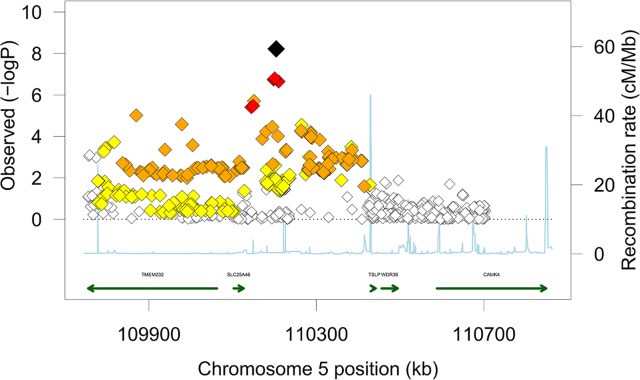
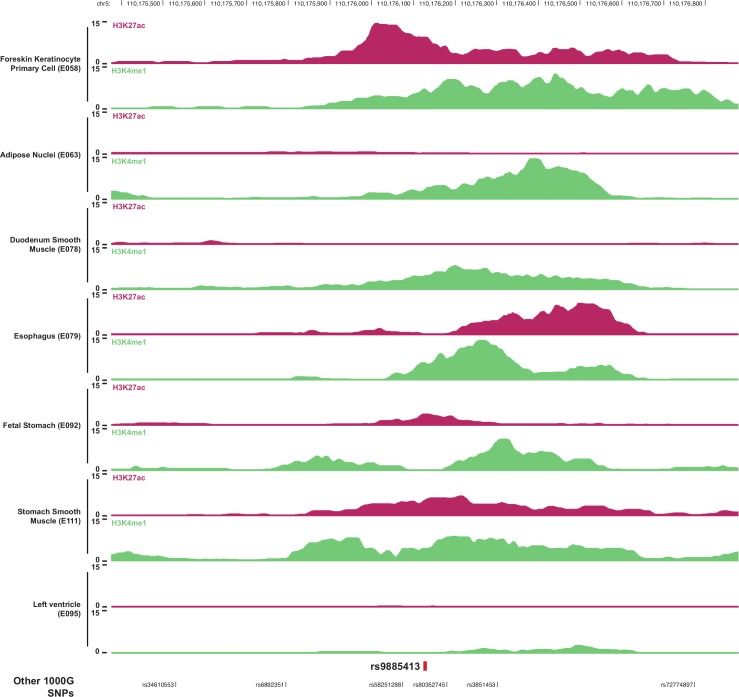
Failure of the human heart to maintain sufficient output of blood for the demands of the body, heart failure, is a common condition with high mortality even with modern therapeutic alternatives. To identify molecular determinants of mortality in patients with new-onset heart failure, we performed a meta-analysis of genome-wide association studies and follow-up genotyping in independent populations. We identified and replicated an association for a genetic variant on chromosome 5q22 with 36% increased risk of death in subjects with heart failure (rs9885413, P = 2.7x10⁻⁹). We provide evidence from reporter gene assays, computational predictions and epigenomic marks that this polymorphism increases activity of an enhancer region active in multiple human tissues. The polymorphism was further reproducibly associated with a DNA methylation signature in whole blood (P = 4.5x10-40) that also associated with allergic sensitization and expression in blood of the cytokine TSLP (P = 1.1x10⁻⁴). Knockdown of the transcription factor predicted to bind the enhancer region (NHLH1) in a human cell line (HEK293) expressing NHLH1 resulted in lower TSLP expression. In addition, we observed evidence of recent positive selection acting on the risk allele in populations of African descent. Our findings provide novel genetic leads to factors that influence mortality in patients with heart failure.
人体心脏无法维持足够的血液输出以满足身体需求,即心力衰竭,这是一种常见病症,即便有现代治疗手段,死亡率仍很高。为了确定新发心力衰竭患者死亡率的分子决定因素,我们对全基因组关联研究进行了荟萃分析,并在独立人群中进行了后续基因分型。我们在5号染色体q22区域鉴定并重复验证了一个基因变异与心力衰竭患者死亡风险增加36%相关(rs9885413,P = 2.7×10⁻⁹)。我们通过报告基因检测、计算预测和表观基因组标记提供证据表明,这种多态性增加了在多种人体组织中活跃的增强子区域的活性。该多态性还与全血中的DNA甲基化特征可重复相关(P = 4.5×10⁻⁴⁰),而该特征也与过敏致敏以及细胞因子TSLP在血液中的表达相关(P = 1.1×10⁻⁴)。在表达NHLH1的人类细胞系(HEK293)中敲低预测会结合增强子区域的转录因子(NHLH1),导致TSLP表达降低。此外,我们观察到在非洲裔人群中存在对风险等位基因的近期正选择证据。我们的研究结果为影响心力衰竭患者死亡率的因素提供了新的遗传线索。