Dai Xiaoyu, Fang Xiangming, Ma Ying, Xianyu Jianbo
From the Department of Nephrology (XD); Department of Endocrinology (XF); Department of Gynaecology and Obstetrics (MY); Department of General Surgery (JX), Mianyang Central Hospital, Mianyang, China.
Medicine (Baltimore). 2016 May;95(18):e3493. doi: 10.1097/MD.0000000000003493.
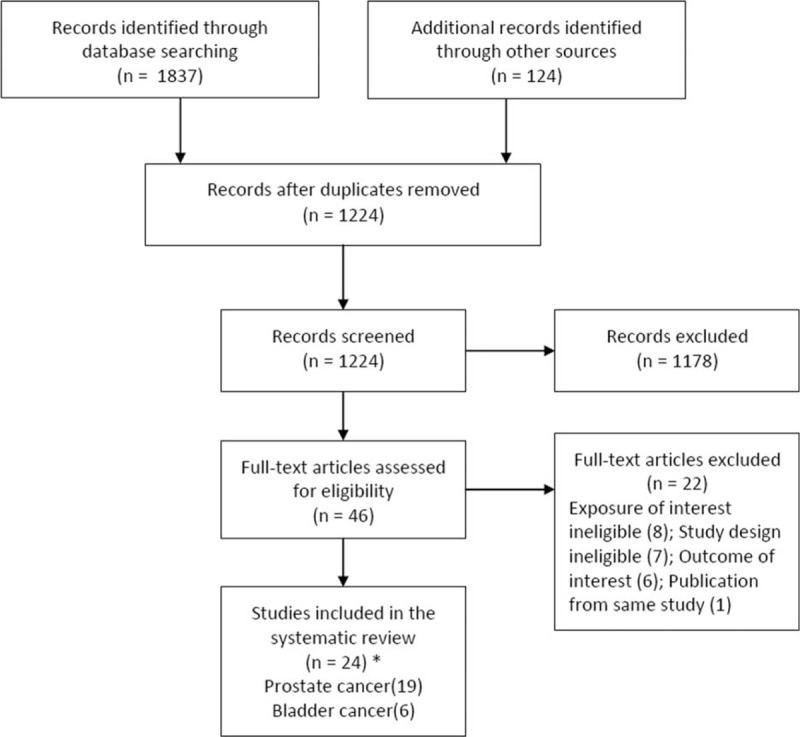
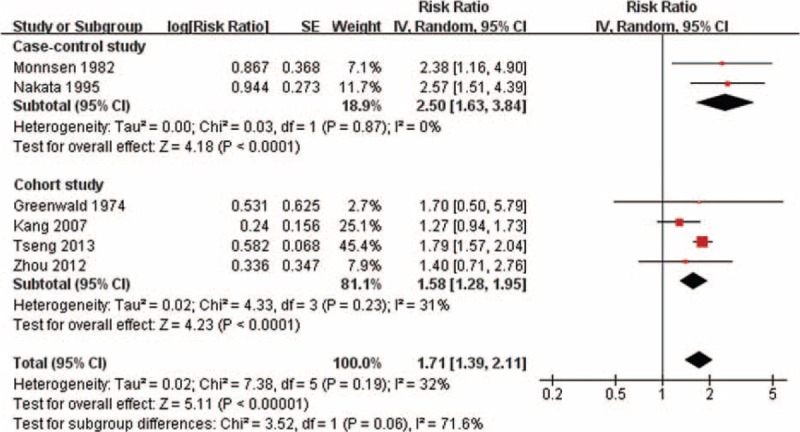
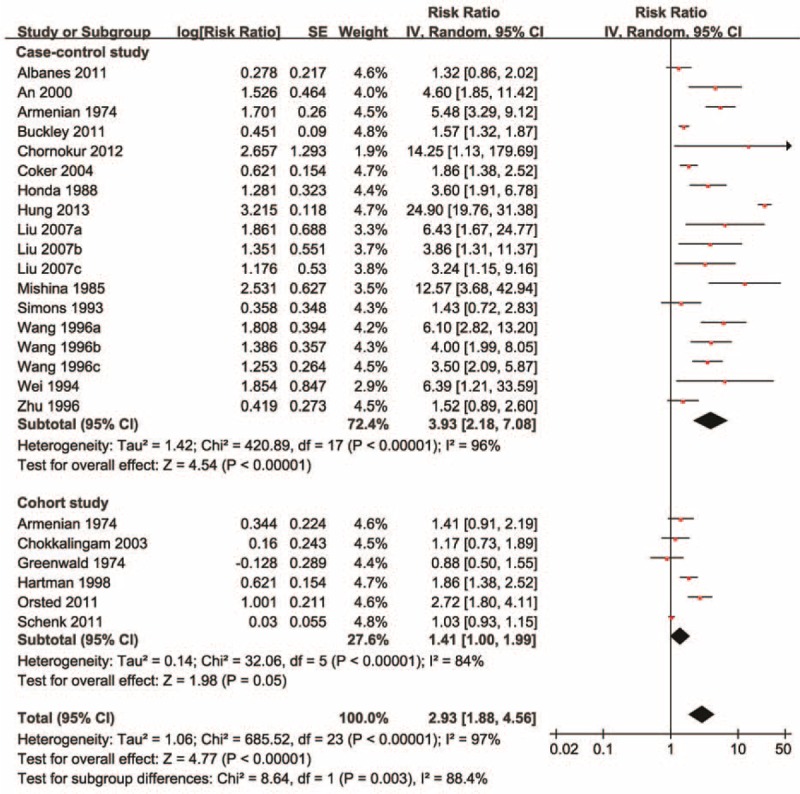
Benign prostatic hyperplasia (BPH) has been suggested to be a risk factor for certain urologic cancers, but the current evidence is inconsistent.The aim of this study was to investigate the association between BPH and urologic cancers.MEDLINE, EMBASE, Cochrane Library, and Web of Science were searched for potential eligible studies.We included case-control studies or cohort studies, which evaluated the association between BPH and urologic cancers (including prostate cancer, bladder cancer, kidney cancer, testicular cancer, or penile cancer).Overall effect estimates were calculated using the DerSimonian-Laird method for a random-effects model. Summary effect-size was calculated as risk ratio (RR), together with the 95% confidence interval (CI).This systematic review included 16 case-control studies and 10 cohort studies evaluating the association of BPH and prostate or bladder cancer; we did not identify any study about other urologic cancers. Meta-analyses demonstrated that BPH was associated with an increased incidence of prostate cancer (case-control study: RR = 3.93, 95% CI = 2.18-7.08; cohort-study: RR = 1.41, 95% CI = 1.00-1.99) and bladder cancer (case-control study: RR = 2.50, 95% CI = 1.63-3.84; cohort-study: RR = 1.58, 95% CI = 1.28-1.95). Subgroup analysis by ethnicity suggested that the association between BPH and prostate cancer was much stronger in Asians (RR = 6.09, 95% CI = 2.96-12.54) than in Caucasians (RR = 1.54, 95% CI = 1.19-2.01). Egger's tests indicated low risk of publication bias (prostate cancer: P = 0.11; bladder cancer: P = 0.95).BPH is associated with an increased risk of prostate cancer and bladder cancer. The risk of prostate cancer is particularly high in Asian BPH patients. Given the limitations of included studies, additional prospective studies with strict design are needed to confirm our findings.
良性前列腺增生(BPH)已被认为是某些泌尿系统癌症的一个危险因素,但目前的证据并不一致。本研究的目的是调查BPH与泌尿系统癌症之间的关联。我们在MEDLINE、EMBASE、Cochrane图书馆和科学网中搜索了潜在的符合条件的研究。我们纳入了病例对照研究或队列研究,这些研究评估了BPH与泌尿系统癌症(包括前列腺癌、膀胱癌、肾癌、睾丸癌或阴茎癌)之间的关联。使用DerSimonian-Laird方法对随机效应模型计算总体效应估计值。汇总效应大小计算为风险比(RR),以及95%置信区间(CI)。这项系统评价包括16项病例对照研究和10项队列研究,评估了BPH与前列腺癌或膀胱癌的关联;我们未发现任何关于其他泌尿系统癌症的研究。荟萃分析表明,BPH与前列腺癌发病率增加相关(病例对照研究:RR = 3.93,95% CI = 2.18 - 7.08;队列研究:RR = 1.41,95% CI = 1.00 - 1.99)以及与膀胱癌相关(病例对照研究:RR = 2.50,95% CI = 1.63 - 3.84;队列研究:RR = 1.58,95% CI = 1.28 - 1.95)。按种族进行的亚组分析表明,BPH与前列腺癌之间的关联在亚洲人中(RR = 6.09,95% CI = 2.96 - 12.54)比在白种人中(RR = 1.54,95% CI = 1.19 - 2.01)更强。Egger检验表明发表偏倚风险较低(前列腺癌:P = 0.11;膀胱癌:P = 0.95)。BPH与前列腺癌和膀胱癌风险增加相关。亚洲BPH患者患前列腺癌的风险特别高。鉴于纳入研究的局限性,需要进行更多设计严格的前瞻性研究来证实我们的发现。