Kimura Tomomi
Epidemiology, Janssen Pharmaceutical K.K., Tokyo 101-0065, Japan.
Chin J Cancer. 2012 Sep;31(9):421-9. doi: 10.5732/cjc.011.10324. Epub 2011 Nov 15.
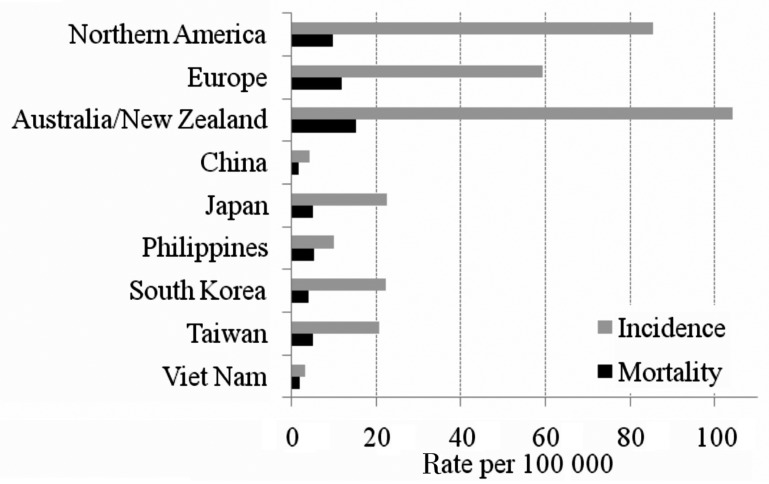
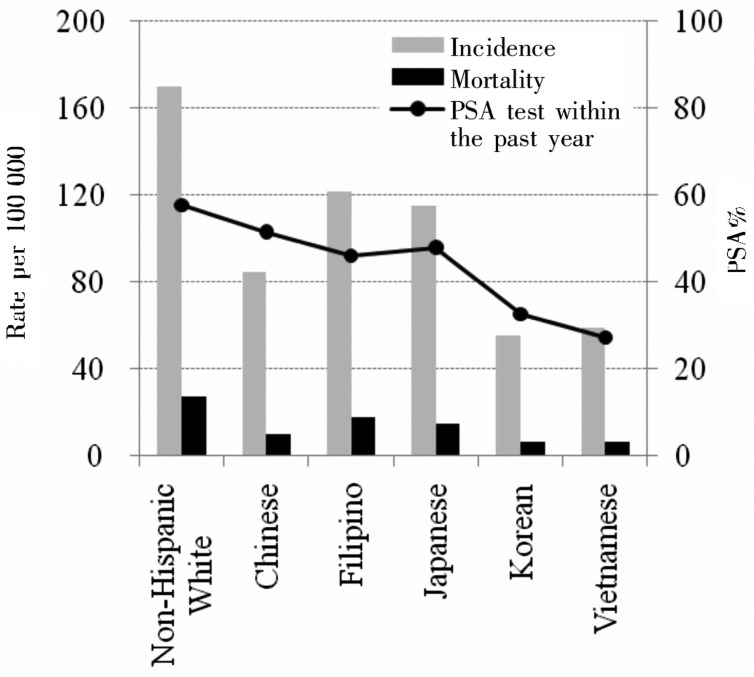
Prostate cancer is the most prevalent cancer in males in Western countries. The reported incidence in Asia is much lower than that in African Americans and European Caucasians. Although the lack of systematic prostate cancer screening system in Asian countries explains part of the difference, this alone cannot fully explain the lower incidence in Asian immigrants in the United States and west-European countries compared to the black and non-Hispanic white in those countries, nor the somewhat better prognosis in Asian immigrants with prostate cancer in the United States. Soy food consumption, more popular in Asian populations, is associated with a 25% to 30% reduced risk of prostate cancer. Prostate-specific antigen(PSA) is the only established and routinely implemented clinical biomarker for prostate cancer detection and disease status. Other biomarkers, such as urinary prostate cancer antigen 3 RNA, may increase accuracy of prostate cancer screening compared to PSA alone. Several susceptible loci have been identified in genetic linkage analyses in populations of countries in the West, and approximately 30 genetic polymorphisms have been reported to modestly increase the prostate cancer risk in genome-wide association studies. Most of the identified polymorphisms are reproducible regardless of ethnicity. Somatic mutations in the genomes of prostate tumors have been repeatedly reported to include deletion and gain of the 8p and 8q chromosomal regions, respectively; epigenetic gene silencing of glutathione S-transferase Pi(GSTP1); as well as mutations in androgen receptor gene. However, the molecular mechanisms underlying carcinogenesis, aggressiveness, and prognosis of prostate cancer remain largely unknown. Gene-gene and/or gene-environment interactions still need to be learned. In this review, the differences in PSA screening practice, reported incidence and prognosis of prostate cancer, and genetic factors between the populations in East and West factors are discussed.
前列腺癌是西方国家男性中最常见的癌症。据报道,亚洲的发病率远低于非裔美国人和欧洲白种人。尽管亚洲国家缺乏系统的前列腺癌筛查体系可以部分解释这种差异,但这 alone 无法完全解释在美国和西欧国家的亚洲移民与这些国家的黑人和非西班牙裔白人相比前列腺癌发病率较低的原因,也无法解释美国前列腺癌亚洲移民的预后稍好的原因。在亚洲人群中更普遍食用的大豆类食品与前列腺癌风险降低25%至30%有关。前列腺特异性抗原(PSA)是唯一既定且常规实施的用于前列腺癌检测和疾病状态的临床生物标志物。其他生物标志物,如尿前列腺癌抗原3 RNA,与单独使用PSA相比,可能会提高前列腺癌筛查的准确性。在西方国家人群的基因连锁分析中已鉴定出几个易感基因座,在全基因组关联研究中,约有30种基因多态性被报道会适度增加前列腺癌风险。无论种族如何,大多数已鉴定的多态性都是可重复的。前列腺肿瘤基因组中的体细胞突变已被多次报道,分别包括8号染色体短臂和长臂的缺失和增加;谷胱甘肽S-转移酶Pi(GSTP1)的表观遗传基因沉默;以及雄激素受体基因的突变。然而,前列腺癌发生、侵袭性和预后的分子机制在很大程度上仍然未知。基因-基因和/或基因-环境相互作用仍有待了解。在本综述中,讨论了东西方人群在PSA筛查实践、前列腺癌报道发病率和预后以及遗传因素方面的差异。