
绿茶和槲皮素使PC-3异种移植前列腺肿瘤对多西他赛化疗敏感。
Green tea and quercetin sensitize PC-3 xenograft prostate tumors to docetaxel chemotherapy.
作者信息
Wang Piwen, Henning Susanne M, Magyar Clara E, Elshimali Yahya, Heber David, Vadgama Jaydutt V
机构信息
Division of Cancer Research and Training, Charles R. Drew University of Medicine and Science, Los Angeles, CA, 90059, USA.
Center for Human Nutrition, Department of Medicine, David Geffen School of Medicine, University of California, Los Angeles, CA, 90095, USA.
出版信息
J Exp Clin Cancer Res. 2016 May 6;35:73. doi: 10.1186/s13046-016-0351-x.
BACKGROUND
Chemotherapy with docetaxel (Doc) remains the standard treatment for metastatic and castration-resistance prostate cancer (CRPC). However, the clinical success of Doc is limited by its chemoresistance and side effects. This study investigated whether natural products green tea (GT) and quercetin (Q) enhance the therapeutic efficacy of Doc in CRPC in mouse models.
METHODS
Male severe combined immunodeficiency (SCID) mice (n = 10 per group) were inoculated with androgen-independent prostate cancer PC-3 cells subcutaneously. When tumors were established the intervention started. Mice were administered with GT + Q, Doc 5 mg/kg (LD), GT + Q + LD Doc, Doc 10 mg/kg (HD) or control. The concentration of GT polyphenols in brewed tea administered as drinking water was 0.07% and Q was supplemented in diet at 0.4%. Doc was intravenously injected weekly for 4 weeks, GT and Q given throughout the study.
RESULTS
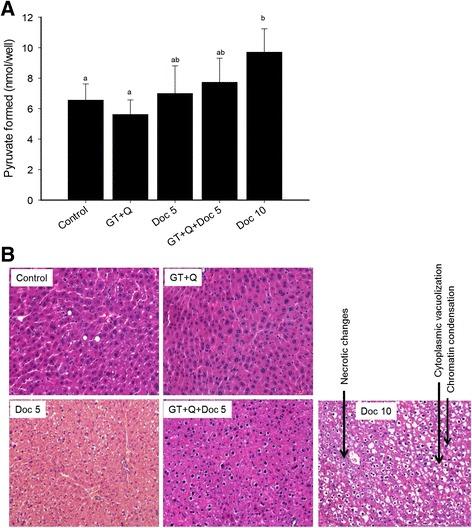
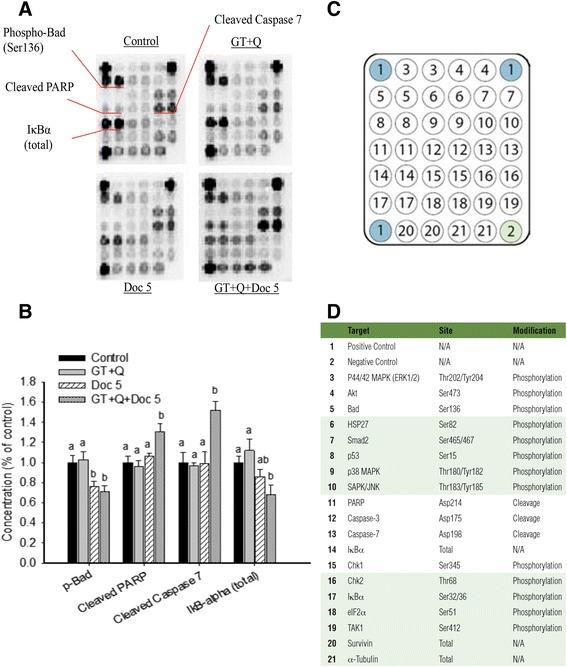
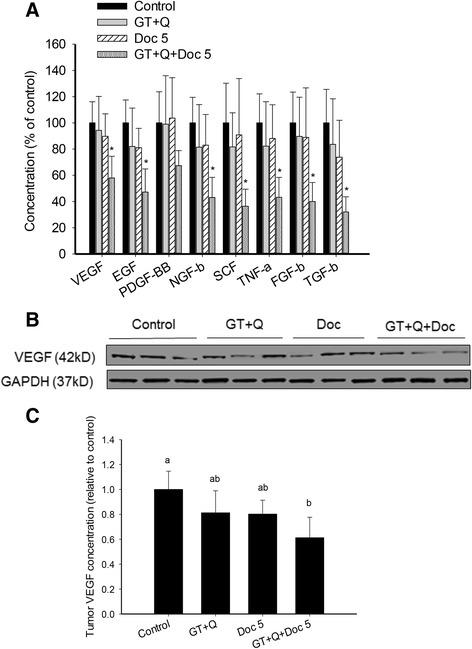
GT + Q or LD Doc slightly inhibited tumor growth compared to control. However, the combination of GT and Q with LD Doc significantly enhanced the potency of Doc 2-fold and reduced tumor growth by 62% compared to LD Doc in 7-weeks intervention. A decrease of Ki67 and increase of cleaved caspase 7 were observed in tumors by the mixture, along with lowered blood concentrations of growth factors like VEGF and EGF. The mixture significantly elevated the levels of tumor suppressor mir15a and mir330 in tumor tissues. An increased risk of liver toxicity was only observed with HD Doc treatment.
CONCLUSIONS
These results provide a promising regimen to enhance the therapeutic effect of Doc in a less toxic manner.
背景
多西他赛(Doc)化疗仍是转移性和去势抵抗性前列腺癌(CRPC)的标准治疗方法。然而,Doc的临床疗效受到其化疗耐药性和副作用的限制。本研究调查了天然产物绿茶(GT)和槲皮素(Q)是否能增强Doc对CRPC小鼠模型的治疗效果。
方法
将雄性严重联合免疫缺陷(SCID)小鼠(每组n = 10只)皮下接种雄激素非依赖性前列腺癌PC-3细胞。肿瘤形成后开始干预。给小鼠施用GT + Q、5 mg/kg的Doc(低剂量,LD)、GT + Q + LD Doc、10 mg/kg的Doc(高剂量,HD)或作为对照。作为饮用水给予的冲泡茶中GT多酚的浓度为0.07%,Q以0.4%的比例添加到饮食中。Doc每周静脉注射一次,共注射4周,GT和Q在整个研究过程中给予。
结果
与对照组相比,GT + Q或LD Doc对肿瘤生长有轻微抑制作用。然而,在7周的干预中,GT和Q与LD Doc联合使用可使Doc的效力显著增强2倍,与LD Doc相比,肿瘤生长减少了62%。混合物处理的肿瘤中观察到Ki67减少,裂解的半胱天冬酶7增加,同时血液中VEGF和EGF等生长因子的浓度降低。混合物显著提高了肿瘤组织中肿瘤抑制因子mir15a和mir330的水平。仅在HD Doc治疗中观察到肝毒性风险增加。
结论
这些结果提供了一种有前景的方案,以较低毒性的方式增强Doc的治疗效果。



 Zotero 插件