Wang Jun, Yu Yeisoo, Tao Feng, Zhang Jianwei, Copetti Dario, Kudrna Dave, Talag Jayson, Lee Seunghee, Wing Rod A, Fan Chuanzhu
Department of Biological Sciences, Wayne State University, 5047 Gullen Mall, Detroit, MI, 48202, USA.
Arizona Genomics Institute, BIO5 Institute and School of Plant Sciences, University of Arizona, Tucson, AZ, 85721, USA.
Genome Biol. 2016 May 6;17(1):92. doi: 10.1186/s13059-016-0954-8.
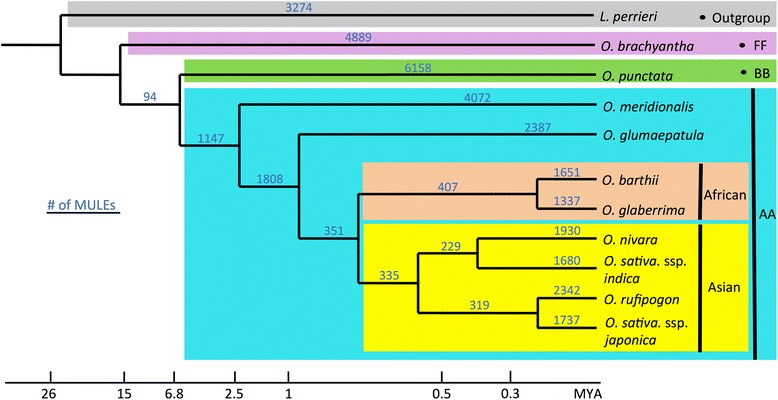
Mutator-like transposable elements, a class of DNA transposons, exist pervasively in both prokaryotic and eukaryotic genomes, with more than 10,000 copies identified in the rice genome. These elements can capture ectopic genomic sequences that lead to the formation of new gene structures. Here, based on whole-genome comparative analyses, we comprehensively investigated processes and mechanisms of the evolution of putative genes derived from Mutator-like transposable elements in ten Oryza species and the outgroup Leersia perieri, bridging ~20 million years of evolutionary history.
Our analysis identified thousands of putative genes in each of the Oryza species, a large proportion of which have evidence of expression and contain chimeric structures. Consistent with previous reports, we observe that the putative Mutator-like transposable element-derived genes are generally GC-rich and mainly derive from GC-rich parental sequences. Furthermore, we determine that Mutator-like transposable elements capture parental sequences preferentially from genomic regions with low methylation levels and high recombination rates. We explicitly show that methylation levels in the internal and terminated inverted repeat regions of these elements, which might be directed by the 24-nucleotide small RNA-mediated pathway, are different and change dynamically over evolutionary time. Lastly, we demonstrate that putative genes derived from Mutator-like transposable elements tend to be expressed in mature pollen, which have undergone de-methylation programming, thereby providing a permissive expression environment for newly formed/transposable element-derived genes.
Our results suggest that DNA methylation may be a primary mechanism to facilitate the origination, survival, and regulation of genes derived from Mutator-like transposable elements, thus contributing to the evolution of gene innovation and novelty in plant genomes.
类Mutator转座元件是一类DNA转座子,广泛存在于原核生物和真核生物基因组中,在水稻基因组中已鉴定出超过10000个拷贝。这些元件可以捕获异位基因组序列,从而导致新基因结构的形成。在此,基于全基因组比较分析,我们全面研究了十个稻属物种以及外类群李氏禾中源自类Mutator转座元件的假定基因的进化过程和机制,跨越了约2000万年的进化历史。
我们的分析在每个稻属物种中鉴定出数千个假定基因,其中很大一部分有表达证据且包含嵌合结构。与之前的报道一致,我们观察到假定的类Mutator转座元件衍生基因通常富含GC,并且主要源自富含GC的亲本序列。此外,我们确定类Mutator转座元件优先从甲基化水平低和重组率高的基因组区域捕获亲本序列。我们明确表明,这些元件内部和末端反向重复区域的甲基化水平不同,且在进化过程中动态变化,这可能由24核苷酸小RNA介导的途径调控。最后,我们证明源自类Mutator转座元件的假定基因倾向于在经历去甲基化编程的成熟花粉中表达,从而为新形成的/转座元件衍生的基因提供了一个允许表达的环境。
我们的结果表明,DNA甲基化可能是促进类Mutator转座元件衍生基因的起源、存活和调控的主要机制,从而有助于植物基因组中基因创新和新颖性的进化。