Benoit J, Manger P R, Rubidge B S
Evolutionary Studies Institute (ESI), University of the Witwatersrand, PO Wits, 2050, Johannesburg, South Africa.
School of Anatomical Sciences, University of the Witwatersrand, 7 York Road, Parktown, 2193, Johannesburg, South Africa.
Sci Rep. 2016 May 9;6:25604. doi: 10.1038/srep25604.
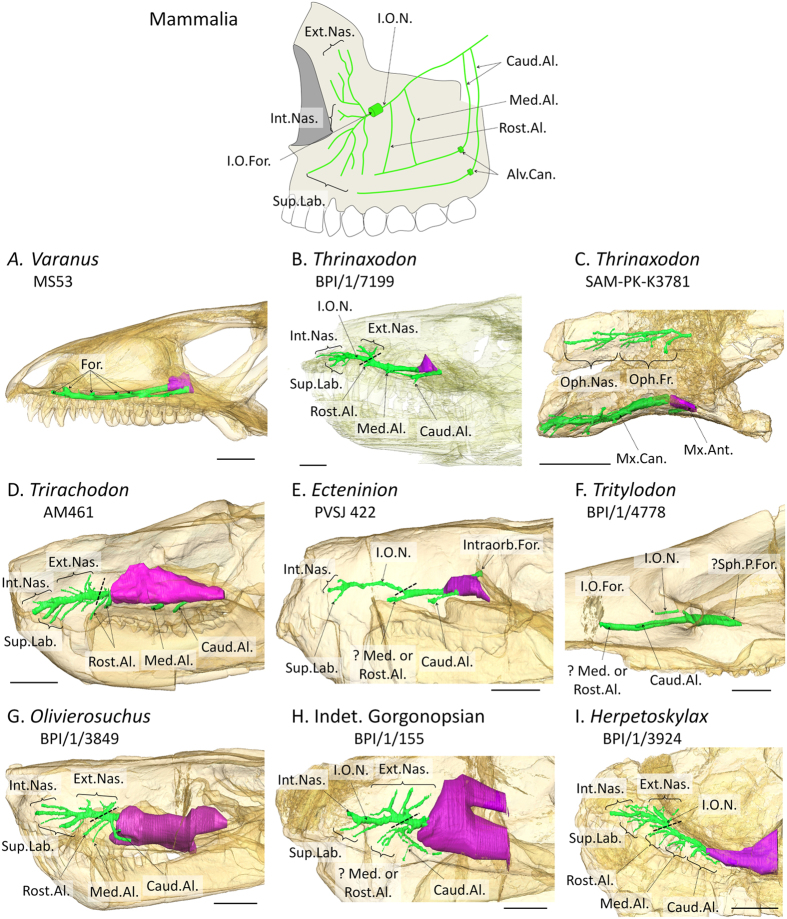
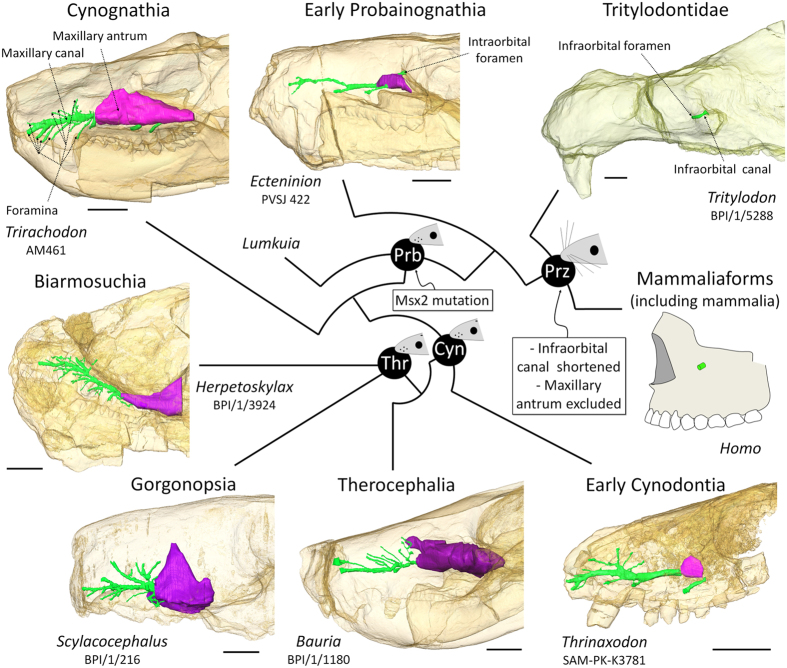
A rich fossil record chronicles the distant origins of mammals, but the evolution of defining soft tissue characters of extant mammals, such as mammary glands and hairs is difficult to interpret because soft tissue does not readily fossilize. As many soft tissue features are derived from dermic structures, their evolution is linked to that of the nervous syutem, and palaeoneurology offers opportunities to find bony correlates of these soft tissue features. Here, a CT scan study of 29 fossil skulls shows that non-mammaliaform Prozostrodontia display a retracted, fully ossified, and non-ramified infraorbital canal for the infraorbital nerve, unlike more basal therapsids. The presence of a true infraorbital canal in Prozostrodontia suggests that a motile rhinarium and maxillary vibrissae were present. Also the complete ossification of the parietal fontanelle (resulting in the loss of the parietal foramen) and the development of the cerebellum in Probainognathia may be pleiotropically linked to the appearance of mammary glands and having body hair coverage since these traits are all controlled by the same homeogene, Msx2, in mice. These suggest that defining soft tissue characters of mammals were already present in their forerunners some 240 to 246 mya.
丰富的化石记录记载了哺乳动物的遥远起源,但现存哺乳动物一些具有代表性的软组织特征,如乳腺和毛发的进化却难以解读,因为软组织不容易形成化石。由于许多软组织特征源自皮肤结构,它们的进化与神经系统的进化相关联,而古神经学为寻找这些软组织特征的骨骼关联提供了机会。在此,一项对29个化石头骨的CT扫描研究表明,与更原始的兽孔目动物不同,非哺乳形类原兽齿类动物的眶下神经管为眶下神经提供了一个后缩、完全骨化且无分支的通道。原兽齿类动物中真正眶下神经管的存在表明其具有可活动的鼻镜和上颌触须。此外,在原颌兽类中,顶骨囟门的完全骨化(导致顶骨孔消失)和小脑的发育可能与乳腺的出现和体表有毛发呈多效性关联,因为在小鼠中这些特征均由同一同源基因Msx2控制。这些表明哺乳动物具有代表性的软组织特征在其约2.4亿至2.46亿年前的祖先中就已存在。