Ajit Deepa, Simonyi Agnes, Li Runting, Chen Zihong, Hannink Mark, Fritsche Kevin L, Mossine Valeri V, Smith Robert E, Dobbs Thomas K, Luo Rensheng, Folk William R, Gu Zezong, Lubahn Dennis B, Weisman Gary A, Sun Grace Y
Biochemistry Department, University of Missouri, Columbia, MO, USA.
Biochemistry Department, University of Missouri, Columbia, MO, USA; Center for Botanical Interaction Studies, University of Missouri, Columbia, MO, USA.
Neurochem Int. 2016 Jul;97:49-56. doi: 10.1016/j.neuint.2016.05.004. Epub 2016 May 7.
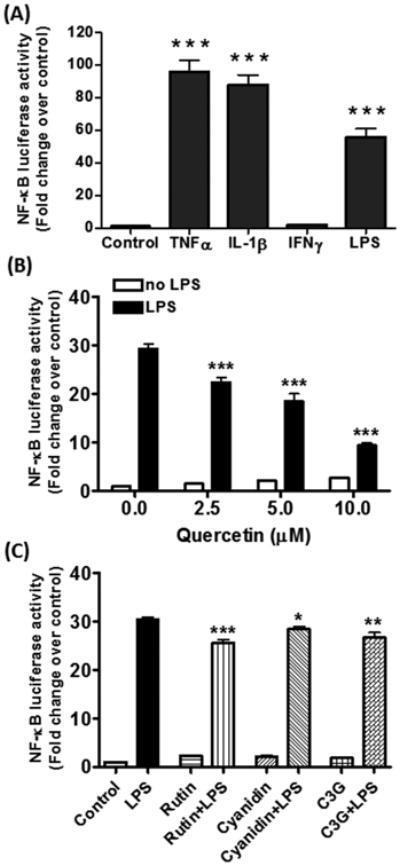
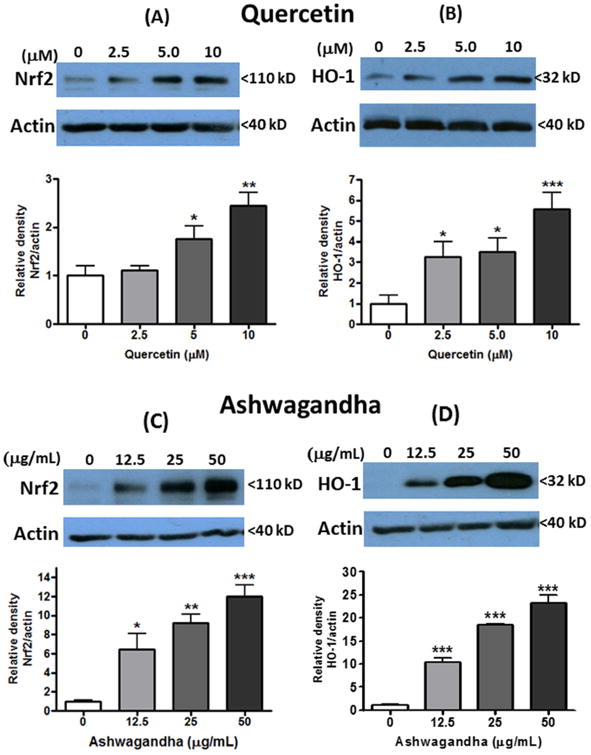
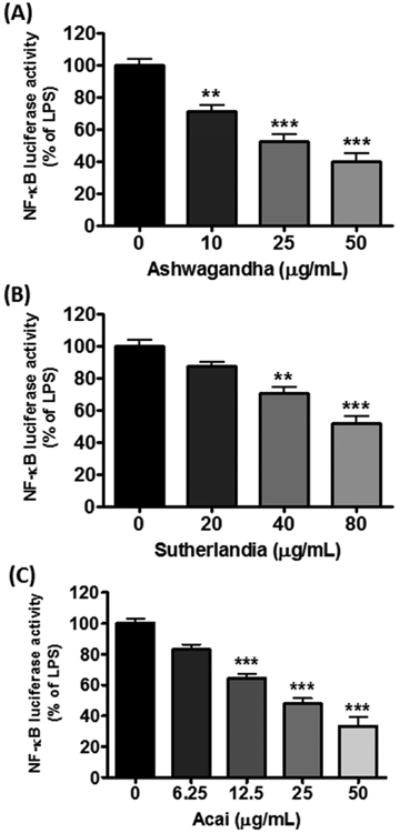
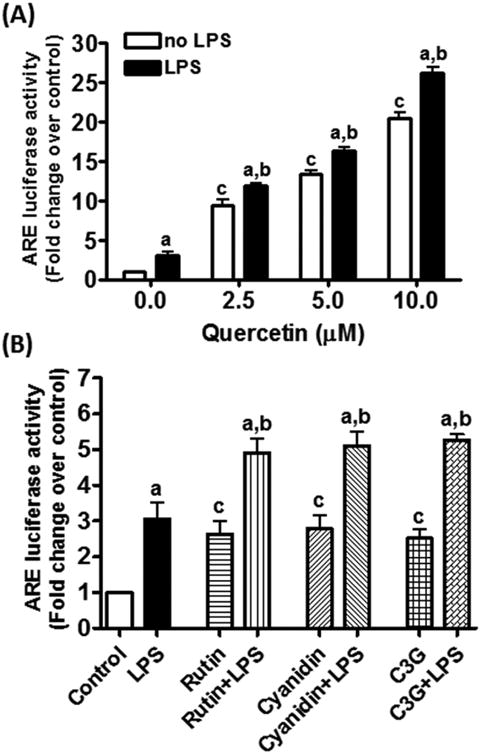
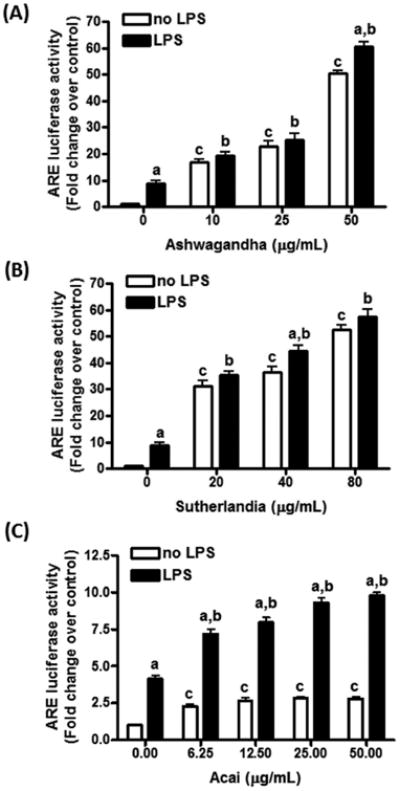
The increase in oxidative stress and inflammatory responses associated with neurodegenerative diseases has drawn considerable attention towards understanding the transcriptional signaling pathways involving NF-κB (nuclear factor kappa-light-chain-enhancer of activated B cells) and Nrf2 (Nuclear Factor Erythroid 2-like 2). Our recent studies with immortalized murine microglial cells (BV-2) demonstrated effects of botanical polyphenols to inhibit lipopolysaccharide (LPS)-induced nitric oxide (NO) and enhance Nrf2-mediated antioxidant responses (Sun et al., 2015). In this study, an immortalized rat astrocyte (DI TNC1) cell line expressing a luciferase reporter driven by the NF-κB or the Nrf2/Antioxidant Response Element (ARE) promoter was used to assess regulation of these two pathways by phytochemicals such as quercetin, rutin, cyanidin, cyanidin-3-O-glucoside, as well as botanical extracts from Withania somnifera (Ashwagandha), Sutherlandia frutescens (Sutherlandia) and Euterpe oleracea (Açaí). Quercetin effectively inhibited LPS-induced NF-κB reporter activity and stimulated Nrf2/ARE reporter activity in DI TNC1 astrocytes. Cyanidin and the glycosides showed similar effects but only at much higher concentrations. All three botanical extracts effectively inhibited LPS-induced NF-κB reporter activity. These extracts were capable of enhancing ARE activity by themselves and further enhanced ARE activity in the presence of LPS. Quercetin and botanical extracts induced Nrf2 and HO-1 protein expression. Interestingly, Ashwagandha extract was more active in inducing Nrf2 and HO-1 expression in DI TNC1 astrocytes as compared to Sutherlandia and Açaí extracts. In summary, this study demonstrated NF-kB and Nrf2/ARE promoter activities in DI TNC1 astrocytes, and further showed differences in ability for specific botanical polyphenols and extracts to down-regulate LPS-induced NF-kB and up-regulate the NRF2/ARE activities in these cells.
与神经退行性疾病相关的氧化应激和炎症反应增加,使得人们对涉及核因子κB(NF-κB,即活化B细胞核因子κ轻链增强子)和核因子E2相关因子2(Nrf2)的转录信号通路的理解备受关注。我们最近对永生化小鼠小胶质细胞(BV-2)的研究表明,植物多酚可抑制脂多糖(LPS)诱导的一氧化氮(NO)生成,并增强Nrf2介导的抗氧化反应(Sun等人,2015年)。在本研究中,使用了一种表达由NF-κB或Nrf2/抗氧化反应元件(ARE)启动子驱动的荧光素酶报告基因的永生化大鼠星形胶质细胞(DI TNC1)细胞系,来评估槲皮素、芦丁、花青素、花青素-3-O-葡萄糖苷等植物化学物质以及南非醉茄(Ashwagandha)、灌木南非茶(Sutherlandia)和巴西莓(Euterpe oleracea,即阿萨伊果)的植物提取物对这两条信号通路的调控作用。槲皮素有效抑制了LPS诱导的DI TNC1星形胶质细胞中NF-κB报告基因的活性,并刺激了Nrf2/ARE报告基因的活性。花青素及其糖苷表现出类似的作用,但仅在高得多的浓度下。所有三种植物提取物均有效抑制了LPS诱导的NF-κB报告基因的活性。这些提取物自身能够增强ARE活性,并且在存在LPS的情况下进一步增强ARE活性。槲皮素和植物提取物诱导了Nrf2和血红素加氧酶-1(HO-1)蛋白的表达。有趣的是,与灌木南非茶和巴西莓提取物相比,南非醉茄提取物在诱导DI TNC1星形胶质细胞中Nrf2和HO-1表达方面更具活性。总之,本研究证明了DI TNC1星形胶质细胞中的NF-κB和Nrf2/ARE启动子活性,并进一步显示了特定植物多酚和提取物在下调LPS诱导的NF-κB以及上调这些细胞中Nrf2/ARE活性能力方面的差异。