de Miguel-Luken María José, Chaves-Conde Manuel, Quintana Begoña, Menoyo Alicia, Tirado Isabel, de Miguel-Luken Verónica, Pachón Jerónimo, Chinchón David, Suarez Vladimir, Carnero Amancio
Department of Medical Oncology, Virgen del Rocío University Hospital, Seville, Spain.
Department of Radiation Oncology, Virgen del Rocío University Hospital, Seville, Spain.
Oncotarget. 2016 May 31;7(22):31723-37. doi: 10.18632/oncotarget.9172.
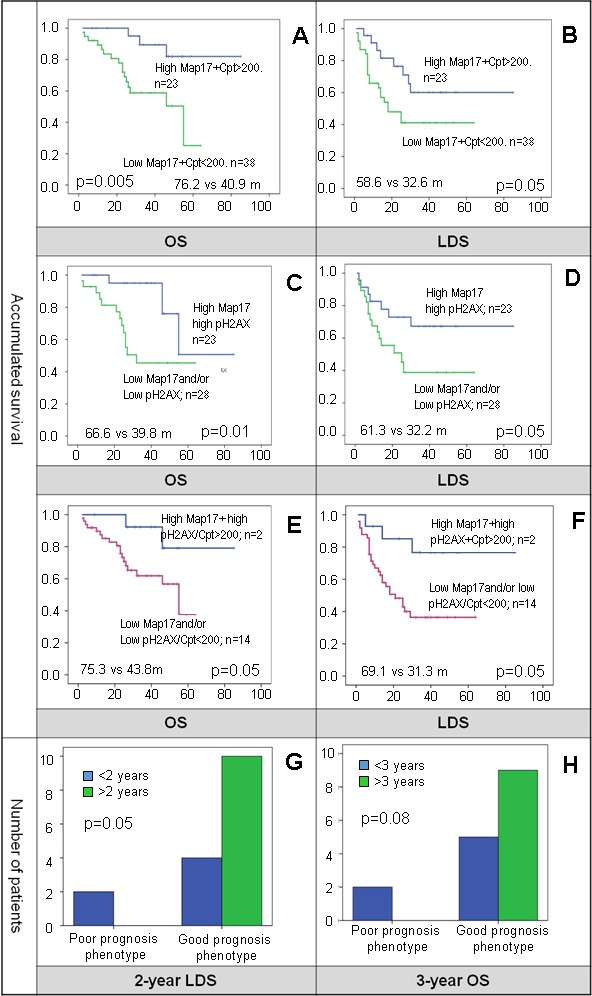
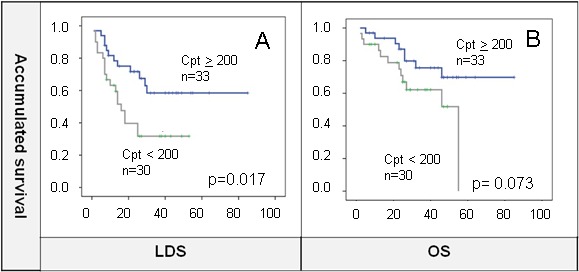
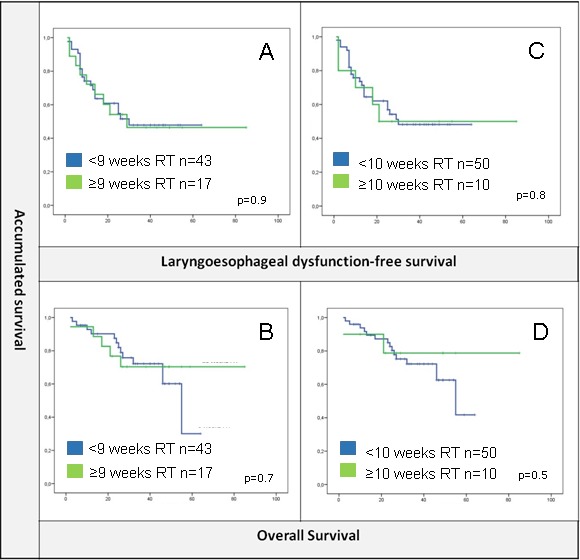
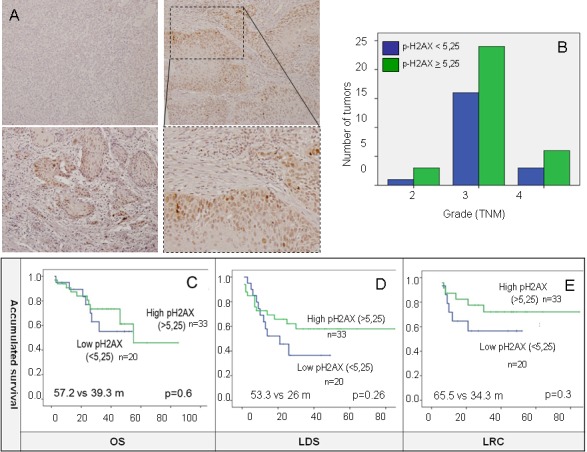
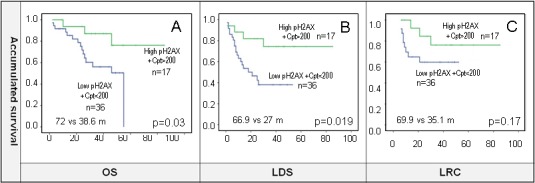
Current larynx preservation treatments have achieved an improvement of laryngoesophageal dysfunction-free survival (LDS) but lead to significant toxicities and recurrences. At present, there is no evidence to select the group of patients that may benefit from preservation approaches instead of surgery. Therefore, laryngeal biomarkers could facilitate pretreatment identification of patients who could respond to chemoradiation-based therapy. In this study, we evaluated retrospectively 53 patients with larynx cancer to determine whether gH2AX phosphorylation (pH2AX) alone or in combination with the membrane protein MAP17 (PDZK1IP1) could be used as prognostic biomarkers. We also evaluated whether the completion of cisplatin treatment and radiotherapy could predict survival in combination with pH2AX.We found that the dose of cisplatin received but not the length of the radiotherapy influenced LDS. High-pH2AX expression was associated with prolonged LDS (HR 0.26, p = 0.02) while MAP17 correlated with overall survival (OS) (HR 0.98, p = 0.05). High-MAP17 and high-pH2AX combined analysis showed improved LDS (with 61.35 months vs 32.2 months, p = 0.05) and OS (with 66.6 months vs 39.8 months, p = 0.01). Furthermore, the subgroup of high-pH2AX and optimal dose of cisplatin was also associated with OS (72 months vs 38.6 months, p = 0.03) and LDS (66.9 months vs 27 months, p = 0.017). These findings suggest that pH2AX alone or better in combination with MAP17 may become a novel and valuable prognostic biomarker for patients with laryngeal carcinoma treated with preservation approaches.
目前的喉保留治疗已提高了无喉食管功能障碍生存期(LDS),但会导致显著的毒性反应和复发。目前,尚无证据可用于选择可能从保留治疗而非手术中获益的患者群体。因此,喉生物标志物有助于在治疗前识别可能对基于放化疗的治疗有反应的患者。在本研究中,我们回顾性评估了53例喉癌患者,以确定单独的γ-H2AX磷酸化(pH2AX)或与膜蛋白MAP17(PDZK1IP1)联合是否可作为预后生物标志物。我们还评估了顺铂治疗和放疗的完成情况与pH2AX联合是否可预测生存期。我们发现,接受的顺铂剂量而非放疗时长影响LDS。高pH2AX表达与LDS延长相关(HR 0.26,p = 0.02),而MAP17与总生存期(OS)相关(HR 0.98,p = 0.05)。高MAP17和高pH2AX联合分析显示LDS改善(分别为61.35个月和32.2个月,p = 0.05)和OS改善(分别为66.6个月和39.8个月,p = 0.01)。此外,高pH2AX和顺铂最佳剂量亚组也与OS(分别为72个月和38.6个月,p = 0.03)和LDS(分别为66.9个月和27个月,p = 0.017)相关。这些发现表明,单独的pH2AX或与MAP17联合可能成为采用保留治疗方法的喉癌患者一种新的有价值的预后生物标志物。