Wuhan University; Beaumont Health System.
J Appl Clin Med Phys. 2016 May 8;17(3):236-245. doi: 10.1120/jacmp.v17i3.6065.
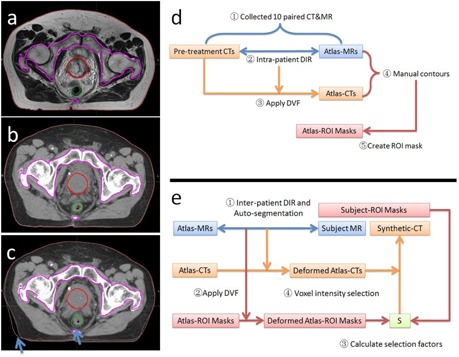
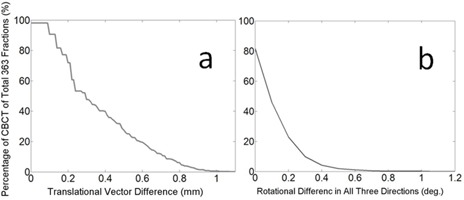
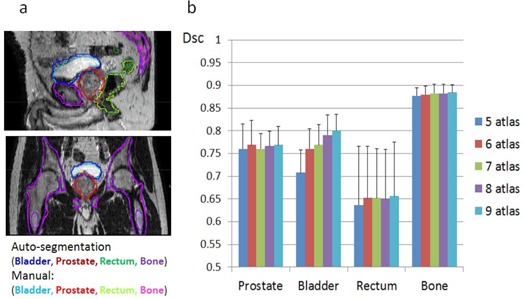
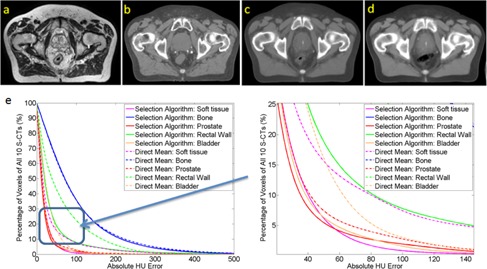
The purpose of this study was to propose and evaluate a method of creating a synthetic CT (S-CT) from MRI simulation for dose calculation and daily CBCT localization. A pair of MR and CT images was obtained in the same day from each of 10 prostate patients. The pair of MR and CT images was preregistered using the deformable image registration (DIR). Using the corresponding displacement vector field (atlas-DVF), the CT image was deformed to the MR image to create an atlas MR-CT pair. Regions of interest (ROI) on the atlas MR-CT pair were delineated and used to create atlas-ROI masks. 'Leave-one-out' test (one pair of MR and CT was used as subject-MR and subject-CT for evaluation, and the remaining 9 pairs were in the atlas library) was performed. For a subject-MR, autosegmentation and DVFs were generated using DIR between the subject-MR and the 9 atlas-MRs. An S-CT was then generated using the corresponding 9 paired atlas-CTs, the 9 atlas-DVFs and the corresponding atlas-ROI masks. The total 10 S-CTs were evaluated using the Hounsfield unit (HU), the calculated dose distribution, and the auto bony registration to daily CBCT images with respect to the 10 subject-CTs. HU differences (mean ± STD) were (2.4 ± 25.23), (1.18 ± 39.49), (32.46 ± 81.9), (0.23 ± 40.13), and (3.74 ± 144.76) for prostate, bladder, rectal wall, soft tissue outside all ROIs, and bone, respectively. The discrepancy of dose-volume param-eters calculated using the S-CT for treatment planning was small (≤ 0.22% with 95% confidence). Gamma pass rate (2% & 2 mm) was higher than 99.86% inside PTV and 98.45% inside normal structures. Using the 10 S-CTs as the reference CT for daily CBCT localization achieved the similar results compared to using the subject-CT. The translational vector differences were within 1.08 mm (0.37 ± 0.23 mm), and the rotational differences were within 1.1° in all three directions. S-CT created from a simulation MR image using the proposed approach with the preconstructed atlas library can replace the planning CT for dose calculation and daily CBCT image guidance.
本研究旨在提出并评估一种从 MRI 模拟中创建合成 CT(S-CT)以进行剂量计算和日常 CBCT 定位的方法。对 10 例前列腺患者的同一天内的一对 MR 和 CT 图像进行了采集。使用可变形图像配准(DIR)对 MR 和 CT 图像进行预配准。使用相应的位移向量场(图谱-DVF)将 CT 图像变形到 MR 图像,以创建图谱 MR-CT 对。在图谱 MR-CT 对上勾勒出感兴趣区域(ROI),并用于创建图谱 ROI 蒙版。进行了“留一法”测试(一对 MR 和 CT 被用作受试 MR 和受试 CT 进行评估,其余 9 对用于图谱库)。对于受试 MR,使用 DIR 在受试 MR 与 9 个图谱 MR 之间生成自动分割和 DVF。然后,使用相应的 9 对图谱 CT、9 个图谱 DVF 和相应的图谱 ROI 蒙版生成 S-CT。对 10 个受试 CT 的 10 个 S-CT 进行了基于体素 HU、计算剂量分布以及与日常 CBCT 图像的自动骨性配准的评估。HU 差异(均值±标准差)分别为前列腺(2.4±25.23)、膀胱(1.18±39.49)、直肠壁(32.46±81.9)、所有 ROI 外软组织(0.23±40.13)和骨骼(3.74±144.76)。使用 S-CT 进行治疗计划计算的剂量-体积参数差异较小(置信度为 95%时≤0.22%)。在 PTV 内的伽玛通过率(2%和 2mm)高于 99.86%,在正常结构内的通过率高于 98.45%。使用 10 个 S-CT 作为日常 CBCT 定位的参考 CT 可获得与使用受试 CT 相似的结果。平移向量差异在 1.08mm 以内(0.37±0.23mm),三个方向的旋转差异均在 1.1°以内。使用预先构建的图谱库从模拟 MR 图像创建的 S-CT 可以替代计划 CT 进行剂量计算和日常 CBCT 图像引导。