Rachmi Cut Novianti, Agho Kingsley E, Li Mu, Baur Louise Alison
Discipline of Paediatrics and Child Health, The Children's Hospital at Westmead (University of Sydney Clinical School), Sydney, NSW, Australia.
School of Science and Health, Western Sydney University-Campbelltown Campus, Sydney, NSW, Australia.
PLoS One. 2016 May 11;11(5):e0154756. doi: 10.1371/journal.pone.0154756. eCollection 2016.
The double burden of malnutrition affects many low and middle-income countries. This study aimed to: a) determine temporal trends in the prevalence of underweight, stunting, and at risk of overweight/ overweight or obesity in Indonesian children aged 2.0-4.9 years; and b) examine associated risk factors.
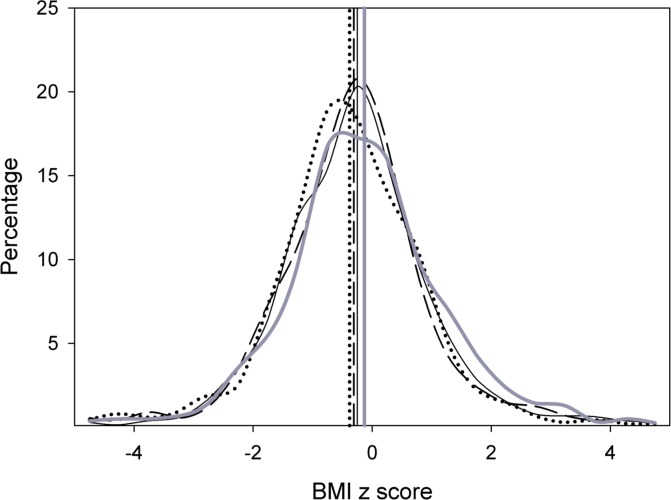
A repeated cross-sectional survey. This is a secondary data analysis of waves 1, 2, 3, and 4 (1993, 1997, 2000, and 2007) of the Indonesian Family Life Survey, which includes 13 out of 27 provinces in Indonesia. Height, weight and BMI were expressed as z-scores (2006 WHO Child Growth Standards). Weight-for-age-z-score <-2 was categorised as underweight, height-for-age-z-score <-2 as stunted, and BMI-z-score >+1, >+2, >+3 as at-risk, overweight and obese, respectively.
There are 938, 913, 939, and 1311 separate children in the 4 waves, respectively. The prevalence of stunting decreased significantly from waves 1 to 4 (from 50.8% to 36.7%), as did the prevalence of underweight (from 34.5% to 21.4%). The prevalence of 'at-risk'/overweight/obesity increased from 10.3% to 16.5% (all P<0.01). Stunting and underweight were related to lower birth weight, being breastfed for 6 months or more, having parents who were underweight or had short stature, and mothers who never attended formal education. Stunting was also higher in rural areas. Being at-risk, or overweight/obese were closely related to being in the youngest age group (2-2·9 years) or male, having parents who were overweight/obese or having fathers with university education.
The double burden of malnutrition occurs in Indonesian children. Development of policy to combine the management of chronic under-nutrition and over-nutrition is required.
营养不良的双重负担影响着许多低收入和中等收入国家。本研究旨在:a)确定印度尼西亚2.0至4.9岁儿童体重不足、发育迟缓以及超重/肥胖风险的时间趋势;b)检查相关风险因素。
重复横断面调查。这是对印度尼西亚家庭生活调查第1、2、3和4轮(1993年、1997年、2000年和2007年)数据的二次分析,该调查涵盖印度尼西亚27个省份中的13个。身高、体重和体重指数以z评分表示(2006年世界卫生组织儿童生长标准)。年龄别体重z评分<-2被归类为体重不足,年龄别身高z评分<-2为发育迟缓,体重指数z评分>+1、>+2、>+3分别为超重风险、超重和肥胖。
四轮调查中分别有938、913、,939和1311名不同儿童。从第1轮至第4轮,发育迟缓患病率显著下降(从50.8%降至36.7%),体重不足患病率也显著下降(从34.5%降至21.4%)。超重风险/超重/肥胖患病率从10.3%增至16.5%(所有P<0.01)。发育迟缓和体重不足与低出生体重、母乳喂养6个月或更长时间、父母体重不足或身材矮小以及母亲从未接受过正规教育有关。农村地区发育迟缓情况也更为严重。超重风险、超重或肥胖与最年幼年龄组(2 - 2.9岁)或男性、父母超重/肥胖或父亲受过大学教育密切相关。
印度尼西亚儿童存在营养不良的双重负担。需要制定政策,将慢性营养不良和营养过剩的管理结合起来。