Gelsomino Luca, Gu Guowei, Rechoum Yassine, Beyer Amanda R, Pejerrey Sasha M, Tsimelzon Anna, Wang Tao, Huffman Kenneth, Ludlow Andrew, Andò Sebastiano, Fuqua Suzanne A W
Department of Pharmacy, Health, and Nutritional Sciences, University of Calabria, Arcavacata di Rende, Cosenza, Italy.
Lester & Sue Smith Breast Center, Baylor College of Medicine, One Baylor Plaza, Houston, TX, 77030, USA.
Breast Cancer Res Treat. 2016 Jun;157(2):253-265. doi: 10.1007/s10549-016-3829-5. Epub 2016 May 13.
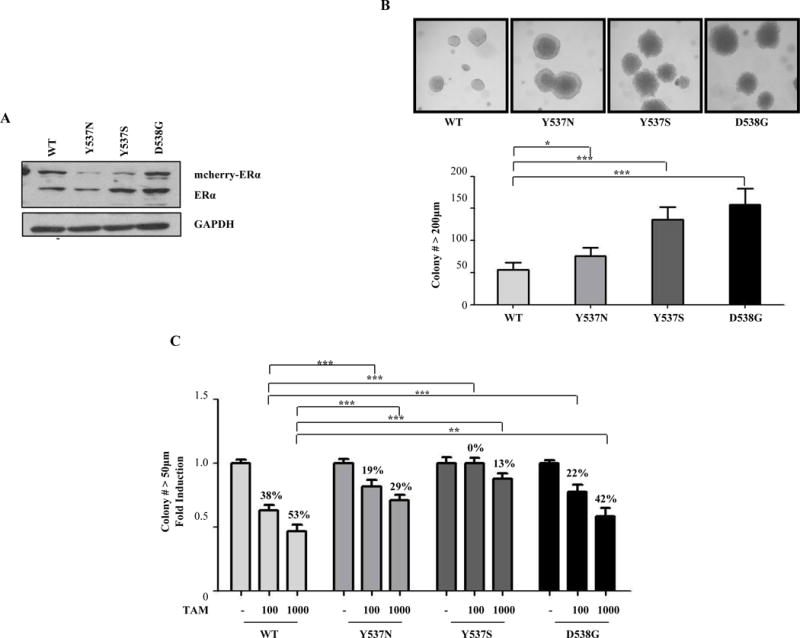
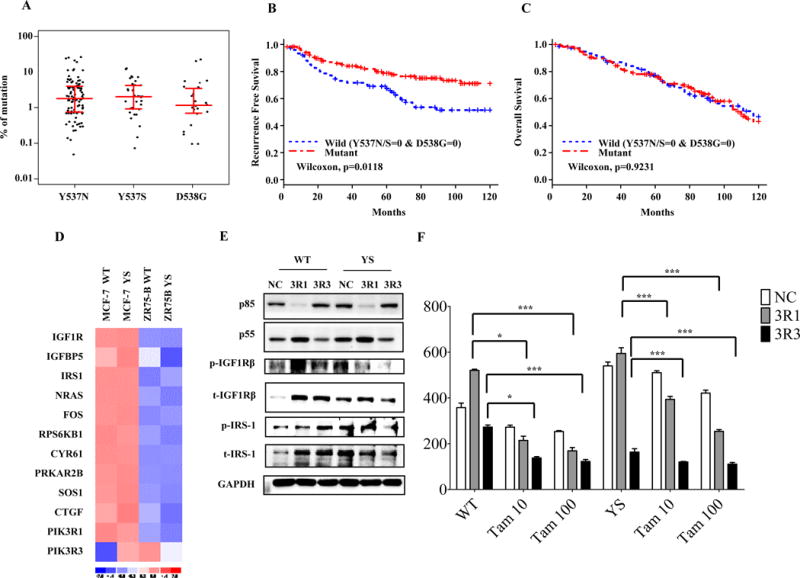
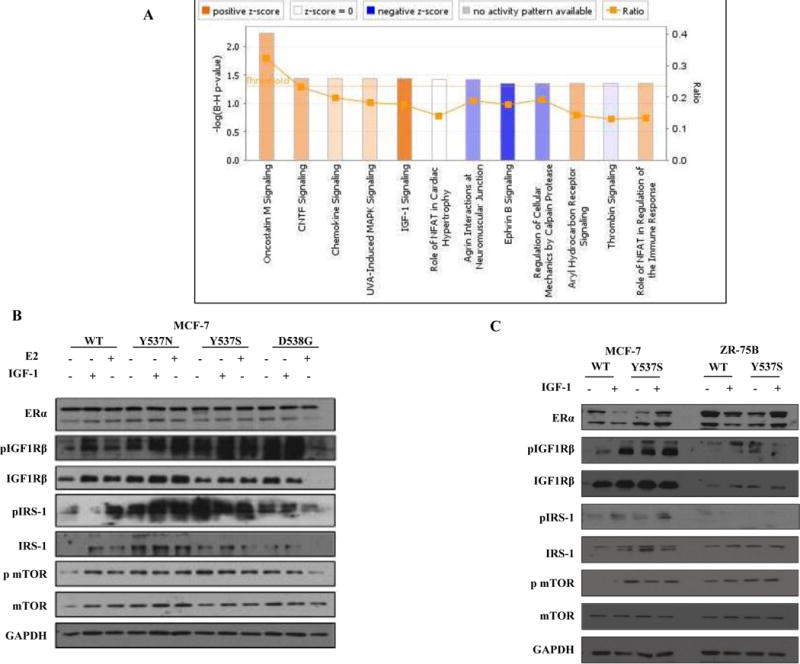
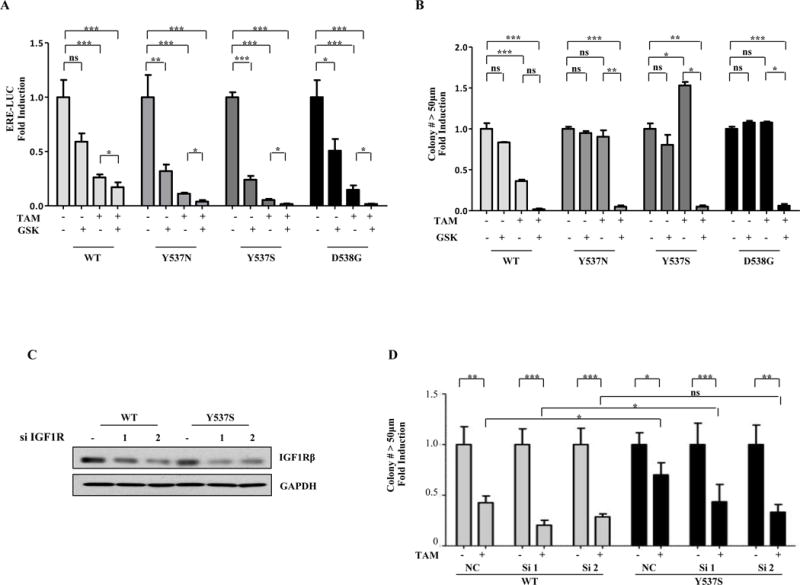
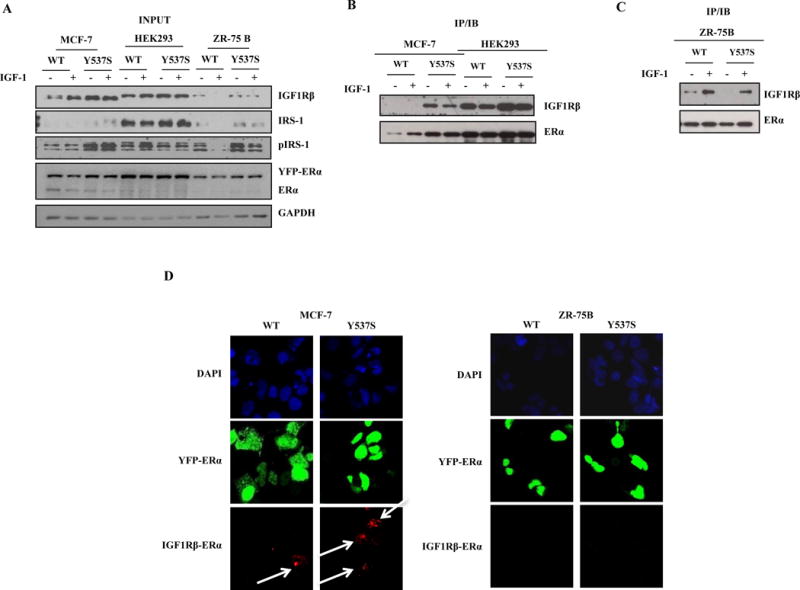
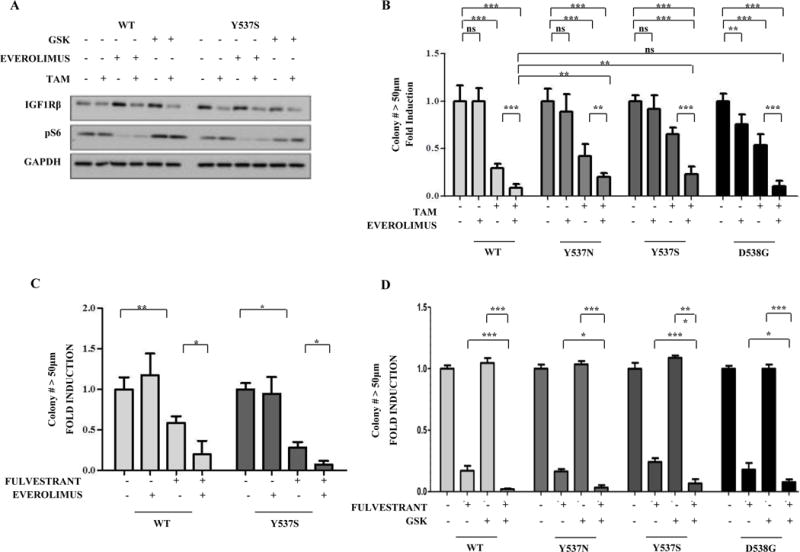
The purpose of this study was to address the role of ESR1 hormone-binding mutations in breast cancer. Soft agar anchorage-independent growth assay, Western blot, ERE reporter transactivation assay, proximity ligation assay (PLA), coimmunoprecipitation assay, silencing assay, digital droplet PCR (ddPCR), Kaplan-Meier analysis, and statistical analysis. It is now generally accepted that estrogen receptor (ESR1) mutations occur frequently in metastatic breast cancers; however, we do not yet know how to best treat these patients. We have modeled the three most frequent hormone-binding ESR1 (HBD-ESR1) mutations (Y537N, Y537S, and D538G) using stable lentiviral transduction in human breast cancer cell lines. Effects on growth were examined in response to hormonal and targeted agents, and mutation-specific changes were studied using microarray and Western blot analysis. We determined that the HBD-ESR1 mutations alter anti-proliferative effects to tamoxifen (Tam), due to cell-intrinsic changes in activation of the insulin-like growth factor receptor (IGF1R) signaling pathway and levels of PIK3R1/PIK3R3. The selective estrogen receptor degrader, fulvestrant, significantly reduced the anchorage-independent growth of ESR1 mutant-expressing cells, while combination treatments with the mTOR inhibitor everolimus, or an inhibitor blocking IGF1R, and the insulin receptor significantly enhanced anti-proliferative responses. Using digital drop (dd) PCR, we identified mutations at high frequencies ranging from 12 % for Y537N, 5 % for Y537S, and 2 % for D538G in archived primary breast tumors from women treated with adjuvant mono-tamoxifen therapy. The HBD-ESR1 mutations were not associated with recurrence-free or overall survival in response in this patient cohort and suggest that knowledge of other cell-intrinsic factors in combination with ESR1 mutation status will be needed determine anti-proliferative responses to Tam.
本研究的目的是探讨雌激素受体1(ESR1)激素结合突变在乳腺癌中的作用。采用软琼脂非锚定依赖性生长试验、蛋白质免疫印迹法、雌激素反应元件(ERE)报告基因反式激活试验、邻近连接试验(PLA)、免疫共沉淀试验、沉默试验、数字液滴PCR(ddPCR)、Kaplan-Meier分析和统计分析。目前普遍认为,雌激素受体(ESR1)突变在转移性乳腺癌中频繁发生;然而,我们尚不知道如何最好地治疗这些患者。我们利用稳定的慢病毒转导在人乳腺癌细胞系中模拟了三种最常见的激素结合ESR1(HBD-ESR1)突变(Y537N、Y537S和D538G)。研究了激素和靶向药物对细胞生长的影响,并使用微阵列和蛋白质免疫印迹分析研究了突变特异性变化。我们确定,由于胰岛素样生长因子受体(IGF1R)信号通路激活和PIK3R1/PIK3R3水平的细胞内在变化,HBD-ESR1突变改变了对他莫昔芬(Tam)的抗增殖作用。选择性雌激素受体降解剂氟维司群显著降低了表达ESR1突变细胞的非锚定依赖性生长,而mTOR抑制剂依维莫司或阻断IGF1R及胰岛素受体的抑制剂联合治疗显著增强了抗增殖反应。使用数字液滴(dd)PCR,我们在接受辅助单药他莫昔芬治疗的女性存档原发性乳腺肿瘤中,鉴定出Y537N突变频率为12%、Y537S突变频率为5%、D538G突变频率为2%的高频突变。在该患者队列中,HBD-ESR1突变与无复发生存率或总生存率无关,这表明需要结合ESR1突变状态了解其他细胞内在因素,以确定对Tam的抗增殖反应。