Suzuki Yuki, Nakamura Nobuhisa, Miyabe Megumi, Nishikawa Toru, Miyajima Shin-Ichi, Adachi Kei, Mizutani Makoto, Kikuchi Takeshi, Miyazawa Ken, Goto Shigemi, Tsukiyama Katsushi, Yamada Yuichiro, Ohno Norikazu, Noguchi Toshihide, Mitani Akio, Matsubara Tatsuaki, Naruse Keiko
Department of Periodontology, School of Dentistry, Aichi Gakuin University, Nagoya, Japan.
Department of Internal Medicine, School of Dentistry, Aichi Gakuin University, Nagoya, Japan.
J Diabetes Investig. 2016 Jul;7(4):497-505. doi: 10.1111/jdi.12450. Epub 2016 Jan 7.
AIMS/INTRODUCTION: The involvement of glucose-dependent insulinotropic polypeptide (GIP) on inflammation was explored in atherosclerosis and adipose tissue. Periodontal disease is a chronic inflammatory disease, and is considered one of the diabetic complications. In the present study, to examine the effect of GIP on periodontitis, we induced experimental periodontitis in glucose-dependent insulinotropic polypeptide receptor-knockout mice (GIPRKO). We also investigated the anti-inflammatory effect of GIP in a culture system.
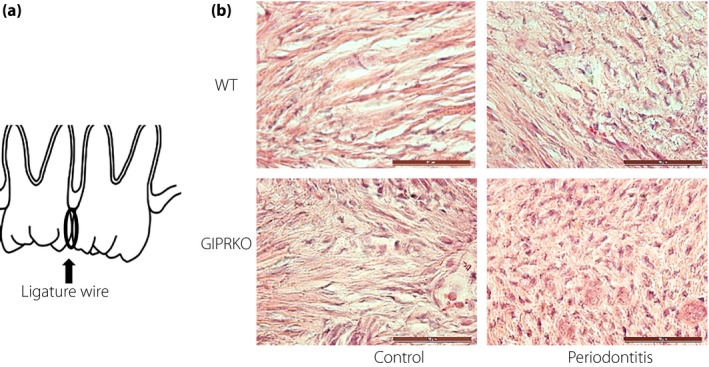
Experimental periodontitis was induced by ligature wire in GIPRKO and C57BL/C mice. Two weeks after the ligature, immunohistological evaluation and inflammatory messenger ribonucleic acid expression in the gingiva was examined. To elucidate the role of GIP in inflammation, the effects of GIP on lipopolysaccharide-induced gene expressions in THP-1 cells were evaluated.
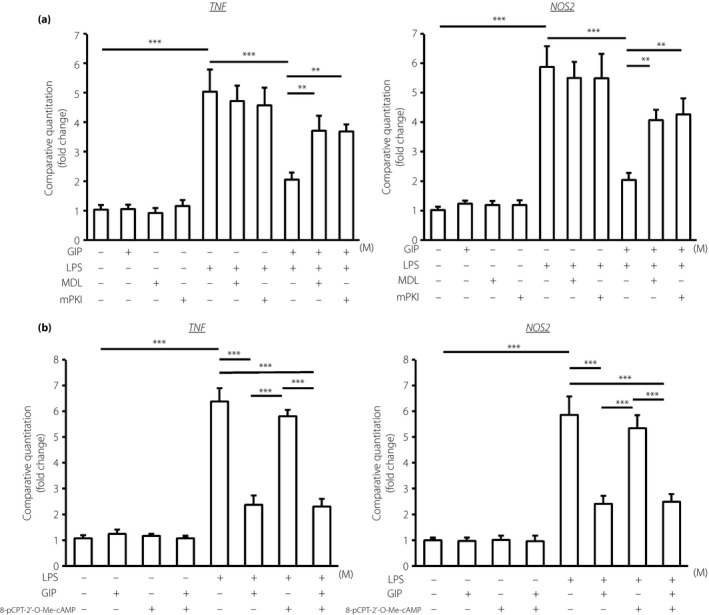
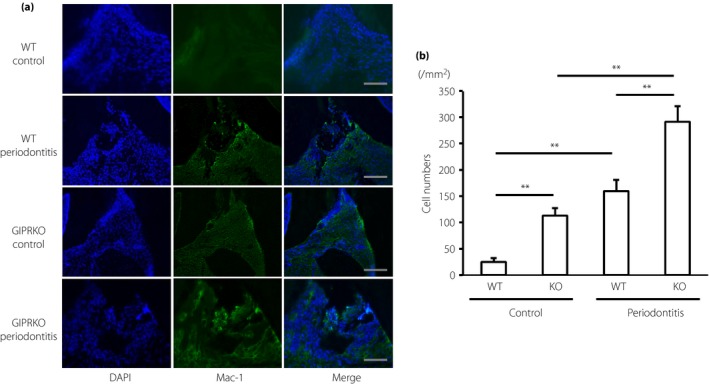
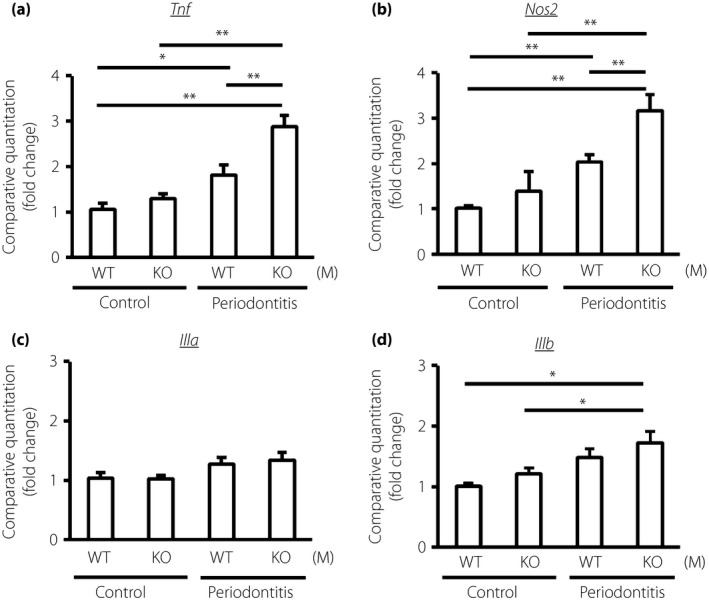
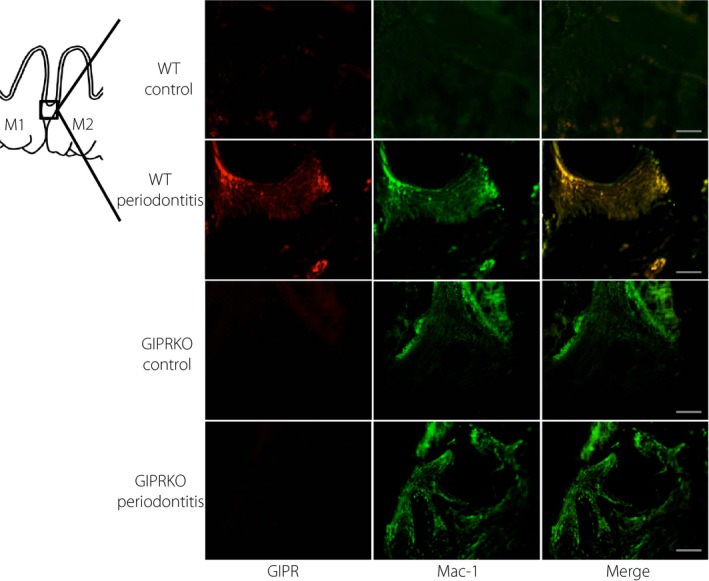
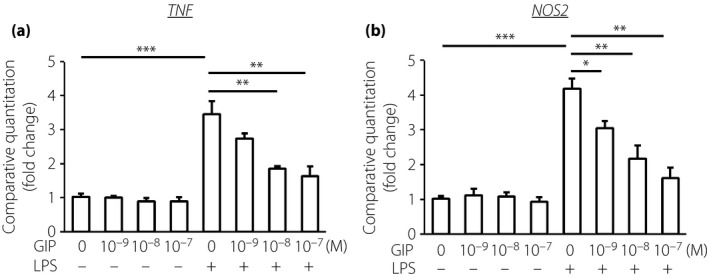
Periodontitis increased inflammatory cell infiltration, macrophage accumulation and tumor necrosis factor-α and nitric oxide synthase gene expressions in the gingiva. Periodontitis in GIPRKO showed a marked increase of inflammatory cells in the gingivomucosal tissue. Mac-1-positive macrophages and the inflammatory gene expressions were significantly increased in periodontitis in GIPRKO compared with C57BL/C mice periodontitis. Immunohistochemical staining confirmed that GIP receptors were expressed in residual and infiltrated Mac-1-positive macrophages. The in vitro study showed that GIP suppressed lipopolysaccharide-induced tumor necrosis factor-α and nitric oxide synthase gene expression in a dose-dependent manner. Furthermore, the inhibitory effect of GIP on lipopolysaccharide-induced inflammatory gene expressions was at least partially through cyclic adenosine monophosphate/protein kinase A pathway.
These results suggest the beneficial effects of GIP on periodontal disease. In diabetic patients, GIP is expected to have a direct anti-inflammatory effect on periodontitis in addition to its glucose-lowering effect.
目的/引言:探讨葡萄糖依赖性促胰岛素多肽(GIP)在动脉粥样硬化和脂肪组织炎症中的作用。牙周病是一种慢性炎症性疾病,被认为是糖尿病并发症之一。在本研究中,为了检测GIP对牙周炎的影响,我们在葡萄糖依赖性促胰岛素多肽受体敲除小鼠(GIPRKO)中诱导实验性牙周炎。我们还在培养系统中研究了GIP的抗炎作用。
通过结扎丝在GIPRKO和C57BL/C小鼠中诱导实验性牙周炎。结扎两周后,检查牙龈组织的免疫组织学评估和炎症信使核糖核酸表达。为了阐明GIP在炎症中的作用,评估了GIP对脂多糖诱导的THP-1细胞基因表达的影响。
牙周炎增加了牙龈组织中炎症细胞浸润、巨噬细胞聚集以及肿瘤坏死因子-α和一氧化氮合酶基因表达。GIPRKO小鼠的牙周炎在龈黏膜组织中显示出炎症细胞的显著增加。与C57BL/C小鼠牙周炎相比,GIPRKO小鼠牙周炎中Mac-1阳性巨噬细胞和炎症基因表达显著增加。免疫组织化学染色证实GIP受体在残留和浸润的Mac-1阳性巨噬细胞中表达。体外研究表明,GIP以剂量依赖性方式抑制脂多糖诱导的肿瘤坏死因子-α和一氧化氮合酶基因表达。此外,GIP对脂多糖诱导的炎症基因表达的抑制作用至少部分是通过环磷酸腺苷/蛋白激酶A途径。
这些结果表明GIP对牙周病具有有益作用。在糖尿病患者中,GIP除了具有降糖作用外,预计对牙周炎还具有直接的抗炎作用。