Kurtyka Karen, Nishikino Rie, Ito Chie, Brodovicz Kim, Chen Yong, Tunceli Kaan
Merck & Co., Inc., Kenilworth, New Jersey, USA.
Japan Medical Data Center, Tokyo, Japan.
J Diabetes Investig. 2016 Sep;7(5):737-43. doi: 10.1111/jdi.12474. Epub 2016 Feb 18.
AIMS/INTRODUCTION: Dipeptidyl peptidase-4 inhibitors (DPP-4i) are a common first-line treatment for type 2 diabetes in Japan. However, little is known about patients' medication adherence, persistence and discontinuation in this setting.
This was a retrospective cohort study of new DPP-4i users in a Japanese claims database. Adult patients (age 18-65 years) with type 2 diabetes diagnosis and no diagnosis of other diabetes or pregnancy during the study period were included if they were prescribed a DPP-4i as monotherapy or combination oral therapy. Adherence to therapy was measured using the proportion of days covered method over a fixed period of 1 year. The proportion of days covered of ≥80% was considered adherent. Persistence was defined as continuing index DPP-4i treatment with <90-day gap between refills. Patient baseline characteristics were explored as potential predictors of DPP-4i discontinuation and adherence in multivariable models.
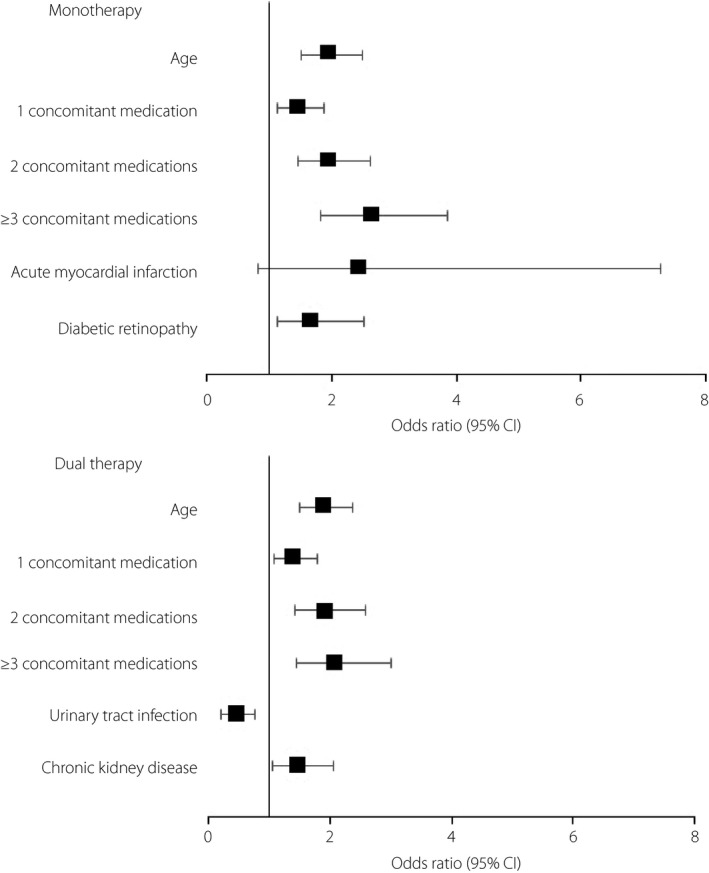
The final sample contained 2,874 monotherapy and 3,016 dual therapy patients. The mean age was approximately 51 years, and 75% were men. The mean proportion of days covered was 76.6% among monotherapy patients and 82.5% among dual therapy patients, with 67.2% of monotherapy and 74.4% of dual therapy patients classified as adherent. At 12 months, 72.2% of monotherapy and 79.2% of dual therapy patients were persistent. In adjusted models, younger age and having fewer concomitant medications were significantly associated with lower adherence and higher discontinuation, in both treatment groups.
Those under the age of 45 years, and those with fewer concomitant medications were less likely to be adherent and persistent, and more likely to discontinue DPP-4i therapy.
目的/引言:在日本,二肽基肽酶-4抑制剂(DPP-4i)是2型糖尿病常见的一线治疗药物。然而,关于患者在这种情况下的用药依从性、持续性和停药情况,人们了解甚少。
这是一项对日本索赔数据库中DPP-4i新使用者的回顾性队列研究。纳入在研究期间被诊断为2型糖尿病且未诊断出其他糖尿病或妊娠的成年患者(年龄18 - 65岁),前提是他们被处方使用DPP-4i作为单药治疗或联合口服治疗。通过在固定的1年期间使用覆盖天数比例法来衡量治疗依从性。覆盖天数比例≥80%被视为依从。持续性定义为持续使用索引DPP-4i治疗,且两次取药间隔<90天。在多变量模型中探索患者基线特征作为DPP-4i停药和依从性的潜在预测因素。
最终样本包括2874名单药治疗患者和3016名联合治疗患者。平均年龄约为51岁,75%为男性。单药治疗患者的平均覆盖天数比例为76.6%,联合治疗患者为82.5%,单药治疗患者中有67.2%、联合治疗患者中有74.4%被归类为依从。在12个月时,单药治疗患者中有72.2%、联合治疗患者中有79.2%持续用药。在调整模型中,两个治疗组中年龄较小和合并用药较少均与较低的依从性及较高的停药率显著相关。
45岁以下人群以及合并用药较少的人群依从性和持续性较低,更有可能停用DPP-4i治疗。