Nezami Brooke T, Lang Wei, Jakicic John M, Davis Kelliann K, Polzien Kristen, Rickman Amy D, Hatley Karen E, Tate Deborah F
Department of Health Behavior, Gillings School of Global Public Health, University of North Carolina at Chapel Hill.
Department of Biostatistical Sciences, Wake Forest University School of Medicine.
Health Psychol. 2016 Jul;35(7):714-722. doi: 10.1037/hea0000378. Epub 2016 May 16.
To determine whether eating self-efficacy (ESE) and physical activity self-efficacy (PASE) are predictive of dietary intake, physical activity, and weight change within a behavioral weight-loss intervention, and whether dietary intake and physical activity mediate relationships between self-efficacy and weight change.
The study sample included 246 participants from a randomized trial with complete data on study variables at 12 months. ESE, PASE, calories consumed, minutes of moderate-to-vigorous physical activity (MVPA), and weight were measured at baseline, 6, and 12 months.
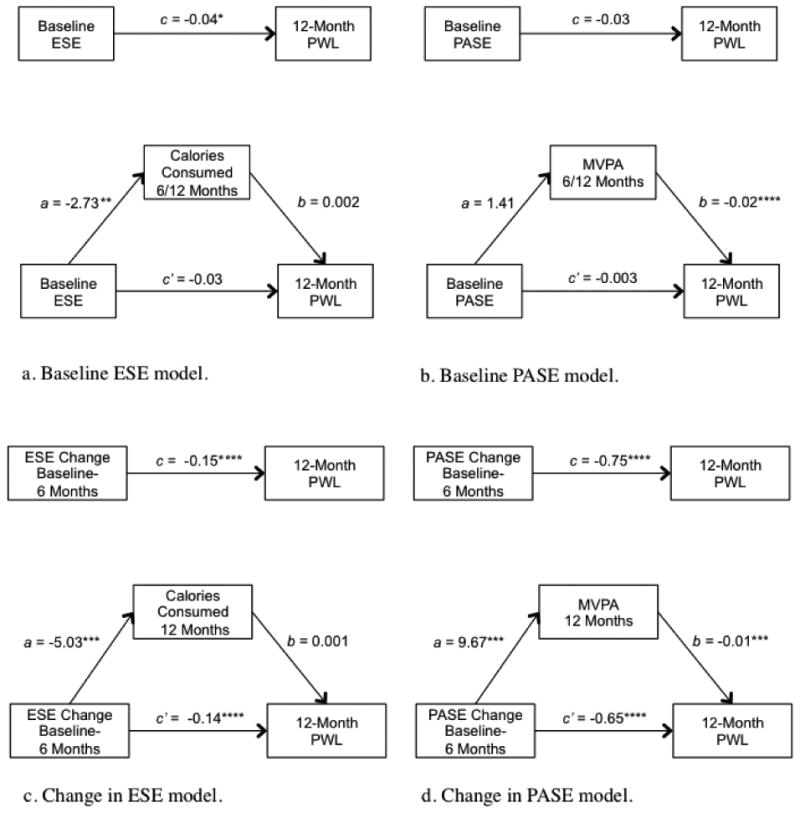
ESE at baseline was associated with 12-month percent weight loss (PWL), and was mediated by average calories consumed at 6 and 12 months. Change in ESE from baseline to 6 months was associated with calories consumed at 12 months and 12-month percent weight loss, but the mediated relationship was not significant. Baseline PASE was not associated with average MVPA at 6 and 12 months or 12-month PWL, but change in PASE from baseline to 6 months was associated with 12-month PWL through its effect on MVPA at 12 months.
Increases in ESE and PASE during the active phase of the intervention are predictive of dietary intake, physical activity and weight loss at later points, but further research should include explorations of the reciprocal relationship between behavior and self-efficacy to better inform intervention strategies that target self-efficacy and promote behavior change. (PsycINFO Database Record (c) 2016 APA, all rights reserved).
确定饮食自我效能(ESE)和身体活动自我效能(PASE)是否能预测行为减肥干预中的饮食摄入、身体活动和体重变化,以及饮食摄入和身体活动是否介导自我效能与体重变化之间的关系。
研究样本包括来自一项随机试验的246名参与者,他们在12个月时拥有关于研究变量的完整数据。在基线、6个月和12个月时测量ESE、PASE、消耗的卡路里、中度至剧烈身体活动(MVPA)的分钟数和体重。
基线时的ESE与12个月时的体重减轻百分比(PWL)相关,并由6个月和12个月时的平均卡路里摄入量介导。从基线到6个月ESE的变化与12个月时消耗的卡路里和12个月时的体重减轻百分比相关,但介导关系不显著。基线PASE与6个月和12个月时的平均MVPA或12个月时的PWL无关,但从基线到6个月PASE的变化通过其对12个月时MVPA的影响与12个月时的PWL相关。
干预活跃期ESE和PASE的增加可预测后期的饮食摄入、身体活动和体重减轻,但进一步的研究应包括探索行为与自我效能之间的相互关系,以便更好地为针对自我效能并促进行为改变的干预策略提供信息。(PsycINFO数据库记录(c)2016美国心理学会,保留所有权利)