Sada Aiko, Jacob Fadi, Leung Eva, Wang Sherry, White Brian S, Shalloway David, Tumbar Tudorita
Department of Molecular Biology and Genetics, Cornell University, Ithaca, New York 14853, USA.
Division of Oncology, Department of Medicine, Washington University, St Louis, Missouri 63110, USA.
Nat Cell Biol. 2016 Jun;18(6):619-31. doi: 10.1038/ncb3359. Epub 2016 May 16.
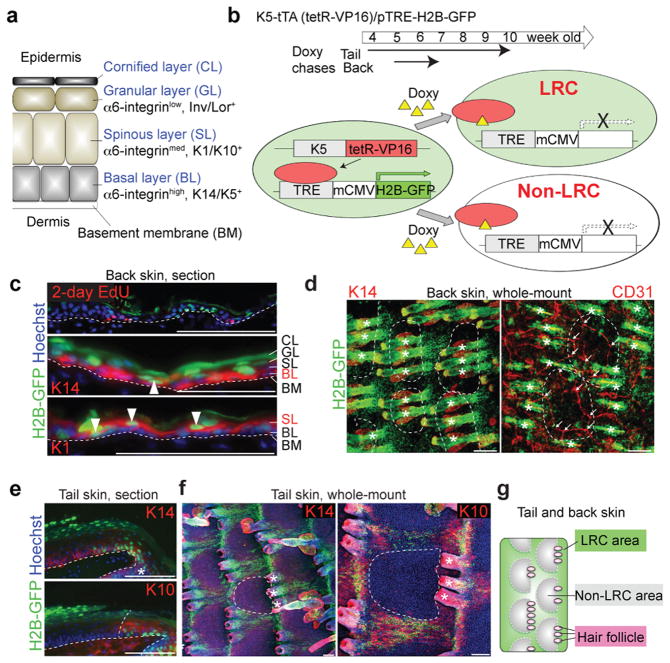
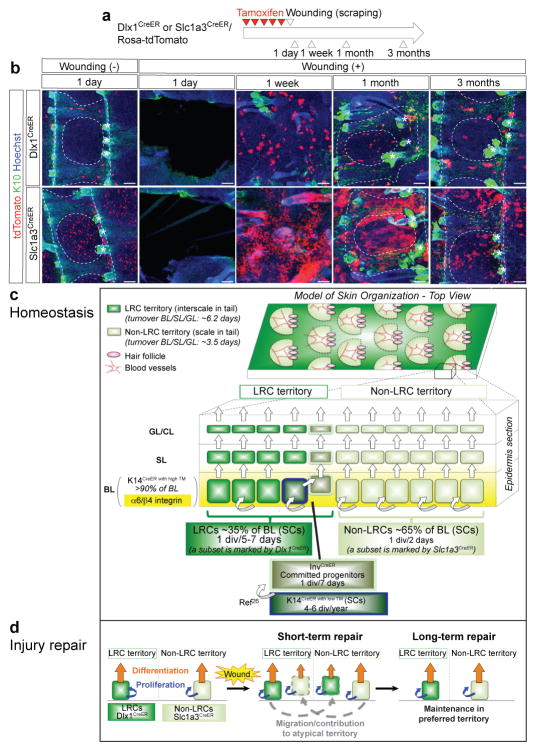
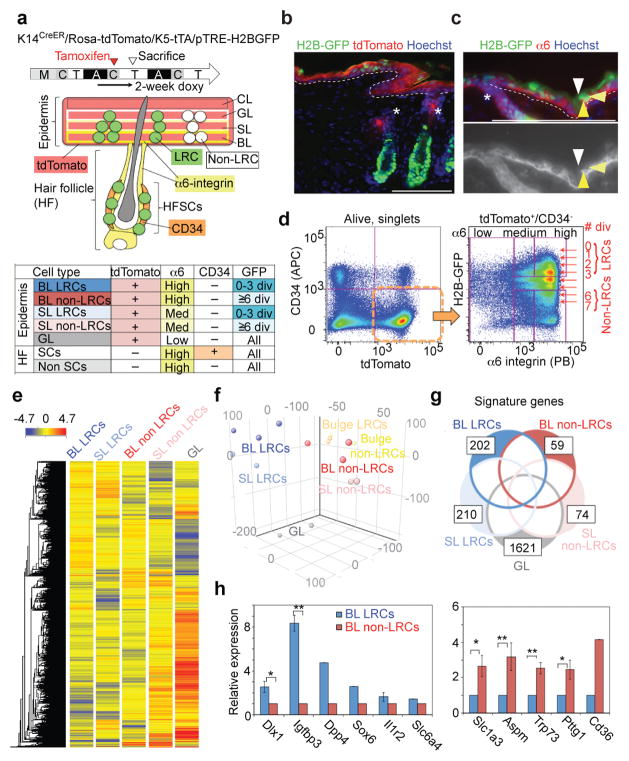
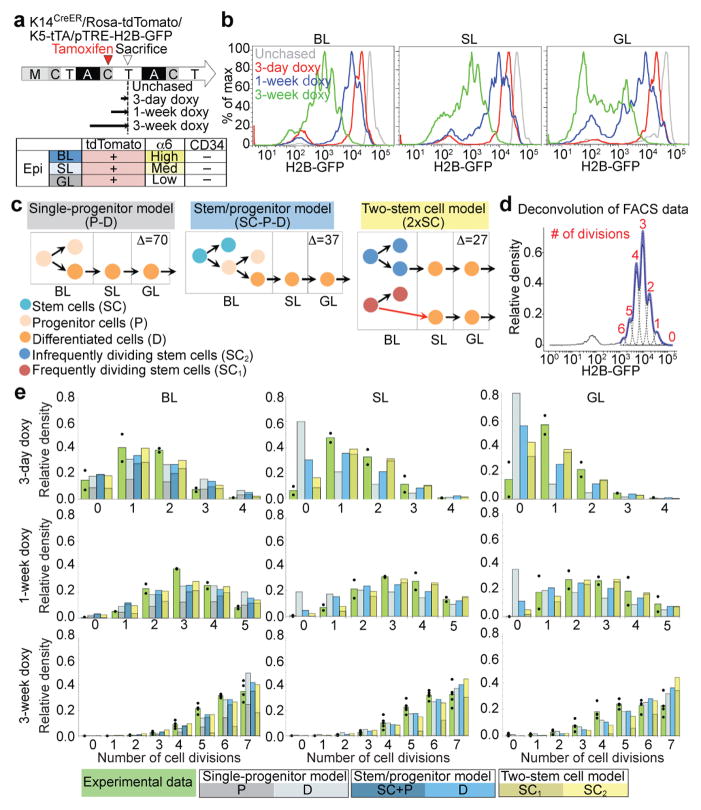
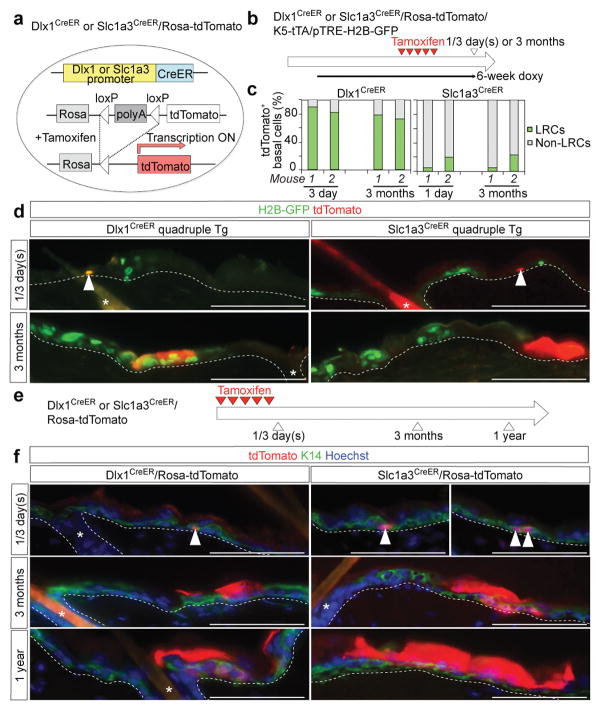
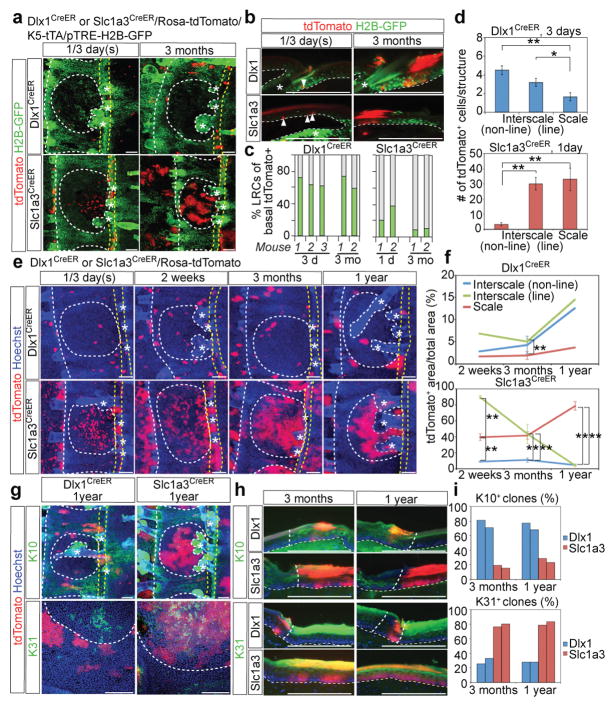
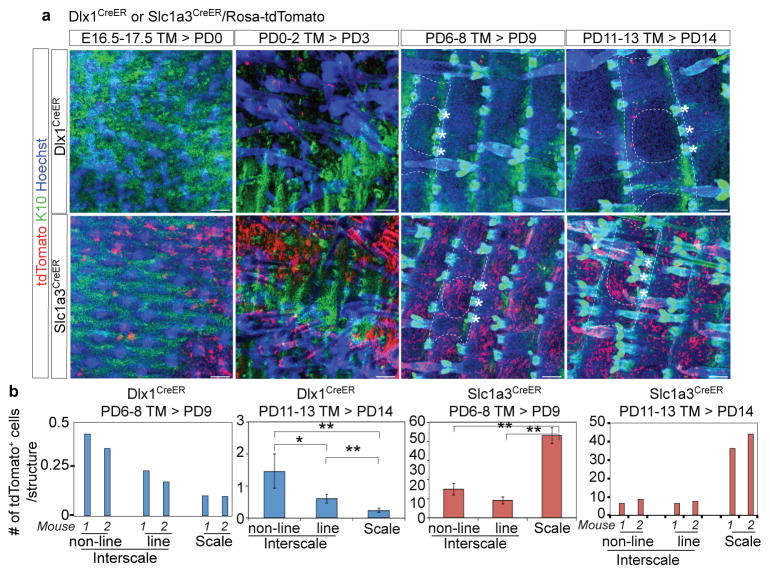
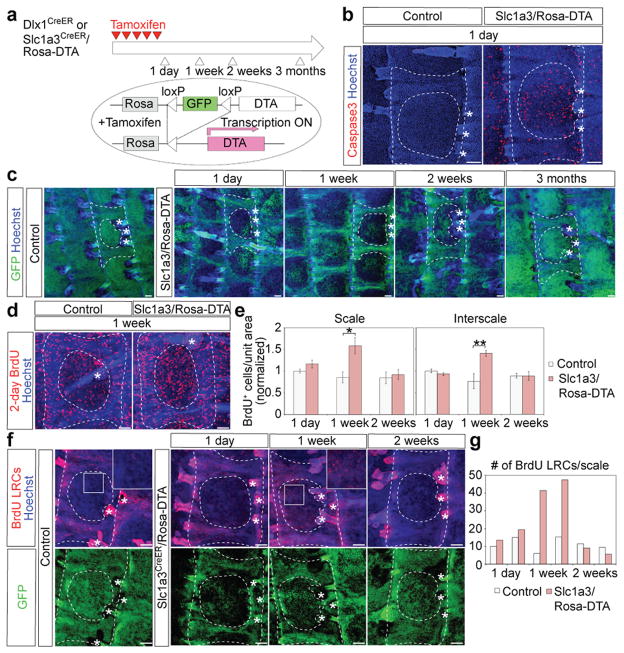
The interfollicular epidermis regenerates from heterogeneous basal skin cell populations that divide at different rates. It has previously been presumed that infrequently dividing basal cells known as label-retaining cells (LRCs) are stem cells, whereas non-LRCs are short-lived progenitors. Here we employ the H2B-GFP pulse-chase system in adult mouse skin and find that epidermal LRCs and non-LRCs are molecularly distinct and can be differentiated by Dlx1(CreER) and Slc1a3(CreER) genetic marking, respectively. Long-term lineage tracing and mathematical modelling of H2B-GFP dilution data show that LRCs and non-LRCs constitute two distinct stem cell populations with different patterns of proliferation, differentiation and upward cellular transport. During homeostasis, these populations are enriched in spatially distinct skin territories and can preferentially produce unique differentiated lineages. On wounding or selective killing, they can temporarily replenish each other's territory. These two discrete interfollicular stem cell populations are functionally interchangeable and intrinsically well adapted to thrive in distinct skin environments.
毛囊间表皮由以不同速率分裂的异质性基底皮肤细胞群体再生而来。以前人们推测,很少分裂的基底细胞,即所谓的标记保留细胞(LRCs)是干细胞,而非LRCs是寿命短暂的祖细胞。在此,我们在成年小鼠皮肤中采用H2B-GFP脉冲追踪系统,发现表皮LRCs和非LRCs在分子上是不同的,并且可以分别通过Dlx1(CreER)和Slc1a3(CreER)基因标记来区分。对H2B-GFP稀释数据的长期谱系追踪和数学建模表明,LRCs和非LRCs构成了两个不同的干细胞群体,它们具有不同的增殖、分化和向上细胞转运模式。在稳态期间,这些群体在空间上不同的皮肤区域富集,并且可以优先产生独特的分化谱系。在受伤或选择性杀伤时,它们可以暂时补充彼此的区域。这两个离散的毛囊间干细胞群体在功能上是可互换的,并且在本质上很好地适应在不同的皮肤环境中茁壮成长。