Department of Medicine Division of Endocrinology University of Wisconsin-Madison Madison Wisconsin USA.
Department of MedicineDivision of EndocrinologyUniversity of Wisconsin-MadisonMadisonWisconsinUSA; William S Middleton Memorial Veterans HospitalMadisonWisconsinUSA.
J Diabetes Investig. 2016 Apr;7 Suppl 1(Suppl 1):44-9. doi: 10.1111/jdi.12465. Epub 2016 Mar 14.
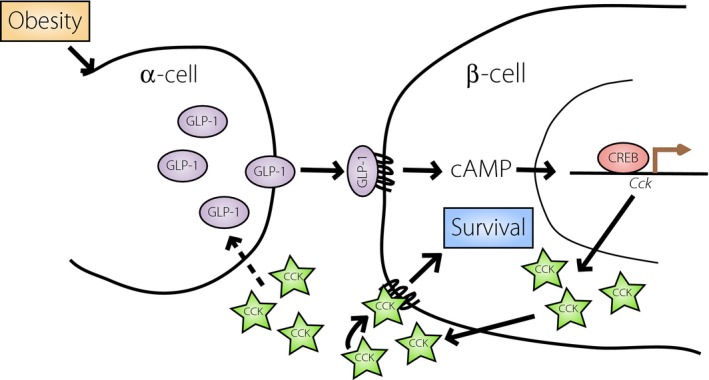
Precise control of blood glucose is dependent on adequate β-cell mass and function. Thus, reductions in β-cell mass and function lead to insufficient insulin production to meet demand, and result in diabetes. Recent evidence suggests that paracrine signaling in the islet might be important in obesity, and disruption of this signaling could play a role in the pathogenesis of diabetes. For example, we recently discovered a novel islet incretin axis where glucagon-like peptide-1 regulates β-cell production of another classic gut hormone, cholecystokinin. This axis is stimulated by obesity, and plays a role in enhancing β-cell survival. In the present review, we place our observations in the wider context of the literature on incretin regulation in the islet, and discuss the potential for therapeutic targeting of these pathways.
血糖的精确控制依赖于足够的β细胞数量和功能。因此,β细胞数量和功能的减少会导致胰岛素产生不足以满足需求,从而导致糖尿病。最近的证据表明,胰岛中的旁分泌信号可能在肥胖中很重要,而这种信号的中断可能在糖尿病的发病机制中发挥作用。例如,我们最近发现了一个新的胰岛肠促胰岛素轴,其中胰高血糖素样肽-1调节β细胞产生另一种经典的肠道激素胆囊收缩素。该轴受肥胖刺激,并在增强β细胞存活方面发挥作用。在本综述中,我们将我们的观察结果置于胰岛肠促胰岛素调节的文献更广泛的背景下,并讨论了针对这些途径的治疗靶向的潜力。