• 文献检索
  • 文档翻译
  • 深度研究
  • 学术资讯
  • Suppr Zotero 插件Zotero 插件
  • 邀请有礼
  • 套餐&价格
  • 历史记录
应用&插件
Suppr Zotero 插件Zotero 插件浏览器插件Mac 客户端Windows 客户端微信小程序
定价
高级版会员购买积分包购买API积分包
服务
文献检索文档翻译深度研究API 文档MCP 服务
关于我们
关于 Suppr公司介绍联系我们用户协议隐私条款
关注我们

Suppr 超能文献

核心技术专利:CN118964589B侵权必究
粤ICP备2023148730 号-1Suppr @ 2026

文献检索

告别复杂PubMed语法,用中文像聊天一样搜索,搜遍4000万医学文献。AI智能推荐,让科研检索更轻松。

立即免费搜索

文件翻译

保留排版,准确专业,支持PDF/Word/PPT等文件格式,支持 12+语言互译。

免费翻译文档

深度研究

AI帮你快速写综述,25分钟生成高质量综述,智能提取关键信息,辅助科研写作。

立即免费体验

使用基于群体的轨迹分析在CHARTER队列的HIV阳性参与者中识别36个月时的神经认知衰退。

Identifying Neurocognitive Decline at 36 Months among HIV-Positive Participants in the CHARTER Cohort Using Group-Based Trajectory Analysis.

作者信息

Brouillette Marie-Josée, Yuen Tracy, Fellows Lesley K, Cysique Lucette A, Heaton Robert K, Mayo Nancy E

机构信息

Department of Psychiatry, McGill University, McGill University Health Centre, Montreal, Canada.

Institute of Health Policy, Management and Evaluation, University of Toronto, Toronto, Canada.

出版信息

PLoS One. 2016 May 18;11(5):e0155766. doi: 10.1371/journal.pone.0155766. eCollection 2016.

DOI:10.1371/journal.pone.0155766
PMID:27191850
原文链接:https://pmc.ncbi.nlm.nih.gov/articles/PMC4871455/
Abstract

INTRODUCTION

While HIV-associated neurocognitive impairment remains common despite the widespread use of combined antiretroviral therapy (cART), there have been relatively few studies investigating the trajectories of neurocognitive change in longitudinal NeuroAIDS studies.

OBJECTIVE

To estimate the magnitude and pattern of neurocognitive change over the first 3 years of follow-up using Group-Based Trajectory Analysis (GBTA) applied to participants in the longitudinal arm of the CHARTER cohort.

METHOD

The study population consisted of 701 CHARTER participants who underwent neuropsychological (NP) testing on at least 2 occasions. Raw test scores on 15 NP measures were modeled using GBTA. Each trajectory was categorized as stable, improved or declined, according to two different criteria for change (whether the magnitude of the estimated change at 36 months differed ≥ 0.5 standard deviations from baseline value or changed by > the standard error of measurement estimated at times 1 and 2). Individuals who declined on one or more NP measures were categorized as decliners.

RESULTS

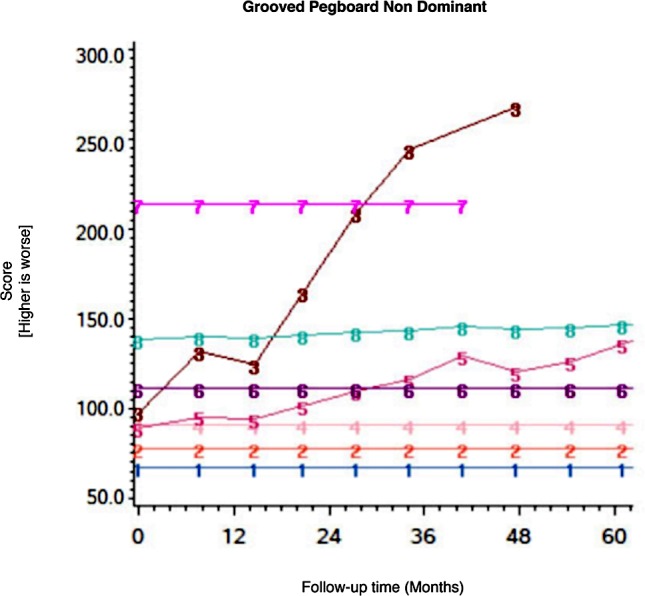
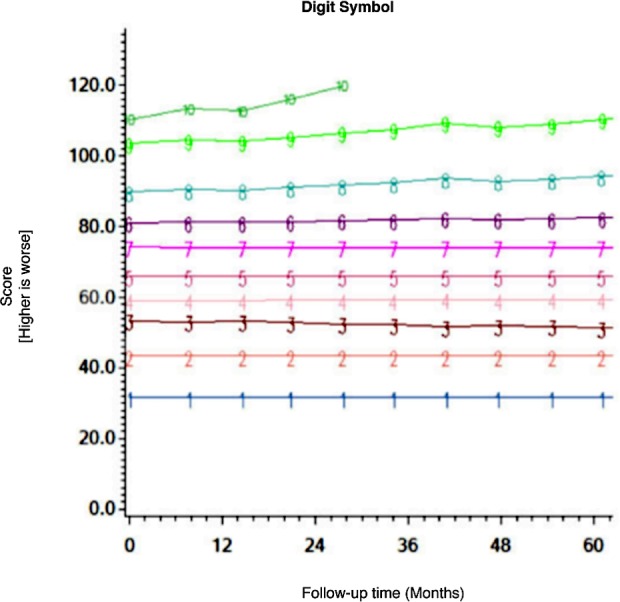
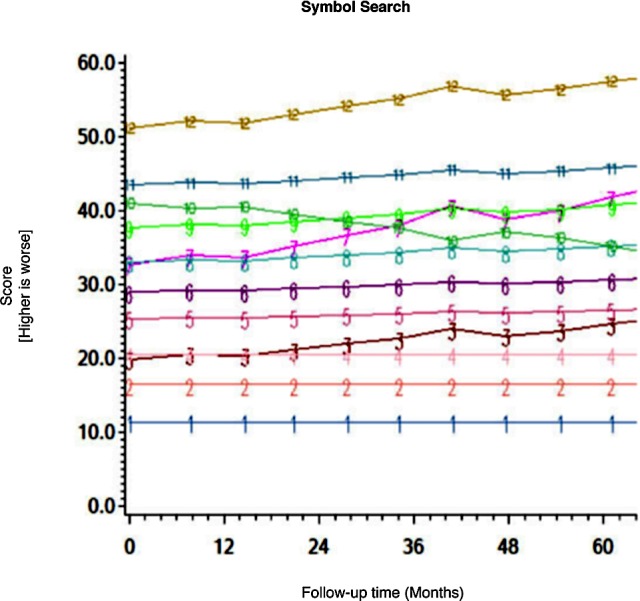
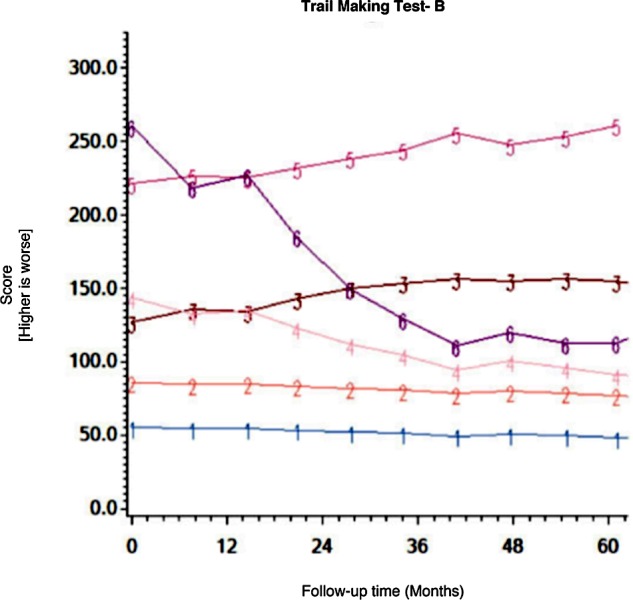
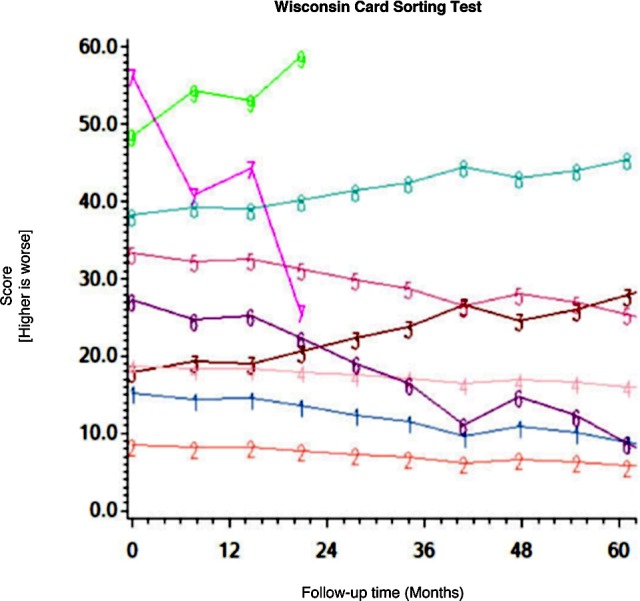
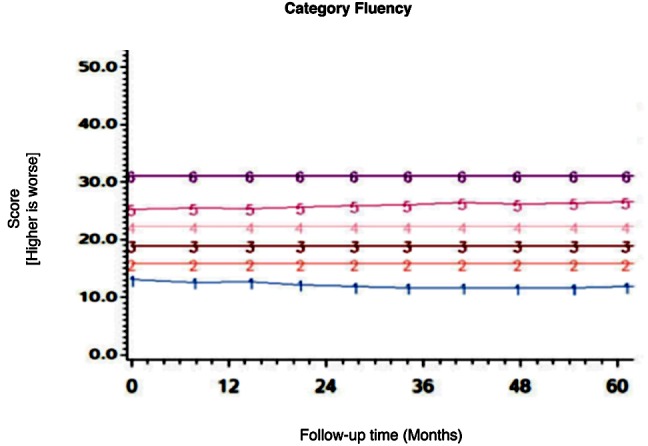
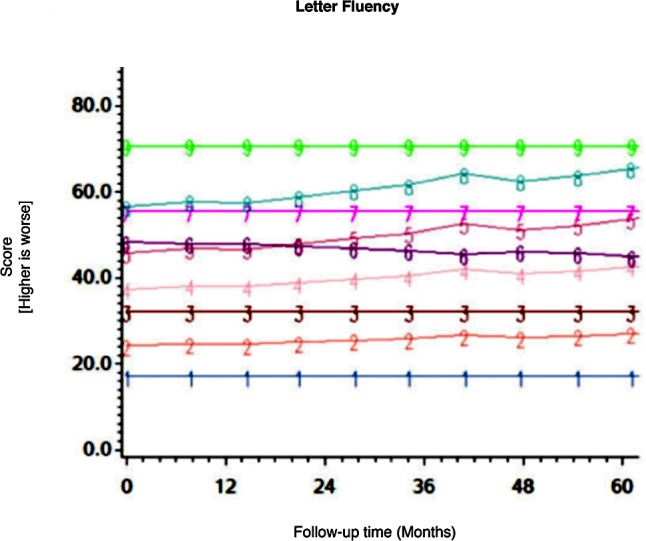
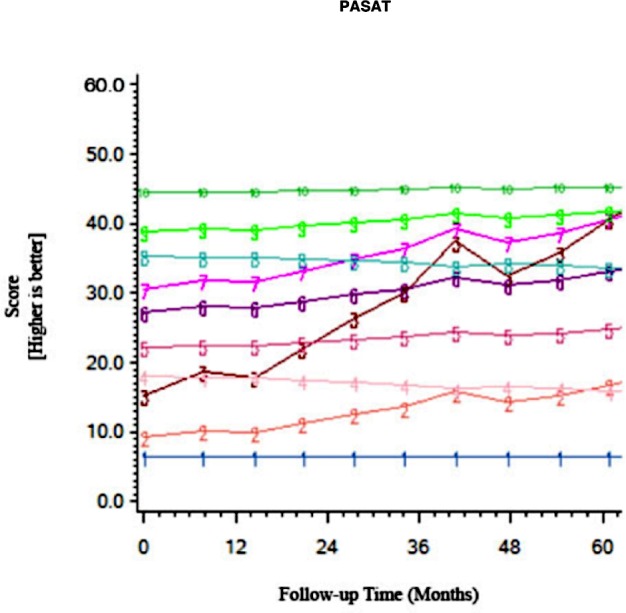
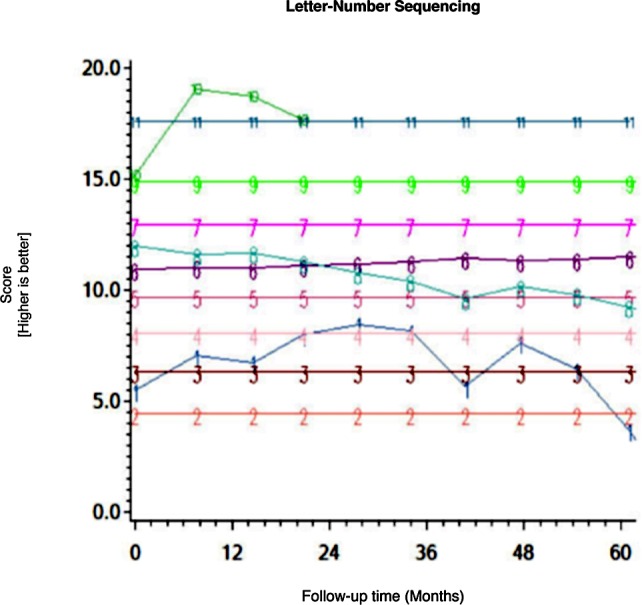
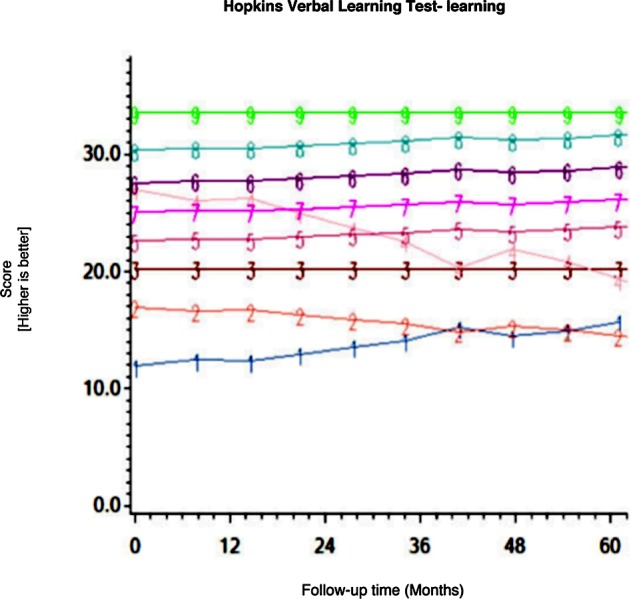
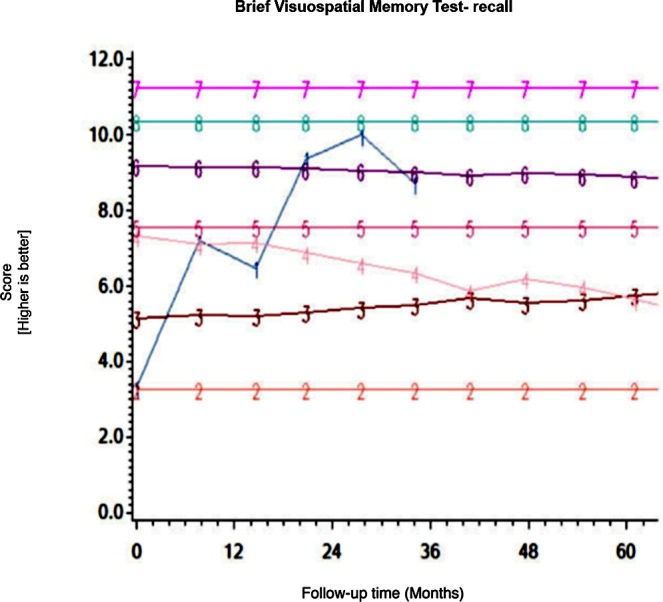
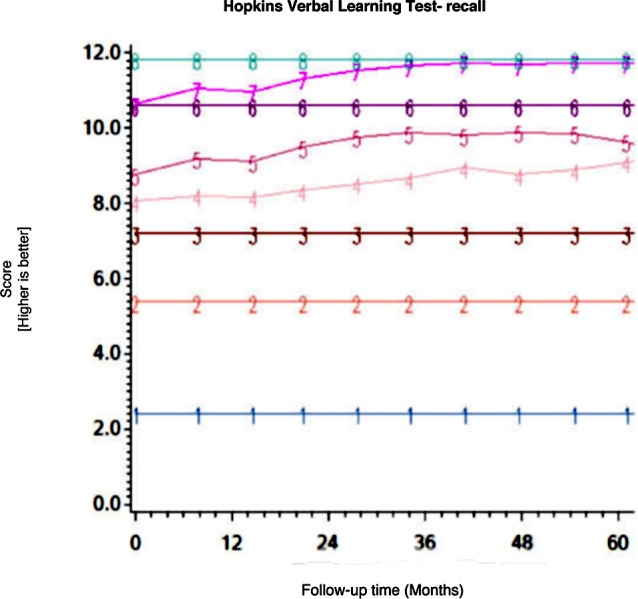
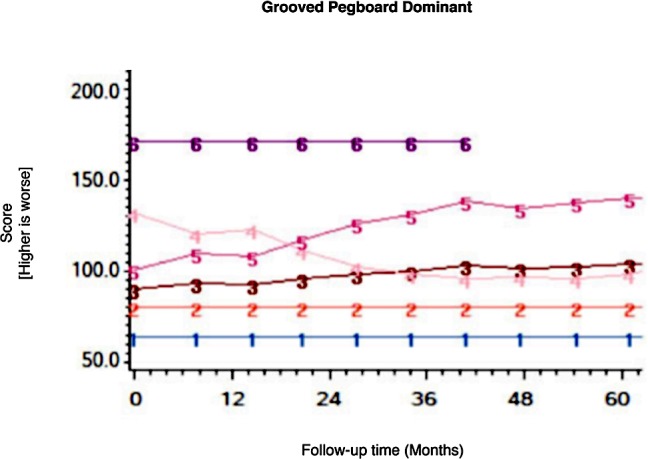
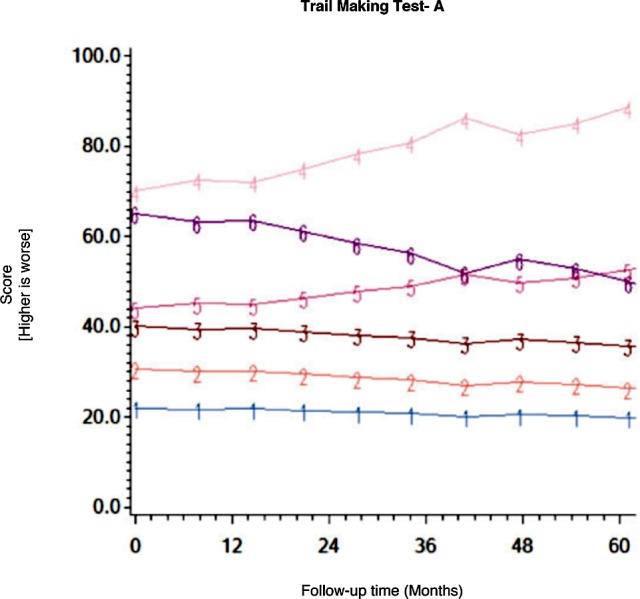
Overall, 111 individuals (15.8%) declined on at least one NP test over 36 months, with the vast majority showing decline on a single NP test (93/111-83.8%). The posterior probability of group assignment was high in most participants (71%) after only 2 sessions, and in the overwhelming majority of those with 3+ sessions. Heterogeneity of trajectories was the norm rather than the exception. Individuals who declined had, on average, worse baseline NP performance on every test, were older, had a longer duration of HIV infection and more follow-up sessions.

CONCLUSION

The present study identified heterogeneous trajectories over 3 years across 15 NP raw test scores using GBTA. Cognitive decline was observed in only a small subset of this study cohort. Decliners had demographics and HIV characteristics that have been previously associated with cognitive decline, suggesting clinical validity for the method.

摘要

引言

尽管联合抗逆转录病毒疗法(cART)已广泛应用,但与HIV相关的神经认知障碍仍然很常见,在纵向神经艾滋病研究中,对神经认知变化轨迹进行调查的研究相对较少。

目的

使用基于群体的轨迹分析(GBTA)对CHARTER队列纵向研究中的参与者进行随访,以估计随访前3年神经认知变化的程度和模式。

方法

研究人群包括701名CHARTER参与者,他们至少接受了2次神经心理学(NP)测试。使用GBTA对15项NP测量的原始测试分数进行建模。根据两种不同的变化标准(36个月时估计变化的幅度与基线值相差是否≥0.5标准差或变化是否大于在第1次和第2次测量时估计的测量标准误差),将每个轨迹分类为稳定、改善或下降。在一项或多项NP测量中出现下降的个体被归类为下降者。

结果

总体而言,111名个体(15.8%)在36个月内至少有一项NP测试出现下降,绝大多数仅在一项NP测试中出现下降(93/111 - 83.8%)。在仅进行2次测试后,大多数参与者(71%)以及绝大多数进行了3次及以上测试的参与者,其分组分配的后验概率都很高。轨迹的异质性是常态而非例外。下降者平均在每项测试中的基线NP表现更差,年龄更大,HIV感染持续时间更长,随访次数更多。

结论

本研究使用GBTA在3年时间内对15项NP原始测试分数确定了异质轨迹。在该研究队列中仅观察到一小部分人出现认知下降。下降者具有先前与认知下降相关的人口统计学和HIV特征,表明该方法具有临床有效性。
https://cdn.ncbi.nlm.nih.gov/pmc/blobs/b45b/4871455/8fc669eb8ebf/pone.0155766.g015.jpg
https://cdn.ncbi.nlm.nih.gov/pmc/blobs/b45b/4871455/2f8f7a52b23f/pone.0155766.g001.jpg
https://cdn.ncbi.nlm.nih.gov/pmc/blobs/b45b/4871455/314cbf5ff6bb/pone.0155766.g002.jpg
https://cdn.ncbi.nlm.nih.gov/pmc/blobs/b45b/4871455/a898cbcdb81c/pone.0155766.g003.jpg
https://cdn.ncbi.nlm.nih.gov/pmc/blobs/b45b/4871455/a2efbf904880/pone.0155766.g004.jpg
https://cdn.ncbi.nlm.nih.gov/pmc/blobs/b45b/4871455/5762d233c8f1/pone.0155766.g005.jpg
https://cdn.ncbi.nlm.nih.gov/pmc/blobs/b45b/4871455/80484a5f6e7a/pone.0155766.g006.jpg
https://cdn.ncbi.nlm.nih.gov/pmc/blobs/b45b/4871455/8ba9fc24c8bf/pone.0155766.g007.jpg
https://cdn.ncbi.nlm.nih.gov/pmc/blobs/b45b/4871455/5decc9de1e4b/pone.0155766.g008.jpg
https://cdn.ncbi.nlm.nih.gov/pmc/blobs/b45b/4871455/80fb3189f570/pone.0155766.g009.jpg
https://cdn.ncbi.nlm.nih.gov/pmc/blobs/b45b/4871455/f8aadd4468c1/pone.0155766.g010.jpg
https://cdn.ncbi.nlm.nih.gov/pmc/blobs/b45b/4871455/b2e8ffd362de/pone.0155766.g011.jpg
https://cdn.ncbi.nlm.nih.gov/pmc/blobs/b45b/4871455/5096cfb882ed/pone.0155766.g012.jpg
https://cdn.ncbi.nlm.nih.gov/pmc/blobs/b45b/4871455/fad5e0ff6b08/pone.0155766.g013.jpg
https://cdn.ncbi.nlm.nih.gov/pmc/blobs/b45b/4871455/e35103bcf3d0/pone.0155766.g014.jpg
https://cdn.ncbi.nlm.nih.gov/pmc/blobs/b45b/4871455/8fc669eb8ebf/pone.0155766.g015.jpg
https://cdn.ncbi.nlm.nih.gov/pmc/blobs/b45b/4871455/2f8f7a52b23f/pone.0155766.g001.jpg
https://cdn.ncbi.nlm.nih.gov/pmc/blobs/b45b/4871455/314cbf5ff6bb/pone.0155766.g002.jpg
https://cdn.ncbi.nlm.nih.gov/pmc/blobs/b45b/4871455/a898cbcdb81c/pone.0155766.g003.jpg
https://cdn.ncbi.nlm.nih.gov/pmc/blobs/b45b/4871455/a2efbf904880/pone.0155766.g004.jpg
https://cdn.ncbi.nlm.nih.gov/pmc/blobs/b45b/4871455/5762d233c8f1/pone.0155766.g005.jpg
https://cdn.ncbi.nlm.nih.gov/pmc/blobs/b45b/4871455/80484a5f6e7a/pone.0155766.g006.jpg
https://cdn.ncbi.nlm.nih.gov/pmc/blobs/b45b/4871455/8ba9fc24c8bf/pone.0155766.g007.jpg
https://cdn.ncbi.nlm.nih.gov/pmc/blobs/b45b/4871455/5decc9de1e4b/pone.0155766.g008.jpg
https://cdn.ncbi.nlm.nih.gov/pmc/blobs/b45b/4871455/80fb3189f570/pone.0155766.g009.jpg
https://cdn.ncbi.nlm.nih.gov/pmc/blobs/b45b/4871455/f8aadd4468c1/pone.0155766.g010.jpg
https://cdn.ncbi.nlm.nih.gov/pmc/blobs/b45b/4871455/b2e8ffd362de/pone.0155766.g011.jpg
https://cdn.ncbi.nlm.nih.gov/pmc/blobs/b45b/4871455/5096cfb882ed/pone.0155766.g012.jpg
https://cdn.ncbi.nlm.nih.gov/pmc/blobs/b45b/4871455/fad5e0ff6b08/pone.0155766.g013.jpg
https://cdn.ncbi.nlm.nih.gov/pmc/blobs/b45b/4871455/e35103bcf3d0/pone.0155766.g014.jpg
https://cdn.ncbi.nlm.nih.gov/pmc/blobs/b45b/4871455/8fc669eb8ebf/pone.0155766.g015.jpg

相似文献

1
Identifying Neurocognitive Decline at 36 Months among HIV-Positive Participants in the CHARTER Cohort Using Group-Based Trajectory Analysis.使用基于群体的轨迹分析在CHARTER队列的HIV阳性参与者中识别36个月时的神经认知衰退。
PLoS One. 2016 May 18;11(5):e0155766. doi: 10.1371/journal.pone.0155766. eCollection 2016.
2
Properties of a brief assessment tool for longitudinal measurement of cognition in people living with HIV.用于评估艾滋病毒感染者认知功能纵向变化的简易评估工具的特性。
PLoS One. 2019 Mar 25;14(3):e0213908. doi: 10.1371/journal.pone.0213908. eCollection 2019.
3
Determining optimal impairment rating methodology for a new HIV-associated neurocognitive disorder screening procedure.确定一种用于新型HIV相关神经认知障碍筛查程序的最佳损伤评级方法。
J Clin Exp Neuropsychol. 2017 Oct;39(8):753-767. doi: 10.1080/13803395.2016.1263282. Epub 2017 Jan 4.
4
Cognitive change trajectories in virally suppressed HIV-infected individuals indicate high prevalence of disease activity.病毒抑制的HIV感染者的认知变化轨迹表明疾病活动的高患病率。
PLoS One. 2017 Mar 6;12(3):e0171887. doi: 10.1371/journal.pone.0171887. eCollection 2017.
5
Cognitive performance after progression to AIDS: a longitudinal study from the Multicenter AIDS Cohort Study.
Neurology. 1995 Feb;45(2):267-75. doi: 10.1212/wnl.45.2.267.
6
Personalized Risk Index for Neurocognitive Decline Among People With Well-Controlled HIV Infection.HIV感染控制良好者神经认知功能下降的个性化风险指数
J Acquir Immune Defic Syndr. 2017 Sep 1;76(1):48-54. doi: 10.1097/QAI.0000000000001466.
7
The Veterans Aging Cohort Study (VACS) Index and Neurocognitive Change: A Longitudinal Study.退伍军人衰老队列研究(VACS)指数与神经认知变化:一项纵向研究。
Clin Infect Dis. 2016 Sep 1;63(5):694-702. doi: 10.1093/cid/ciw328. Epub 2016 May 19.
8
A decreasing CD4/CD8 ratio over time and lower CSF-penetrating antiretroviral regimens are associated with a higher risk of neurocognitive deterioration, independently of viral replication.随着时间推移CD4/CD8比值降低以及脑脊液穿透性较低的抗逆转录病毒治疗方案与神经认知功能恶化风险较高相关,与病毒复制无关。
J Neurovirol. 2017 Apr;23(2):216-225. doi: 10.1007/s13365-016-0490-z. Epub 2016 Nov 4.
9
Dynamics of cognitive change in impaired HIV-positive patients initiating antiretroviral therapy.开始抗逆转录病毒治疗的HIV阳性受损患者认知变化的动态
Neurology. 2009 Aug 4;73(5):342-8. doi: 10.1212/WNL.0b013e3181ab2b3b. Epub 2009 May 27.
10
Asymptomatic neurocognitive impairment is a risk for symptomatic decline over a 3-year study period.无症状性神经认知障碍是 3 年研究期间出现症状性下降的风险。
AIDS. 2021 Jan 1;35(1):63-72. doi: 10.1097/QAD.0000000000002709.

引用本文的文献

1
Dual Trajectories of Serum Brain-Derived Neurotrophic Factor and Cognitive Function in People Living with HIV.HIV感染者血清脑源性神经营养因子与认知功能的双重轨迹
Res Sq. 2025 Apr 14:rs.3.rs-4307577. doi: 10.21203/rs.3.rs-4307577/v1.
2
Dual trajectories of serum brain-derived neurotrophic factor and cognitive function in people living with HIV.HIV感染者血清脑源性神经营养因子与认知功能的双重轨迹
Sci Rep. 2025 May 3;15(1):15520. doi: 10.1038/s41598-025-99569-6.
3
Sex-specific associations between cerebrospinal fluid inflammatory biomarkers and cognition in antiretroviral-naïve people with HIV in rural Uganda.

本文引用的文献

1
Prevalence of HIV-associated neurocognitive disorders in the Multicenter AIDS Cohort Study.多中心艾滋病队列研究中与HIV相关的神经认知障碍的患病率。
Neurology. 2016 Jan 26;86(4):334-40. doi: 10.1212/WNL.0000000000002277. Epub 2015 Dec 30.
2
Neurocognitive deficits increase risk of poor retention in care among older adults with newly diagnosed HIV infection.神经认知缺陷会增加新诊断出感染艾滋病毒的老年人护理依从性差的风险。
AIDS. 2015 Aug 24;29(13):1711-4. doi: 10.1097/QAD.0000000000000700.
3
Neurocognitive change in the era of HIV combination antiretroviral therapy: the longitudinal CHARTER study.
乌干达农村地区未接受抗逆转录病毒治疗的HIV感染者中,脑脊液炎症生物标志物与认知之间的性别特异性关联。
Brain Behav Immun. 2025 Mar;125:1-8. doi: 10.1016/j.bbi.2024.12.012. Epub 2024 Dec 10.
4
Central Nervous System Effects of Early HIV Infection and Consequences of Antiretroviral Therapy Initiation during Acute HIV.早期 HIV 感染对中枢神经系统的影响及急性 HIV 感染时开始抗逆转录病毒治疗的后果。
Viruses. 2024 Jul 5;16(7):1082. doi: 10.3390/v16071082.
5
Cocaine use is associated with cerebral white matter hyperintensities in HIV disease.可卡因使用与 HIV 疾病中的脑白质高信号有关。
Ann Clin Transl Neurol. 2023 Sep;10(9):1633-1646. doi: 10.1002/acn3.51854. Epub 2023 Jul 20.
6
CCL2 is required for initiation but not persistence of HIV infection mediated neurocognitive disease in mice.CCL2 对于介导 HIV 感染所致神经认知疾病的启动而非持续至关重要。
Sci Rep. 2023 Apr 21;13(1):6577. doi: 10.1038/s41598-023-33491-7.
7
Cognitive Health in Persons With Human Immunodeficiency Virus: The Impact of Early Treatment, Comorbidities, and Aging.感染人类免疫缺陷病毒者的认知健康:早期治疗、合并症及衰老的影响
J Infect Dis. 2023 Mar 17;227(Suppl 1):S38-S47. doi: 10.1093/infdis/jiac388.
8
Meaningful cognitive decline is uncommon in virally suppressed HIV, but sustained impairment, subtle decline and abnormal cognitive aging are not.在病毒得到抑制的艾滋病病毒感染者中,有意义的认知能力下降并不常见,但持续性损伤、细微下降和认知老化异常则并非罕见。
EClinicalMedicine. 2022 Dec 26;56:101792. doi: 10.1016/j.eclinm.2022.101792. eCollection 2023 Feb.
9
Identification of Youthful Neurocognitive Trajectories in Adults Aging with HIV: A Latent Growth Mixture Model.识别伴有 HIV 的成人衰老过程中的青少年神经认知轨迹:潜在增长混合模型。
AIDS Behav. 2022 Jun;26(6):1966-1979. doi: 10.1007/s10461-021-03546-9. Epub 2021 Dec 8.
10
A Meta-Analytic Review of the Effect of Antiretroviral Therapy on Neurocognitive Outcomes in Adults Living with HIV-1 in Low-and Middle-Income Countries.抗逆转录病毒疗法对中低收入国家 HIV-1 感染者神经认知结局影响的荟萃分析评价
Neuropsychol Rev. 2022 Dec;32(4):828-854. doi: 10.1007/s11065-021-09527-y. Epub 2021 Nov 10.
HIV联合抗逆转录病毒治疗时代的神经认知变化:纵向CHARTER研究
Clin Infect Dis. 2015 Feb 1;60(3):473-80. doi: 10.1093/cid/ciu862. Epub 2014 Oct 31.
4
Asymptomatic HIV-associated neurocognitive impairment increases risk for symptomatic decline.无症状性 HIV 相关神经认知障碍会增加症状恶化的风险。
Neurology. 2014 Jun 10;82(23):2055-62. doi: 10.1212/WNL.0000000000000492. Epub 2014 May 9.
5
Neurocognitive function in HIV infected patients on antiretroviral therapy.抗反转录病毒治疗的 HIV 感染患者的神经认知功能。
PLoS One. 2013 Apr 30;8(4):e61949. doi: 10.1371/journal.pone.0061949. Print 2013.
6
Normative data and validation of a regression based summary score for assessing meaningful neuropsychological change.基于回归的综合评分评估有意义的神经心理学变化的常模数据和验证。
J Clin Exp Neuropsychol. 2011 Jun;33(5):505-22. doi: 10.1080/13803395.2010.535504. Epub 2011 Mar 7.
7
Identifying and characterizing trajectories of cognitive change in older persons with mild cognitive impairment.识别和描述轻度认知障碍老年人认知变化的轨迹。
Dement Geriatr Cogn Disord. 2011;31(2):165-72. doi: 10.1159/000323568. Epub 2011 Feb 24.
8
HIV-associated neurocognitive disorders before and during the era of combination antiretroviral therapy: differences in rates, nature, and predictors.在联合抗逆转录病毒疗法时代之前和期间与 HIV 相关的神经认知障碍:发生率、性质和预测因素的差异。
J Neurovirol. 2011 Feb;17(1):3-16. doi: 10.1007/s13365-010-0006-1. Epub 2010 Dec 21.
9
HIV-associated neurocognitive disorders persist in the era of potent antiretroviral therapy: CHARTER Study.在高效抗逆转录病毒治疗时代,HIV 相关神经认知障碍仍然存在:CHARTER 研究。
Neurology. 2010 Dec 7;75(23):2087-96. doi: 10.1212/WNL.0b013e318200d727.
10
Cognitive dysfunction in HIV patients despite long-standing suppression of viremia.HIV 感染者尽管病毒血症长期得到抑制,但仍存在认知功能障碍。
AIDS. 2010 Jun 1;24(9):1243-50. doi: 10.1097/QAD.0b013e3283354a7b.