Masson-Lecomte Alexandra, López de Maturana Evangelina, Goddard Michael E, Picornell Antoni, Rava Marta, González-Neira Anna, Márquez Mirari, Carrato Alfredo, Tardon Adonina, Lloreta Josep, Garcia-Closas Montserrat, Silverman Debra, Rothman Nathaniel, Kogevinas Manolis, Allory Yves, Chanock Stephen J, Real Francisco X, Malats Núria
Genetic and Molecular Epidemiology Group, Spanish National Cancer Research Centre (CNIO), Madrid, Spain. Urology Department, Henri Mondor Academic Hospital, Paris Est Créteil University, Créteil, France.
Genetic and Molecular Epidemiology Group, Spanish National Cancer Research Centre (CNIO), Madrid, Spain.
Cancer Epidemiol Biomarkers Prev. 2016 Jul;25(7):1144-50. doi: 10.1158/1055-9965.EPI-15-0894. Epub 2016 May 6.
Increasing evidence points to the role of tumor immunologic environment on urothelial bladder cancer prognosis. This effect might be partly dependent on the host genetic context. We evaluated the association of SNPs in inflammation-related genes with non-muscle-invasive bladder cancer (NMIBC) risk-of-recurrence and risk-of-progression.
We considered 822 NMIBC included in the SBC/EPICURO Study followed-up >10 years. We selected 1,679 SNPs belonging to 251 inflammatory genes. The association of SNPs with risk-of-recurrence and risk-of-progression was assessed using Cox regression single-marker (SMM) and multimarker methods (MMM) Bayes A and Bayesian LASSO. Discriminative abilities of the models were calculated using the c index and validated with bootstrap cross-validation procedures.
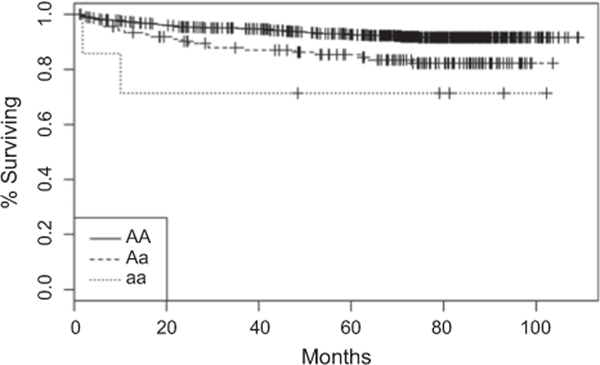
While no SNP was found to be associated with risk-of-recurrence using SMM, three SNPs in TNIP1, CD5, and JAK3 showed very strong association with posterior probabilities >90% using MMM. Regarding risk-of-progression, one SNP in CD3G was significantly associated using SMM (HR, 2.69; P = 1.55 × 10(-5)) and two SNPs in MASP1 and AIRE, showed a posterior probability ≥80% with MMM. Validated discriminative abilities of the models without and with the SNPs were 58.4% versus 60.5% and 72.1% versus 72.8% for risk-of-recurrence and risk-of-progression, respectively.
Using innovative analytic approaches, we demonstrated that SNPs in inflammatory-related genes were associated with NMIBC prognosis and that they improve the discriminative ability of prognostic clinical models for NMIBC.
This study provides proof of concept for the joint effect of genetic variants in improving the discriminative ability of clinical prognostic models. The approach may be extended to other diseases. Cancer Epidemiol Biomarkers Prev; 25(7); 1144-50. ©2016 AACR.
越来越多的证据表明肿瘤免疫环境对尿路上皮膀胱癌预后的作用。这种影响可能部分取决于宿主的基因背景。我们评估了炎症相关基因中的单核苷酸多态性(SNP)与非肌层浸润性膀胱癌(NMIBC)复发风险和进展风险的相关性。
我们纳入了SBC/EPICURO研究中随访超过10年的822例NMIBC患者。我们选择了属于251个炎症基因的1679个SNP。使用Cox回归单标记(SMM)和多标记方法(MMM)的贝叶斯A和贝叶斯LASSO评估SNP与复发风险和进展风险的相关性。使用c指数计算模型的判别能力,并通过自助交叉验证程序进行验证。
虽然使用SMM未发现SNP与复发风险相关,但使用MMM时,TNIP1、CD5和JAK3中的三个SNP显示出与后验概率>90%的非常强的相关性。关于进展风险,使用SMM时CD3G中的一个SNP显著相关(风险比,2.69;P = 1.55×10⁻⁵),而MASP1和AIRE中的两个SNP使用MMM时后验概率≥80%。对于复发风险和进展风险,无SNP模型和有SNP模型的验证判别能力分别为58.4%对60.5%和72.1%对72.8%。
使用创新的分析方法,我们证明炎症相关基因中的SNP与NMIBC预后相关,并且它们提高了NMIBC预后临床模型的判别能力。
本研究为基因变异联合改善临床预后模型判别能力提供了概念验证。该方法可能扩展到其他疾病。癌症流行病学、生物标志物与预防;25(7);1144 - 50。©2016美国癌症研究协会。