• 文献检索
  • 文档翻译
  • 深度研究
  • 学术资讯
  • Suppr Zotero 插件Zotero 插件
  • 邀请有礼
  • 套餐&价格
  • 历史记录
应用&插件
Suppr Zotero 插件Zotero 插件浏览器插件Mac 客户端Windows 客户端微信小程序
定价
高级版会员购买积分包购买API积分包
服务
文献检索文档翻译深度研究API 文档MCP 服务
关于我们
关于 Suppr公司介绍联系我们用户协议隐私条款
关注我们

Suppr 超能文献

核心技术专利:CN118964589B侵权必究
粤ICP备2023148730 号-1Suppr @ 2026

文献检索

告别复杂PubMed语法,用中文像聊天一样搜索,搜遍4000万医学文献。AI智能推荐,让科研检索更轻松。

立即免费搜索

文件翻译

保留排版,准确专业,支持PDF/Word/PPT等文件格式,支持 12+语言互译。

免费翻译文档

深度研究

AI帮你快速写综述,25分钟生成高质量综述,智能提取关键信息,辅助科研写作。

立即免费体验

将遗传风险评分添加到家族史中可识别出患前列腺癌高风险男性的数量是原来的两倍:前列腺癌预防试验的结果。

Adding genetic risk score to family history identifies twice as many high-risk men for prostate cancer: Results from the prostate cancer prevention trial.

作者信息

Chen Haitao, Liu Xu, Brendler Charles B, Ankerst Donna P, Leach Robin J, Goodman Phyllis J, Lucia M Scott, Tangen Catherine M, Wang Li, Hsu Fang-Chi, Sun Jielin, Kader A Karim, Isaacs William B, Helfand Brian T, Zheng S Lilly, Thompson Ian M, Platz Elizabeth A, Xu Jianfeng

机构信息

State Key Laboratory of Genetic Engineering, School of Life Science, Fudan University, Shanghai, China.

Center for Cancer Genomics, Wake Forest School of Medicine, Winston-Salem, North Carolina.

出版信息

Prostate. 2016 Sep;76(12):1120-9. doi: 10.1002/pros.23200. Epub 2016 May 16.

DOI:10.1002/pros.23200
PMID:27197965
原文链接:https://pmc.ncbi.nlm.nih.gov/articles/PMC5501387/
Abstract

BACKGROUND

While family history (FH) has been widely used to provide risk information, it captures only a small proportion of subjects with higher genetic susceptibility. Our objective is to assess whether a genetic risk score (GRS) calculated from prostate cancer (PCa) risk-associated single nucleotide polymorphisms (SNPs) can supplement FH for more effective risk stratification for PCa screening decision-making.

METHODS

A GRS was calculated based on 29 PCa risk-associated SNPs for 4,528 men of European descent in the placebo arm of the Prostate Cancer Prevention Trial (PCPT). At study entry, participants were free of PCa diagnosis. Performance of FH and GRS were measured by observed detection rate of PCa and high-grade PCa (Gleason score ≥7) during the 7-year study.

RESULTS

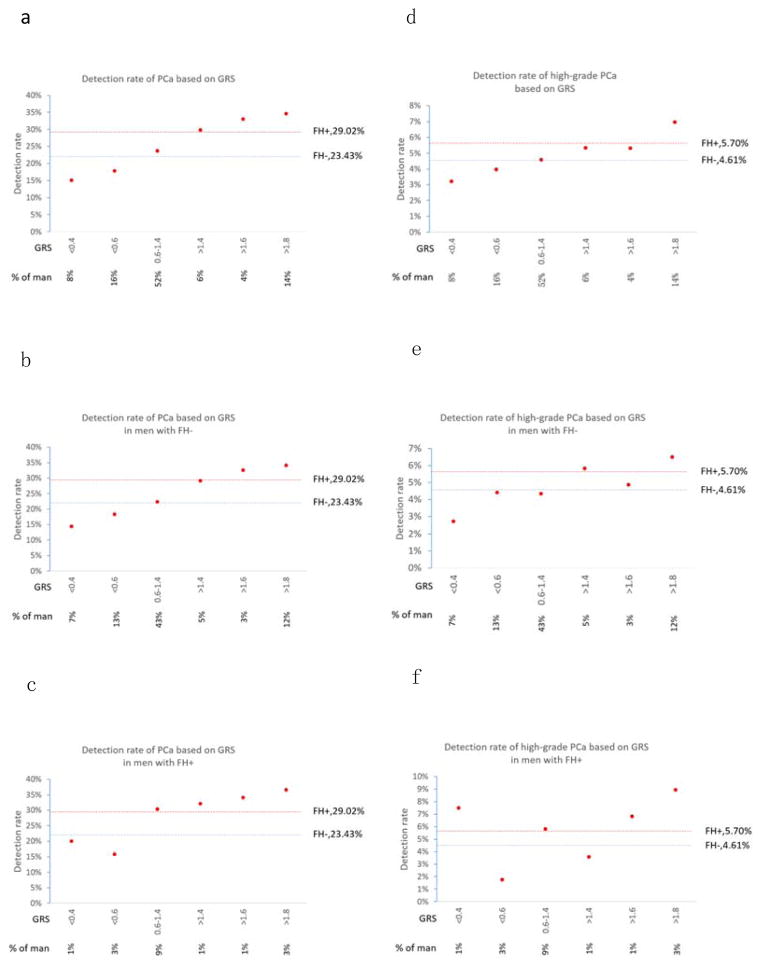
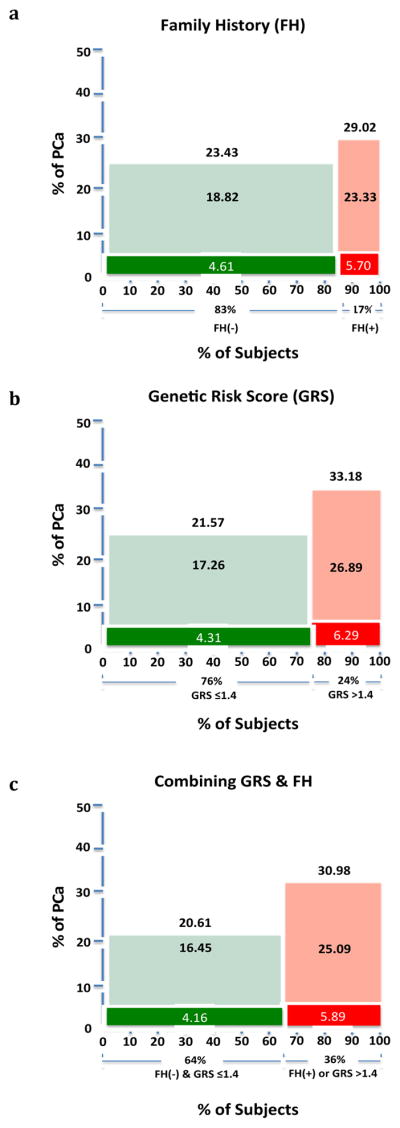
GRS was a significant predictor of PCa in men with or without a positive FH (P = 1.18 × 10(-4) and P = 4.50 × 10(-16) , respectively). Using FH alone, as expected, the 17% of men who were FH+ had a PCa detection rate that was significantly higher (29.02%) than FH- men (23.43%, P = 0.001). When both FH+ or GRS >1.4 are considered, more than twice as many men (36%) can be classified as higher risk, as evidenced by a significantly higher PCa detection rate (30.98%) than in the remaining men (20.61%, P = 5.30 × 10(-15) ). If targeting only FH+ men, four out of five PCa cases would go undetected, as would a similarly large fraction (∼80%) of high-grade PCa cases. In comparison, if targeting FH+ or GRS >1.4 men, almost half of all PCa cases would be detected, including 45% of high-grade PCa cases.

CONCLUSIONS

A prostate cancer GRS can supplement family history to better identify higher risk men for targeted intervention. Prostate 76:1120-1129, 2016. © 2016 Wiley Periodicals, Inc.

摘要

背景

虽然家族史(FH)已被广泛用于提供风险信息,但它仅涵盖了一小部分遗传易感性较高的个体。我们的目标是评估由前列腺癌(PCa)风险相关单核苷酸多态性(SNP)计算得出的遗传风险评分(GRS)是否可以补充家族史,以便在前列腺癌筛查决策中进行更有效的风险分层。

方法

基于前列腺癌预防试验(PCPT)安慰剂组中4528名欧洲裔男性的29个PCa风险相关SNP计算GRS。在研究开始时,参与者未被诊断出患有PCa。通过在7年研究期间观察到的PCa和高级别PCa(Gleason评分≥7)的检出率来衡量家族史和GRS的表现。

结果

GRS是有或没有阳性家族史男性中PCa的显著预测指标(分别为P = 1.18×10^(-4)和P = 4.50×10^(-16))。正如预期的那样,仅使用家族史时,17%的家族史阳性男性的PCa检出率(29.02%)显著高于家族史阴性男性(23.43%,P = 0.001)。当同时考虑家族史阳性或GRS>1.4时,两倍多的男性(36%)可被归类为高风险,这表现为PCa检出率(30.98%)显著高于其余男性(20.61%,P = 5.30×10^(-15))。如果仅针对家族史阳性男性,五分之四的PCa病例将未被检测到,高级别PCa病例的未被检测到比例也同样高(约80%)。相比之下,如果针对家族史阳性或GRS>1.4的男性,几乎一半的PCa病例将被检测到,包括45%的高级别PCa病例。

结论

前列腺癌GRS可以补充家族史,以更好地识别高风险男性进行有针对性的干预。《前列腺》76:1120 - 1129,2016年。©2016威利期刊公司。
https://cdn.ncbi.nlm.nih.gov/pmc/blobs/69a9/5501387/5f9100c353db/nihms870699f2.jpg
https://cdn.ncbi.nlm.nih.gov/pmc/blobs/69a9/5501387/5310ab7810e8/nihms870699f1.jpg
https://cdn.ncbi.nlm.nih.gov/pmc/blobs/69a9/5501387/5f9100c353db/nihms870699f2.jpg
https://cdn.ncbi.nlm.nih.gov/pmc/blobs/69a9/5501387/5310ab7810e8/nihms870699f1.jpg
https://cdn.ncbi.nlm.nih.gov/pmc/blobs/69a9/5501387/5f9100c353db/nihms870699f2.jpg

相似文献

1
Adding genetic risk score to family history identifies twice as many high-risk men for prostate cancer: Results from the prostate cancer prevention trial.将遗传风险评分添加到家族史中可识别出患前列腺癌高风险男性的数量是原来的两倍:前列腺癌预防试验的结果。
Prostate. 2016 Sep;76(12):1120-9. doi: 10.1002/pros.23200. Epub 2016 May 16.
2
Single-Nucleotide Polymorphism-Based Genetic Risk Score and Patient Age at Prostate Cancer Diagnosis.基于单核苷酸多态性的遗传风险评分与前列腺癌诊断时患者年龄的关系。
JAMA Netw Open. 2019 Dec 2;2(12):e1918145. doi: 10.1001/jamanetworkopen.2019.18145.
3
Performance of Three Inherited Risk Measures for Predicting Prostate Cancer Incidence and Mortality: A Population-based Prospective Analysis.三种遗传风险指标预测前列腺癌发病和死亡风险的性能:基于人群的前瞻性分析。
Eur Urol. 2021 Mar;79(3):419-426. doi: 10.1016/j.eururo.2020.11.014. Epub 2020 Nov 28.
4
Race-specific genetic risk score is more accurate than nonrace-specific genetic risk score for predicting prostate cancer and high-grade diseases.种族特异性遗传风险评分在预测前列腺癌和高级别疾病方面比非种族特异性遗传风险评分更准确。
Asian J Androl. 2016 Jul-Aug;18(4):525-9. doi: 10.4103/1008-682X.179857.
5
A comparison of genetic risk score with family history for estimating prostate cancer risk.比较遗传风险评分与家族史以评估前列腺癌风险。
Asian J Androl. 2016 Jul-Aug;18(4):515-9. doi: 10.4103/1008-682X.177122.
6
Clinical validity and utility of genetic risk scores in prostate cancer.前列腺癌基因风险评分的临床有效性和实用性。
Asian J Androl. 2016 Jul-Aug;18(4):509-14. doi: 10.4103/1008-682X.182981.
7
Potential impact of adding genetic markers to clinical parameters in predicting prostate biopsy outcomes in men following an initial negative biopsy: findings from the REDUCE trial.在初始阴性前列腺活检后,添加遗传标记物对临床参数在预测前列腺活检结果中的潜在影响:来自 REDUCE 试验的结果。
Eur Urol. 2012 Dec;62(6):953-61. doi: 10.1016/j.eururo.2012.05.006. Epub 2012 May 12.
8
A genetic score can identify men at high risk for prostate cancer among men with prostate-specific antigen of 1-3 ng/ml.遗传评分可识别前列腺特异性抗原为 1-3ng/ml 的男性中患前列腺癌风险较高的男性。
Eur Urol. 2014 Jun;65(6):1184-90. doi: 10.1016/j.eururo.2013.07.005. Epub 2013 Jul 19.
9
Exome-based genome-wide association study and risk assessment using genetic risk score to prostate cancer in the Korean population.基于外显子组的全基因组关联研究及利用遗传风险评分对韩国人群前列腺癌进行风险评估。
Oncotarget. 2017 Jul 4;8(27):43934-43943. doi: 10.18632/oncotarget.16540.
10
Risk stratification in men with a negative prostate biopsy: an interim analysis of a prospective cohort study.前列腺活检阴性男性的风险分层:一项前瞻性队列研究的中期分析。
BJU Int. 2021 Dec;128(6):702-712. doi: 10.1111/bju.15443. Epub 2021 Jun 17.

引用本文的文献

1
Evaluating the Impact of Family History and Polygenic Risk Scores on Cardiometabolic Disease Risk.评估家族史和多基因风险评分对心脏代谢疾病风险的影响。
Res Sq. 2025 Aug 1:rs.3.rs-7142452. doi: 10.21203/rs.3.rs-7142452/v1.
2
Polygenic Risk, Rare Variants, and Family History: Independent and Additive Effects on Coronary Heart Disease.多基因风险、罕见变异与家族史:对冠心病的独立和累加效应
JACC Adv. 2023 Aug 26;2(7):100567. doi: 10.1016/j.jacadv.2023.100567. eCollection 2023 Sep.
3
CanRisk-Prostate: A Comprehensive, Externally Validated Risk Model for the Prediction of Future Prostate Cancer.

本文引用的文献

1
A large multiethnic genome-wide association study of prostate cancer identifies novel risk variants and substantial ethnic differences.一项大规模的多民族前列腺癌全基因组关联研究发现了新的风险变异和显著的种族差异。
Cancer Discov. 2015 Aug;5(8):878-91. doi: 10.1158/2159-8290.CD-15-0315. Epub 2015 Jun 1.
2
A meta-analysis of 87,040 individuals identifies 23 new susceptibility loci for prostate cancer.一项对87040名个体的荟萃分析确定了23个新的前列腺癌易感基因座。
Nat Genet. 2014 Oct;46(10):1103-9. doi: 10.1038/ng.3094. Epub 2014 Sep 14.
3
Impact of family history on prostate cancer mortality in white men undergoing prostate specific antigen based screening.
CanRisk-Prostate:一种全面且经过外部验证的预测未来前列腺癌风险的模型。
J Clin Oncol. 2023 Feb 10;41(5):1092-1104. doi: 10.1200/JCO.22.01453. Epub 2022 Dec 9.
4
Reliability of Ancestry-specific Prostate Cancer Genetic Risk Score in Four Racial and Ethnic Populations.四种种族和族裔人群中特定祖先的前列腺癌遗传风险评分的可靠性
Eur Urol Open Sci. 2022 Sep 17;45:23-30. doi: 10.1016/j.euros.2022.09.001. eCollection 2022 Nov.
5
Capturing additional genetic risk from family history for improved polygenic risk prediction.从家族史中获取额外的遗传风险以提高多基因风险预测。
Commun Biol. 2022 Jun 16;5(1):595. doi: 10.1038/s42003-022-03532-4.
6
Can polygenic risk scores contribute to cost-effective cancer screening? A systematic review.多基因风险评分能否有助于具有成本效益的癌症筛查?系统评价。
Genet Med. 2022 Aug;24(8):1604-1617. doi: 10.1016/j.gim.2022.04.020. Epub 2022 May 16.
7
Inherited risk assessment and its clinical utility for predicting prostate cancer from diagnostic prostate biopsies.遗传性风险评估及其在预测前列腺癌诊断性前列腺活检中的临床应用。
Prostate Cancer Prostatic Dis. 2022 Sep;25(3):422-430. doi: 10.1038/s41391-021-00458-6. Epub 2022 Mar 28.
8
Genetic Factors Associated with Prostate Cancer Conversion from Active Surveillance to Treatment.与前列腺癌从主动监测转为治疗相关的遗传因素。
HGG Adv. 2022 Jan 13;3(1). doi: 10.1016/j.xhgg.2021.100070. Epub 2021 Nov 19.
9
Blood and urine biomarkers in prostate cancer: Are we ready for reflex testing in men with an elevated prostate-specific antigen?前列腺癌中的血液和尿液生物标志物:对于前列腺特异性抗原升高的男性,我们是否准备好进行反射检测了?
Asian J Urol. 2021 Oct;8(4):343-353. doi: 10.1016/j.ajur.2021.06.003. Epub 2021 Jun 23.
10
Novel strategy for disease risk prediction incorporating predicted gene expression and DNA methylation data: a multi-phased study of prostate cancer.纳入预测基因表达和 DNA 甲基化数据的疾病风险预测新策略:前列腺癌的多阶段研究。
Cancer Commun (Lond). 2021 Dec;41(12):1387-1397. doi: 10.1002/cac2.12205. Epub 2021 Sep 14.
家族史对接受前列腺特异性抗原筛查的白人男性前列腺癌死亡率的影响。
J Urol. 2015 Jan;193(1):75-9. doi: 10.1016/j.juro.2014.07.085. Epub 2014 Jul 24.
4
Long-term survival of participants in the prostate cancer prevention trial.前列腺癌预防试验参与者的长期生存情况。
N Engl J Med. 2013 Aug 15;369(7):603-10. doi: 10.1056/NEJMoa1215932.
5
Prediction of prostate cancer from prostate biopsy in Chinese men using a genetic score derived from 24 prostate cancer risk-associated SNPs.利用来自 24 个前列腺癌风险相关 SNP 的遗传评分预测中国男性前列腺癌活检。
Prostate. 2013 Nov;73(15):1651-9. doi: 10.1002/pros.22661. Epub 2013 Jul 18.
6
Early detection of prostate cancer: AUA Guideline.早期前列腺癌检测:AUA 指南。
J Urol. 2013 Aug;190(2):419-26. doi: 10.1016/j.juro.2013.04.119. Epub 2013 May 6.
7
Prostate cancer risk-associated genetic markers and their potential clinical utility.前列腺癌风险相关遗传标志物及其潜在临床应用。
Asian J Androl. 2013 May;15(3):314-22. doi: 10.1038/aja.2013.42. Epub 2013 Apr 8.
8
Genetic score is an objective and better measurement of inherited risk of prostate cancer than family history.基因评分是一种比家族病史更客观、更能准确衡量前列腺癌遗传风险的方法。
Eur Urol. 2013 Mar;63(3):585-7. doi: 10.1016/j.eururo.2012.11.047. Epub 2012 Dec 5.
9
Reproducibility, performance, and clinical utility of a genetic risk prediction model for prostate cancer in Japanese.日本人群前列腺癌遗传风险预测模型的可重复性、性能和临床实用性。
PLoS One. 2012;7(10):e46454. doi: 10.1371/journal.pone.0046454. Epub 2012 Oct 10.
10
Screening for prostate cancer: U.S. Preventive Services Task Force recommendation statement.前列腺癌筛查:美国预防服务工作组推荐声明。
Ann Intern Med. 2012 Jul 17;157(2):120-34. doi: 10.7326/0003-4819-157-2-201207170-00459.