Department of Statistics, Florida State University, Tallahassee, FL, 32304, USA.
Cancer Epidemiology Division, Population Sciences in the Pacific Program, University of Hawaii Cancer Center, University of Hawaii at Manoa, Honolulu, HI, 96813, USA.
Cancer Commun (Lond). 2021 Dec;41(12):1387-1397. doi: 10.1002/cac2.12205. Epub 2021 Sep 14.
DNA methylation and gene expression are known to play important roles in the etiology of human diseases such as prostate cancer (PCa). However, it has not yet been possible to incorporate information of DNA methylation and gene expression into polygenic risk scores (PRSs). Here, we aimed to develop and validate an improved PRS for PCa risk by incorporating genetically predicted gene expression and DNA methylation, and other genomic information using an integrative method.
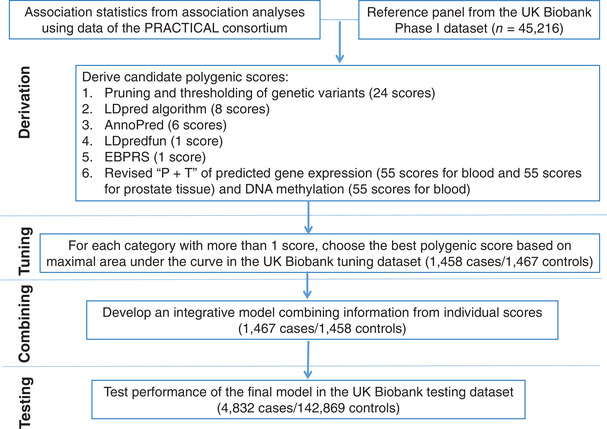
Using data from the PRACTICAL consortium, we derived multiple sets of genetic scores, including those based on available single-nucleotide polymorphisms through widely used methods of pruning and thresholding, LDpred, LDpred-funt, AnnoPred, and EBPRS, as well as PRS constructed using the genetically predicted gene expression and DNA methylation through a revised pruning and thresholding strategy. In the tuning step, using the UK Biobank data (1458 prevalent cases and 1467 controls), we selected PRSs with the best performance. Using an independent set of data from the UK Biobank, we developed an integrative PRS combining information from individual scores. Furthermore, in the testing step, we tested the performance of the integrative PRS in another independent set of UK Biobank data of incident cases and controls.
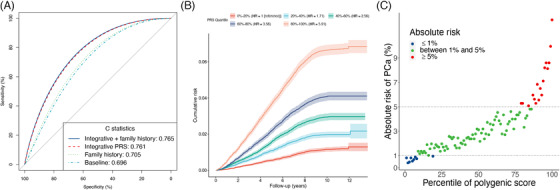
Our constructed PRS had improved performance (C statistics: 76.1%) over PRSs constructed by individual benchmark methods (from 69.6% to 74.7%). Furthermore, our new PRS had much higher risk assessment power than family history. The overall net reclassification improvement was 69.0% by adding PRS to the baseline model compared with 12.5% by adding family history.
We developed and validated a new PRS which may improve the utility in predicting the risk of developing PCa. Our innovative method can also be applied to other human diseases to improve risk prediction across multiple outcomes.
DNA 甲基化和基因表达已知在人类疾病(如前列腺癌(PCa))的发病机制中发挥重要作用。然而,迄今为止,还不可能将 DNA 甲基化和基因表达信息纳入多基因风险评分(PRSs)中。在这里,我们旨在通过整合方法,利用基因预测的基因表达和 DNA 甲基化以及其他基因组信息,开发和验证一种改进的用于 PCa 风险的 PRS。
我们使用 PRACTICAL 联盟的数据,衍生出多套遗传评分,包括通过广泛使用的修剪和阈值、LDpred、LDpred-funt、AnnoPred 和 EBPRS 方法以及使用基于基因预测的基因表达和 DNA 甲基化构建的遗传评分,构建基于可用单核苷酸多态性的遗传评分。在调整步骤中,我们使用英国生物库(UK Biobank)数据(1458 例现患病例和 1467 例对照)选择表现最佳的 PRS。我们使用来自 UK Biobank 的另一组独立数据,开发了一种结合个体评分信息的综合 PRS。此外,在测试步骤中,我们在另一组来自 UK Biobank 的病例和对照的独立数据中测试了综合 PRS 的性能。
我们构建的 PRS 与个体基准方法构建的 PRS(从 69.6%到 74.7%)相比,性能有所提高(C 统计量:76.1%)。此外,我们的新 PRS 比家族史具有更高的风险评估能力。与添加家族史相比,添加 PRS 使基线模型的总体净重新分类改善率提高了 69.0%。
我们开发并验证了一种新的 PRS,该 PRS 可能提高预测前列腺癌发病风险的效用。我们的创新方法还可以应用于其他人类疾病,以提高多种结局的风险预测能力。