Liu Zhengrong, Zheng Wei, Gao Shuai, Qin Zhisong, Li Guannan, Ning Yuping
Psychiatric Hospital of the Bureau of Civil Affairs of Guangzhou Municipality, Guangzhou, China.
The Affiliated Brain Hospital of Guangzhou Medical University (Guangzhou Huiai Hospital), Guangzhou, China.
Shanghai Arch Psychiatry. 2015 Dec 25;27(6):331-40. doi: 10.11919/j.issn.1002-0829.215071.
Long-term use of clozapine for individuals with schizophrenia carries a high risk for developing metabolic abnormalities, especially clozapine-induced weight gain. Previous studies suggest that metformin can decrease clozapine-induced weight gain, but the sample sizes of most of these studies are relatively small.
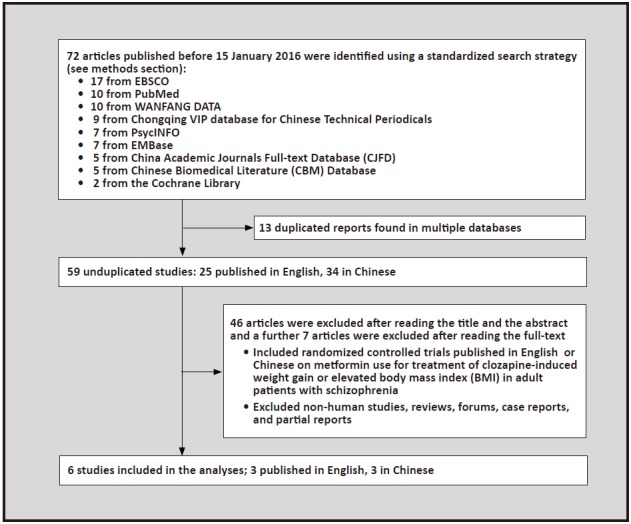
We identified randomized controlled trials (RCTs) published prior to December 15, 2015 about the use of metformin to treat clozapine-induced weight gain in adults with schizophrenia by searching several English-language and Chinese-language databases. Two independent researchers did the screening and data extraction. We used Revman 5.3 to conduct the meta-analyses, assessed the risk of bias (RoB), and assessed the strength of the evidence using the Cochrane Grades of Recommendation, Assessment, Development, and Evaluation (GRADE).
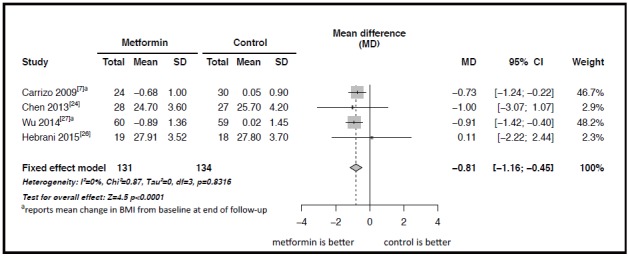
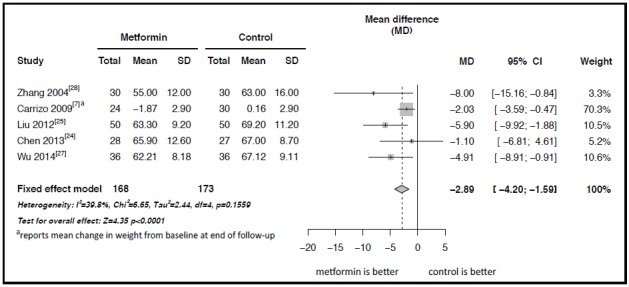
Six studies with a pooled sample of 207 treatment-group patients and 207 control-group patients were included -- three double-blind, placebo-controlled RCTs and three RCTs that did not use placebo controls and were not blinded. The meta-analysis found that compared to the control condition, patients receiving metformin experienced significantly greater reductions in body weight (mean difference [MD]=-2.89 kg, 95% CI: -4.20 to -1.59 kg) and body mass index (BMI) (MD=-0.81, 95% CI: -1.16 to -0.45), but there was no significant difference between the groups in the prevalence of side effects. Based on the GRADE scale, the strength of the evidence for the change in weight outcome was 'moderate' and that for the change in BMI outcome was 'high', but the strength of evidence about differences in side effects between groups was 'low' or 'very low'.
Adjunctive treatment with metformin appears to be effective for treating clozapine-induced weight gain and elevations in BMI in adult patients with schizophrenia. However, the quality of the evidence about the safety of this treatment is low, follow-up time in the available studies is relatively short, and half of the studies did not employ blinded assessment of outcome measures. Larger studies with placebo controls that follow patients for at least 24 weeks and that make blinded assessments of a range of relevant outcome measures (weight, BMI, blood lipids, insulin resistance, etc.) are needed to confirm these results.
长期使用氯氮平治疗精神分裂症患者会带来发生代谢异常的高风险,尤其是氯氮平引起的体重增加。既往研究表明二甲双胍可减少氯氮平引起的体重增加,但这些研究大多样本量相对较小。
通过检索多个英文和中文数据库,我们确定了2015年12月15日前发表的关于使用二甲双胍治疗成年精神分裂症患者氯氮平引起的体重增加的随机对照试验(RCT)。两名独立研究人员进行筛选和数据提取。我们使用Revman 5.3进行荟萃分析,评估偏倚风险(RoB),并使用Cochrane推荐、评估、制定和评价等级(GRADE)评估证据强度。
纳入了六项研究,治疗组患者207例,对照组患者207例,样本合并——三项双盲、安慰剂对照RCT和三项未使用安慰剂对照且未设盲的RCT。荟萃分析发现,与对照情况相比,接受二甲双胍治疗的患者体重(平均差[MD]=-2.89kg,95%CI:-4.20至-1.59kg)和体重指数(BMI)(MD=-0.81,95%CI:-1.16至-0.45)显著降低,但两组间副作用发生率无显著差异。根据GRADE量表,体重结果变化的证据强度为“中等”,BMI结果变化的证据强度为“高”,但关于组间副作用差异的证据强度为“低”或“极低”。
二甲双胍辅助治疗似乎对治疗成年精神分裂症患者氯氮平引起的体重增加和BMI升高有效。然而,关于这种治疗安全性的证据质量较低,现有研究的随访时间相对较短,且一半的研究未对结局指标进行设盲评估。需要开展更大规模的设安慰剂对照的研究,对患者进行至少24周的随访,并对一系列相关结局指标(体重、BMI、血脂、胰岛素抵抗等)进行设盲评估,以证实这些结果。