Hebrani Paria, Manteghi Ali Akhoundpour, Behdani Fatemeh, Hessami Elham, Rezayat Kambiz Akhavan, Marvast Majid Nabizadeh, Rezayat Amir Akhavan
Department of Psychiatry, Faculty of Medicine, Mashhad University of Medical Sciences, Mashhad, Iran.
Department of Internal Medicine, Faculty of Medicine, Mashhad University of Medical Sciences, Mashhad, Iran.
J Res Med Sci. 2015 Apr;20(4):364-71.
One of the major causes of death in schizophrenia is a metabolic syndrome. The clozapine has the highest rate of weight gain among antipsychotics. It has been shown that metformin can promote weight loss. We aimed to investigate the effect of metformin as an adjunctive therapy with clozapine to prevent metabolic syndrome in patients with schizophrenia.
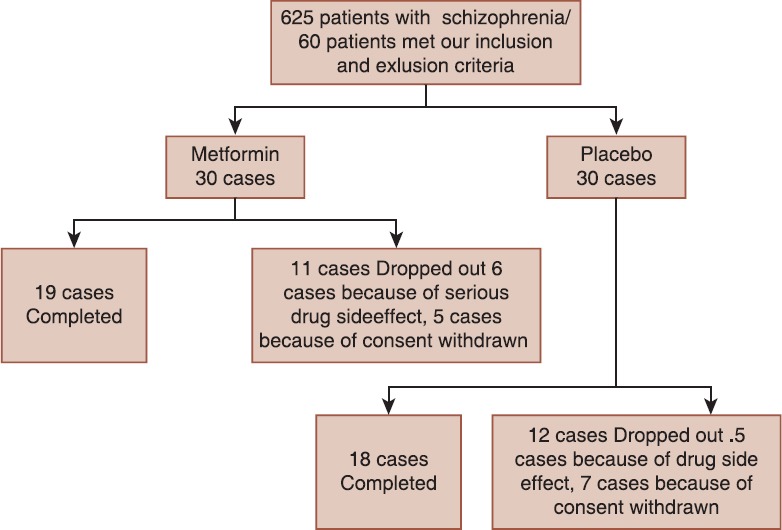
A total of 37 patients consisting metformin group (19 cases) and a group of placebo consisting of 18 cases were evaluated. A brief psychiatric rating scale score (BPRS) and metabolic profiles was determined for all patients. All of the variables were also determined at 2, 8, 16, and 20 weeks after the onset of the study.
The mean age of the group of metformin was 47.2 ± 10.4 compared with 45.8 ± 10.2 for the group of placebo. The difference in mean waist circumference and serum level of triglyceride at baseline compared with the end of study showed a statistically significant difference between two groups (P = 0. 000). A statistically significant difference was also observed in a comparison of mean difference of weight and body mass index at baseline compared with end of study (P = 0. 000). There was a statistically significant difference of fasting blood sugar (P = 0.011) and serum high-density lipoprotein (P = 0.000) between two groups but this difference was not significant for mean BPRS scores, mean systolic and diastolic blood pressure, serum level of triiodothyronine, thyroxin and thyroid stimulating hormone, serum low-density lipoprotein and serum cholesterol.
Metformin could be considered an adjunctive therapy with clozapine to prevent metabolic syndrome in schizophrenic patients.
精神分裂症患者的主要死因之一是代谢综合征。氯氮平在抗精神病药物中体重增加率最高。已有研究表明二甲双胍可促进体重减轻。我们旨在研究二甲双胍作为氯氮平辅助治疗药物对预防精神分裂症患者代谢综合征的效果。
共评估了37例患者,其中二甲双胍组19例,安慰剂组18例。测定了所有患者的简明精神病评定量表(BPRS)评分和代谢指标。在研究开始后的第2、8、16和20周也测定了所有变量。
二甲双胍组的平均年龄为47.2±10.4岁,安慰剂组为45.8±10.2岁。与研究结束时相比,两组基线时的平均腰围和甘油三酯血清水平差异具有统计学意义(P = 0.000)。与研究结束时相比,两组基线时体重和体重指数的平均差异比较也观察到具有统计学意义(P = 0.000)。两组间空腹血糖(P = 0.011)和血清高密度脂蛋白(P = 0.000)存在统计学意义的差异,但两组间平均BPRS评分、平均收缩压和舒张压、血清三碘甲状腺原氨酸、甲状腺素和促甲状腺激素水平、血清低密度脂蛋白和血清胆固醇差异无统计学意义。
二甲双胍可被视为氯氮平的辅助治疗药物,用于预防精神分裂症患者的代谢综合征。