Lorrai Irene, Piga Valentina, Carai Mauro A M, Riva Antonella, Morazzoni Paolo, Gessa Gian Luigi, Colombo Giancarlo, Maccioni Paola
Neuroscience Institute, National Research Council of Italy, Section of Cagliari Cagliari, Italy.
Cagliari Pharmacological Research s.r.l. Cagliari, Italy.
Front Pharmacol. 2016 Apr 26;7:109. doi: 10.3389/fphar.2016.00109. eCollection 2016.
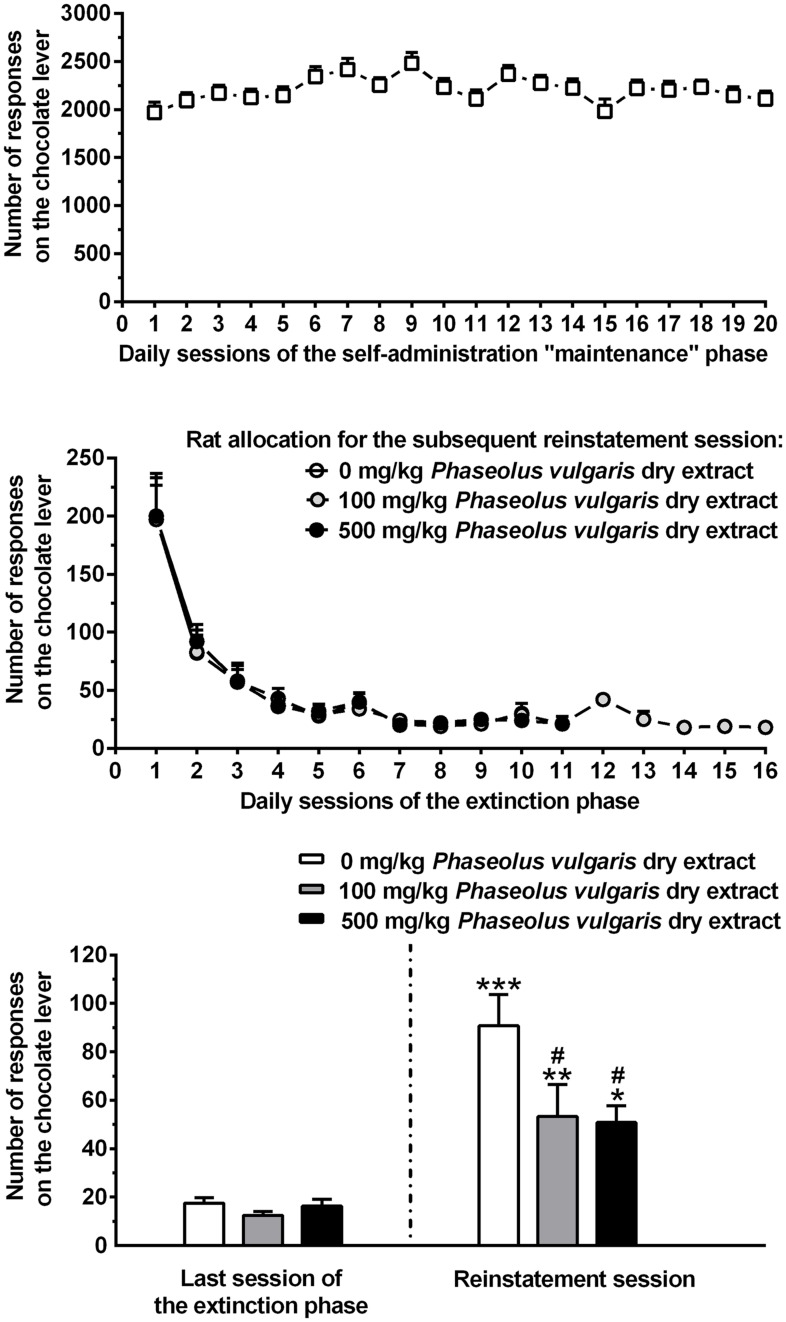
Previous evidence has suggested that treatment with a standardized dry extract of Phaseolus vulgaris reduced intake and operant self-administration of highly palatable foods and fluids in rats and mice. The present study was designed to assess whether such extract was also effective in reducing seeking behavior for a highly hedonic chocolate-flavored beverage, using a "reinstatement" procedure adopted from the drug addiction research field and modeling relapse behavior. Rats were initially trained to lever-respond for the chocolate-flavored beverage under the Fixed Ratio (FR) 10 schedule of reinforcement. Subsequently, rats were exposed to an extinction responding phase, during which lever-responding - being unreinforced - diminished progressively up to extinction. Lever-responding was then powerfully reinstated by the non-contingent presentation of a complex of gustatory, olfactory, auditory, and visual stimuli previously associated to the availability of the chocolate-flavored beverage. Acute, intragastric administration of P. vulgaris dry extract (100 and 500 mg/kg) reduced lever-responding by 40-45%, in comparison to vehicle condition. These results indicate the ability of P. vulgaris dry extract to reduce seeking behavior for a highly palatable nourishment in an experimental model of relapse into disordered eating of palatable foods. The unavailability of the chocolate-flavored beverage in the reinstatement session tends to exclude that the observed effect of the P. vulgaris dry extract was secondary to any inhibition of carbohydrate metabolism; conversely, it is the likely consequence on a central action on the rewarding and hedonic properties of food.
先前的证据表明,用标准化的菜豆干提取物进行治疗可减少大鼠和小鼠对高度可口食物和液体的摄入量及操作性自我给药。本研究旨在评估这种提取物是否也能有效减少对一种高度愉悦的巧克力味饮料的觅求行为,采用的是从药物成瘾研究领域采用的“恢复”程序并模拟复发行为。大鼠最初在固定比率(FR)10强化程序下接受训练,通过按压杠杆获取巧克力味饮料。随后,大鼠进入消退反应阶段,在此期间,杠杆按压(未得到强化)逐渐减少直至消退。然后,通过非条件呈现先前与巧克力味饮料可得性相关的味觉、嗅觉、听觉和视觉刺激复合物,有力地恢复了杠杆按压行为。与赋形剂对照相比,急性胃内给予菜豆干提取物(100和500毫克/千克)可使杠杆按压行为减少40 - 45%。这些结果表明,在一个美味食物无序进食复发的实验模型中,菜豆干提取物有能力减少对高度可口营养物的觅求行为。在恢复实验环节中巧克力味饮料不可得,这倾向于排除菜豆干提取物观察到的效果是继发于对碳水化合物代谢的任何抑制作用;相反,这可能是对食物的奖赏和愉悦特性产生中枢作用的结果。