Turel Ofir, Bechara Antoine
Department of Information Systems and Decision Sciences, California State UniversityFullerton, CA, USA; Department of Psychology, Brain and Creativity Institute, University of Southern CaliforniaLos Angeles, CA, USA.
Department of Psychology, Brain and Creativity Institute, University of Southern California Los Angeles, CA, USA.
Front Psychol. 2016 Apr 26;7:601. doi: 10.3389/fpsyg.2016.00601. eCollection 2016.
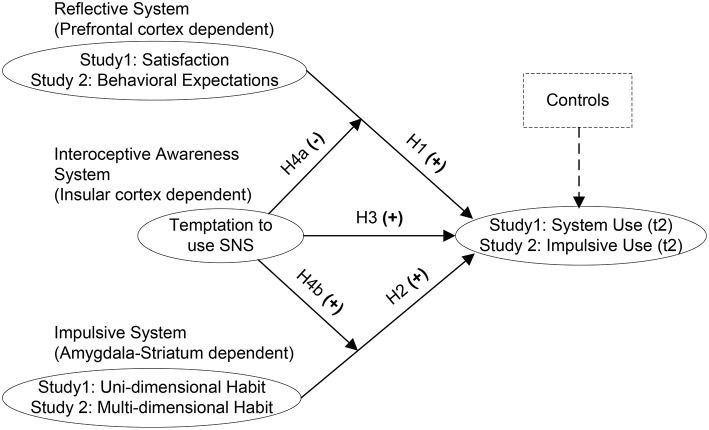
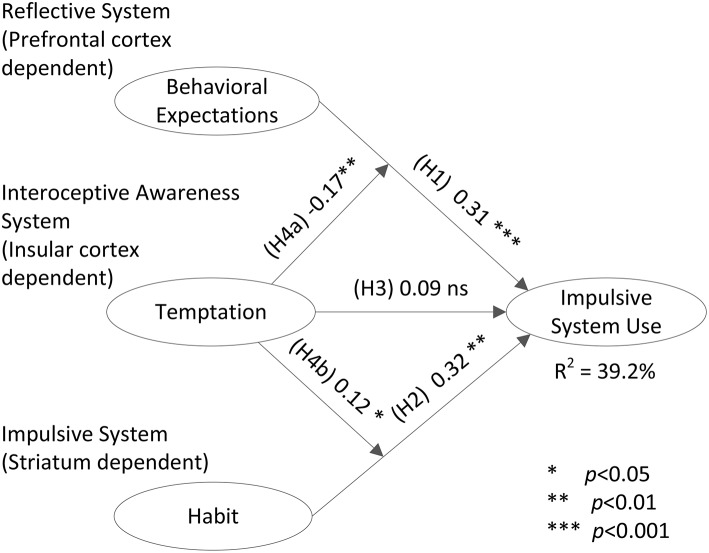
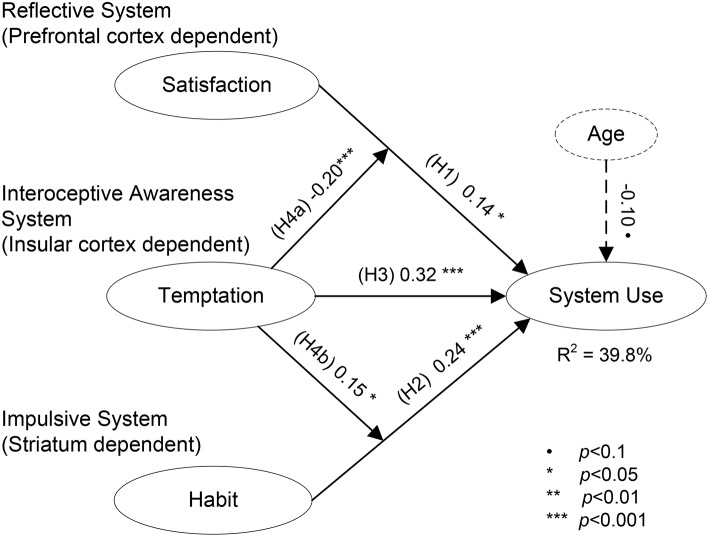
This study examines a behavioral tripartite model developed in the field of addiction, and applies it here to understanding general and impulsive information technology use. It suggests that technology use is driven by two information-processing brain systems: reflective and impulsive, and that their effects on use are modulated by interoceptive awareness processes. The resultant reflective-impulsive-interoceptive awareness model is tested in two behavioral studies. Both studies employ SEM techniques to time-lagged self-report data from n 1 = 300 and n 2 = 369 social networking site users. Study 1 demonstrated that temptations augment the effect of habit on technology use, and reduce the effect of satisfaction on use. Study 2 showed that temptations strengthen the effect of habit on impulsive technology use, and weaken the effect of behavioral expectations on impulsive technology use. Hence, the results consistently support the notion that information technology users' behaviors are influenced by reflective and impulsive information processing systems; and that the equilibrium of these systems is determined, at least in part, by one's temptations. These results can serve as a basis for understanding the etiology of modern day addictions.
本研究考察了成瘾领域中发展起来的一种行为三方模型,并将其应用于理解一般性和冲动性信息技术使用。研究表明,技术使用由两个信息处理脑系统驱动:反思性和冲动性系统,并且它们对使用的影响受到内感受觉知过程的调节。由此产生的反思 - 冲动 - 内感受觉知模型在两项行为研究中得到检验。两项研究均采用结构方程模型(SEM)技术对来自n1 = 300和n2 = 369名社交网站用户的时间滞后自我报告数据进行分析。研究1表明,诱惑增强了习惯对技术使用的影响,并降低了满意度对使用的影响。研究2表明,诱惑增强了习惯对冲动性技术使用的影响,并削弱了行为期望对冲动性技术使用的影响。因此,结果一致支持以下观点:信息技术用户的行为受到反思性和冲动性信息处理系统的影响;并且这些系统的平衡至少部分由个人的诱惑所决定。这些结果可为理解现代成瘾的病因提供依据。