Loy Laura S, Wieber Frank, Gollwitzer Peter M, Oettingen Gabriele
Media Psychology Division, School of Communication, University of HohenheimStuttgart, Germany; Social Psychology and Motivation Division, Department of Psychology, University of KonstanzKonstanz, Germany.
Social Psychology and Motivation Division, Department of Psychology, University of KonstanzKonstanz, Germany; Centre for Health Sciences, School of Health Professions, Zurich University of Applied SciencesWinterthur, Switzerland.
Front Psychol. 2016 Apr 29;7:607. doi: 10.3389/fpsyg.2016.00607. eCollection 2016.
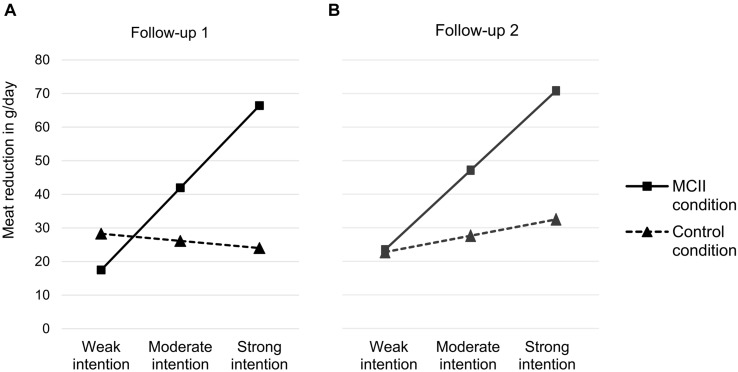
With growing awareness that sustainable consumption is important for quality of life on earth, many individuals intend to act more sustainably. In this regard, interest in reducing meat consumption is on the rise. However, people often do not translate intentions into actual behavior change. To address this intention-behavior gap, we tested the self-regulation strategy of mental contrasting with implementation intentions (MCII). Here, people identify and imagine a desired future and current obstacles standing in its way. They address the obstacles with if-then plans specifying when, where, and how to act differently. In a 5-week randomized controlled experimental study, we compared an information + MCII intervention with an information-only control intervention. As hypothesized, only MCII participants' intention of reducing their meat consumption was predictive of their actual reduction, while no correspondence between intention and behavior change was found for control participants. Participants with a moderate to strong intention to reduce their meat consumption reduced it more in the MCII than in the control condition. Thus, MCII helped to narrow the intention-behavior gap and supported behavior change for those holding moderate and strong respective intentions.
随着人们越来越意识到可持续消费对地球上的生活质量很重要,许多人打算采取更可持续的行动。在这方面,减少肉类消费的兴趣正在上升。然而,人们往往不会将意图转化为实际的行为改变。为了解决这种意图-行为差距,我们测试了将心理对照与实施意图(MCII)相结合的自我调节策略。在这里,人们识别并想象一个期望的未来以及阻碍实现这一未来的当前障碍。他们通过制定“如果……那么……”计划来应对这些障碍,该计划明确了何时、何地以及如何采取不同的行动。在一项为期5周的随机对照实验研究中,我们将信息+MCII干预与仅提供信息的对照干预进行了比较。正如所假设的那样,只有采用MCII的参与者减少肉类消费的意图能够预测他们实际的减少量,而对照参与者的意图与行为改变之间没有发现相关性。有中度至强烈减少肉类消费意图的参与者在MCII组中比在对照组中减少得更多。因此,MCII有助于缩小意图-行为差距,并支持那些有中度和强烈相应意图的人改变行为。