Naud Alexandre, Chailleux Eloise, Kestens Yan, Bret Céline, Desjardins Dominic, Petit Odile, Ngoubangoye Barthélémy, Sueur Cédric
Centre National de la Recherche Scientifique, Département Ecologie, Physiologie, et EthologieStrasbourg, France; Département de Médecine Sociale et Préventive, École de Santé Publique, Université de MontréalMontréal, QC, Canada; Institut Pluridisciplinaire Hubert Curien, Université de StrasbourgStrasbourg, France.
École Nationale Vétérinaire d'Alfort Maison-Alfort, France.
Front Psychol. 2016 May 3;7:612. doi: 10.3389/fpsyg.2016.00612. eCollection 2016.
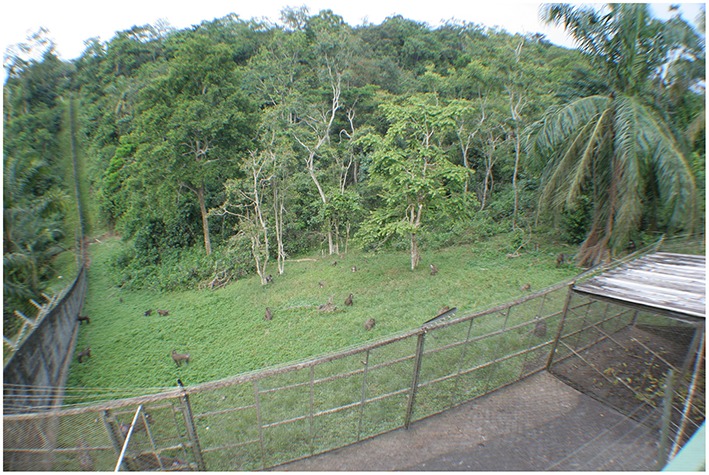
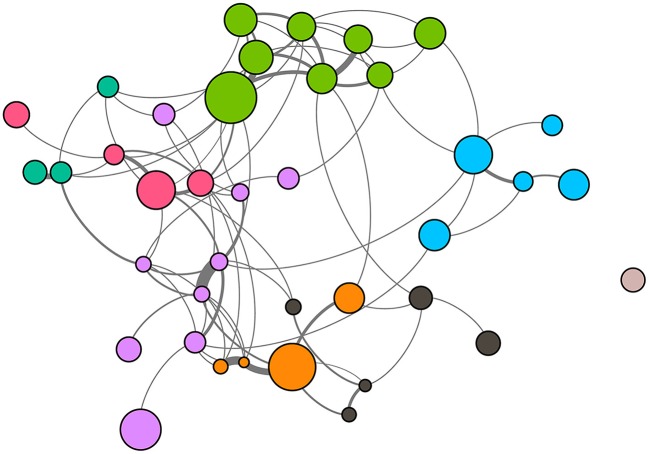
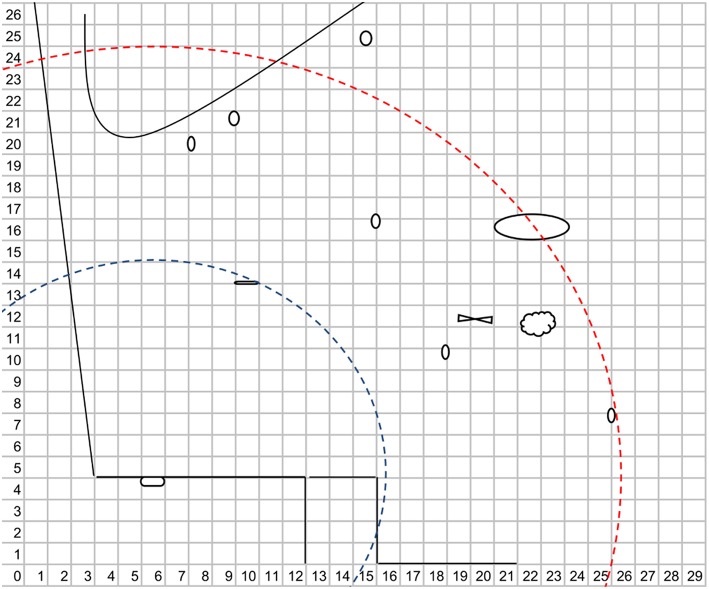
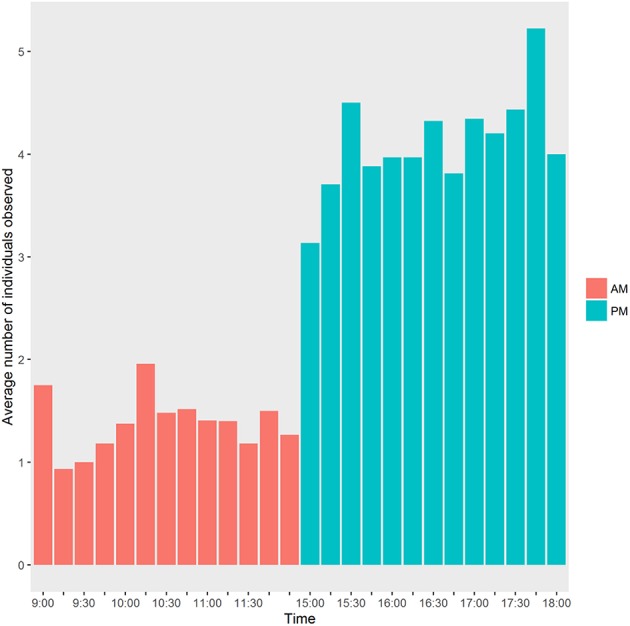
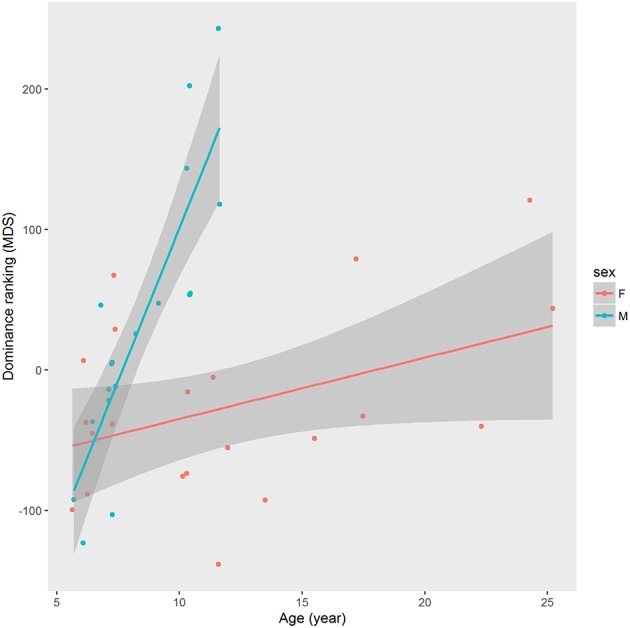
Although there exist advantages to group-living in comparison to a solitary lifestyle, costs and gains of group-living may be unequally distributed among group members. Predation risk, vigilance levels and food intake may be unevenly distributed across group spatial geometry and certain within-group spatial positions may be more or less advantageous depending on the spatial distribution of these factors. In species characterized with dominance hierarchy, high-ranking individuals are commonly observed in advantageous spatial position. However, in complex social systems, individuals can develop affiliative relationships that may balance the effect of dominance relationships in individual's spatial distribution. The objective of the present study is to investigate how the group spatial distribution of a semi-free ranging colony of Mandrills relates to its social organization. Using spatial observations in an area surrounding the feeding zone, we tested the three following hypothesis: (1) does dominance hierarchy explain being observed in proximity or far from a food patch? (2) Do affiliative associations also explain being observed in proximity or far from a food patch? (3) Do the differences in rank in the group hierarchy explain being co-observed in proximity of a food patch? Our results showed that high-ranking individuals were more observed in proximity of the feeding zone while low-ranking individuals were more observed at the boundaries of the observation area. Furthermore, we observed that affiliative relationships were also associated with individual spatial distributions and explain more of the total variance of the spatial distribution in comparison with dominance hierarchy. Finally, we found that individuals observed at a same moment in proximity of the feeding zone were more likely to be distant in the hierarchy while controlling for maternal kinship, age and sex similarity. This study brings some elements about how affiliative networks and dominance hierarchy are related to spatial positions in primates.
与独居生活方式相比,群居生活虽然存在优势,但群居生活的成本和收益在群体成员之间的分配可能并不均衡。捕食风险、警戒水平和食物摄入量在群体空间结构中的分布可能并不均匀,并且某些群体内部的空间位置根据这些因素的空间分布或多或少会更具优势。在具有等级制度的物种中,通常会观察到高等级个体处于优势空间位置。然而,在复杂的社会系统中,个体可以发展出亲和关系,这种关系可能会平衡等级关系对个体空间分布的影响。本研究的目的是调查半散养的山魈群体的空间分布与其社会组织之间的关系。通过在觅食区周围区域进行空间观察,我们检验了以下三个假设:(1)等级制度能否解释个体在靠近或远离食物斑块处被观察到的情况?(2)亲和关系是否也能解释个体在靠近或远离食物斑块处被观察到的情况?(3)群体等级中的等级差异能否解释在食物斑块附近被共同观察到的情况?我们的结果表明,高等级个体在觅食区附近被观察到的频率更高,而低等级个体在观察区域的边界处被观察到的频率更高。此外,我们观察到亲和关系也与个体的空间分布相关,并且与等级制度相比,它能解释空间分布总方差的更多部分。最后,我们发现,在控制母系亲属关系、年龄和性别相似性的情况下,在同一时刻于觅食区附近被观察到的个体在等级上更可能相距较远。这项研究提供了一些关于亲和网络和等级制度如何与灵长类动物的空间位置相关的信息。