O'Brien Katharine R, McAbee Samuel T, Hebl Michelle R, Rodgers John R
CUNA Mutual Group, Human Resources, Insights & Analytics, Madison WI, USA.
Department of Psychology, Illinois Institute of Technology, Chicago IL, USA.
Front Psychol. 2016 Apr 28;7:615. doi: 10.3389/fpsyg.2016.00615. eCollection 2016.
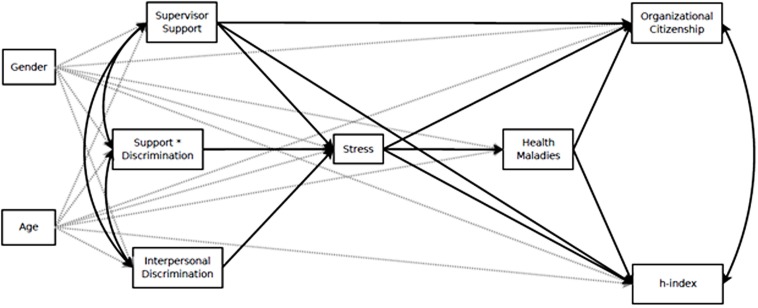
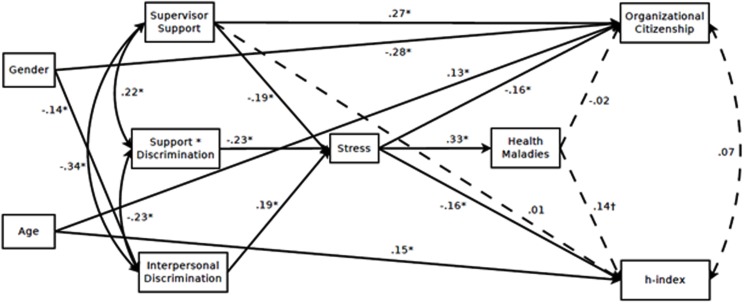
The present study examines the consequences of perceived interpersonal discrimination on stress, health, and performance in a sample of 210 science, technology, engineering, and mathematics (STEM) academicians. Using a path model, we test the relation that perceived interpersonal discrimination has on stress and the relation of stress to physical health maladies and on current and future performance. In so doing, we assess the link between discrimination and decrements in performance over time. Additionally, we test supervisor social support as a moderator of the discrimination-stress relation. Findings support relations between perceived interpersonal discrimination and stress, which in turn relates to declines in physical health and performance outcomes. Moreover, supervisory support is shown to mitigate the influence of interpersonal discrimination on stress in STEM academicians.
本研究调查了210名科学、技术、工程和数学(STEM)领域院士样本中,感知到的人际歧视对压力、健康和工作表现的影响。我们使用路径模型来检验感知到的人际歧视与压力之间的关系,以及压力与身体健康问题、当前和未来工作表现之间的关系。在此过程中,我们评估了歧视与工作表现随时间下降之间的联系。此外,我们测试了上级的社会支持作为歧视-压力关系的调节变量。研究结果支持了感知到的人际歧视与压力之间的关系,而压力又与身体健康和工作表现结果的下降有关。此外,研究表明上级支持能够减轻人际歧视对STEM领域院士压力的影响。