Buntru Alexander, Trepte Philipp, Klockmeier Konrad, Schnoegl Sigrid, Wanker Erich E
Max Delbrueck Center for Molecular Medicine Berlin, Germany.
Front Genet. 2016 May 4;7:74. doi: 10.3389/fgene.2016.00074. eCollection 2016.
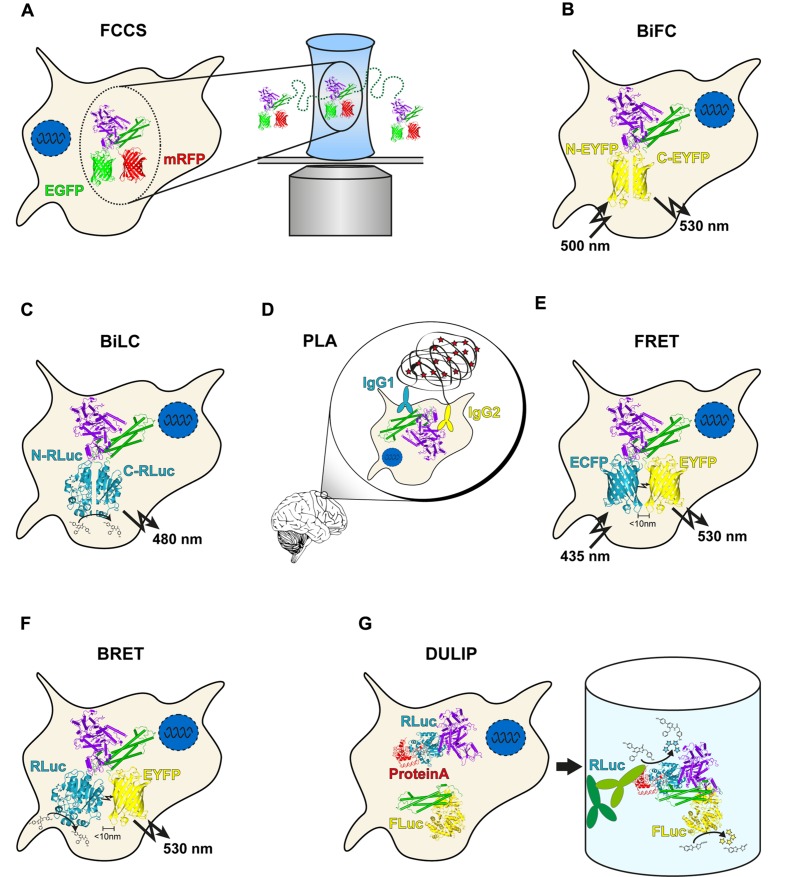
Protein-protein interactions (PPIs) play a key role in many, if not all, cellular processes. Disease is often caused by perturbation of PPIs, as recently indicated by studies of missense mutations. To understand the associations of proteins and to unravel the global picture of PPIs in the cell, different experimental detection techniques for PPIs have been established. Genetic and biochemical methods such as the yeast two-hybrid system or affinity purification-based approaches are well suited to high-throughput, proteome-wide screening and are mainly used to obtain qualitative results. However, they have been criticized for not reflecting the cellular situation or the dynamic nature of PPIs. In this review, we provide an overview of various genetic methods that go beyond qualitative detection and allow quantitative measuring of PPIs in mammalian cells, such as dual luminescence-based co-immunoprecipitation, Förster resonance energy transfer or luminescence-based mammalian interactome mapping with bait control. We discuss the strengths and weaknesses of different techniques and their potential applications in biomedical research.
蛋白质-蛋白质相互作用(PPIs)在许多(即便不是所有)细胞过程中都起着关键作用。正如最近错义突变研究所示,疾病常常是由PPIs的扰动引起的。为了理解蛋白质之间的关联并揭示细胞中PPIs的整体情况,已经建立了不同的PPIs实验检测技术。诸如酵母双杂交系统或基于亲和纯化的方法等遗传和生化方法非常适合高通量、全蛋白质组筛选,并且主要用于获得定性结果。然而,它们因不能反映细胞情况或PPIs的动态性质而受到批评。在本综述中,我们概述了各种超越定性检测、能够对哺乳动物细胞中的PPIs进行定量测量的遗传方法,例如基于双荧光的免疫共沉淀、荧光共振能量转移或基于荧光的带有诱饵对照的哺乳动物相互作用组图谱绘制。我们讨论了不同技术的优缺点及其在生物医学研究中的潜在应用。