Dobija-Kubica Katarzyna, Zalewska-Ziob Marzena, Bruliński Krzysztof, Rogoziński Paweł, Wiczkowski Andrzej, Gawrychowska Agata, Gawrychowski Jacek
John Paul II Beskid Oncology Center in Bielsko-Biala, Bielsko-Biała, Poland.
Medical University of Silesia in Katowice, School of Medicine with the Division of Dentistry, Zabrze, Poland.
Kardiochir Torakochirurgia Pol. 2016 Mar;13(1):15-20. doi: 10.5114/kitp.2016.58959. Epub 2016 Mar 30.
High telomerase activity has been detected in the majority of malignant neoplasms including lung cancer. The purpose of the study was to attempt to use telomerase activity as a prognostic factor in patients with non-small cell lung cancer (NSCLC).
Telomerase activity was analyzed in 47 tissue specimens taken from patients with NSCLC. The control group consisted of 30 specimens of non-cancerous lung parenchyma. Telomerase activity was measured by means of the telomeric repeat amplification protocol (TRAP).
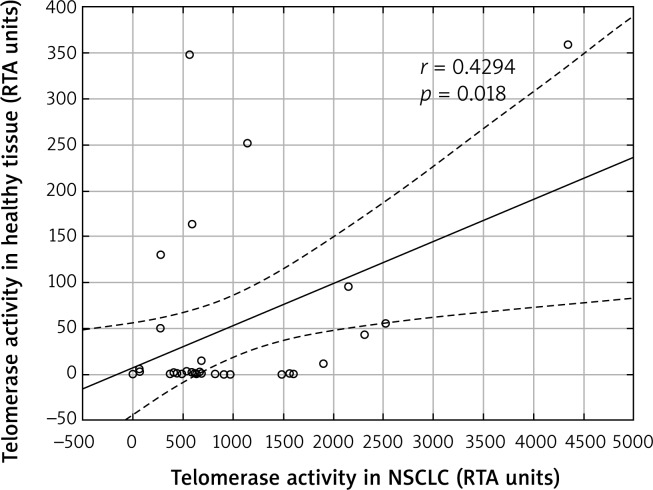
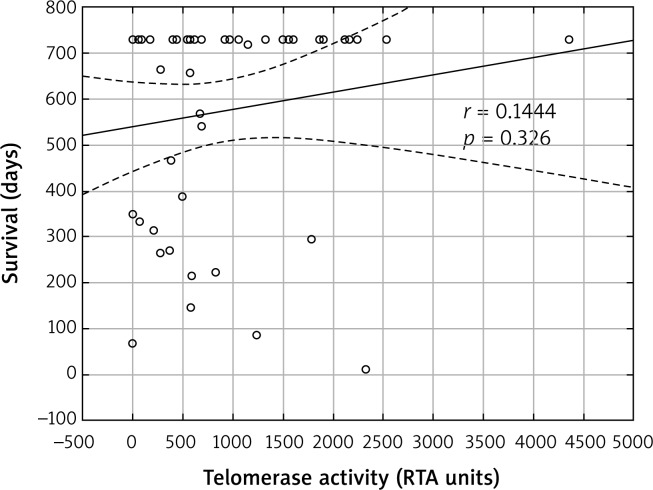
Telomerase activity in the neoplastic tissue was significantly higher than in the lung parenchyma that was free from neoplastic infiltration. There was no significant association between telomerase activity and age, gender, tobacco smoking, histological type of the tumor, or staging (pTNM). No association was found between the level of telomerase activity in NSCLC specimens and the two-year survival rate of patients (p = 0.326). A higher level of telomerase activity in poorly differentiated tumors (G3) as compared to moderately differentiated tumors (G2) was detected (p = 0.008). A positive association was identified between telomerase activity in pulmonary parenchyma free from tumor infiltration and the presence of leukocyte infiltration (p = 0.0001).
No association was found between the level of telomerase activity in NSCLC specimens and the two-year survival rate of patients. The study has revealed a positive association between telomerase activity and the grade of differentiation (G) in NSCLC.
在包括肺癌在内的大多数恶性肿瘤中均检测到高端粒酶活性。本研究的目的是尝试将端粒酶活性用作非小细胞肺癌(NSCLC)患者的预后因素。
对47例NSCLC患者的组织标本进行端粒酶活性分析。对照组由30例非癌性肺实质标本组成。采用端粒重复序列扩增法(TRAP)测定端粒酶活性。
肿瘤组织中的端粒酶活性显著高于无肿瘤浸润的肺实质。端粒酶活性与年龄、性别、吸烟、肿瘤组织学类型或分期(pTNM)之间无显著关联。NSCLC标本中端粒酶活性水平与患者的两年生存率之间未发现关联(p = 0.326)。检测到低分化肿瘤(G3)中的端粒酶活性水平高于中分化肿瘤(G2)(p = 0.008)。在无肿瘤浸润的肺实质中的端粒酶活性与白细胞浸润的存在之间发现正相关(p = 0.0001)。
NSCLC标本中端粒酶活性水平与患者的两年生存率之间未发现关联。该研究揭示了NSCLC中端粒酶活性与分化程度(G)之间的正相关。