Qiu Huan, Cai Guohong, Luo Jing, Bhattacharya Debashish, Zhang Ning
Department of Ecology, Evolution, and Natural Resources, Rutgers University, Foran Hall, 59 Dudley Road, New Brunswick, New Jersey, 08901, USA.
National Animal Disease Center, USDA, 1920 Dayton Ave, PO Box 70, Ames, Iowa, 50010, USA.
BMC Biol. 2016 May 23;14:41. doi: 10.1186/s12915-016-0264-3.
Horizontal gene transfer (HGT) plays an important role in the adaptation of lineages to changing environments. The extent of this process in eukaryotes, however, remains controversial. The most well-known and dramatic form of HGT represents intracellular gene transfer from endosymbionts to the host nuclear genome. Such episodes of transfer typically involve hundreds of genes and are thought to be possible only in the case of endosymbiosis.
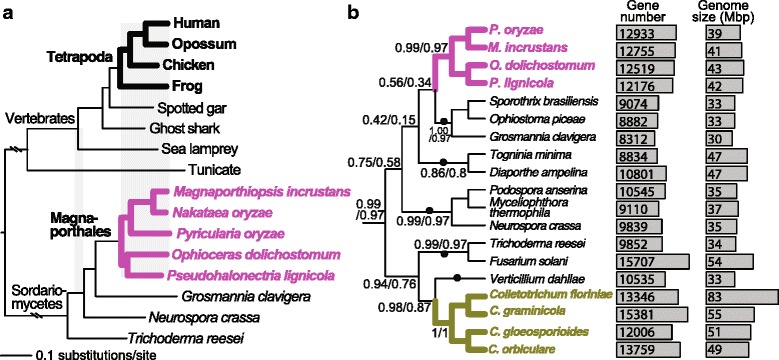
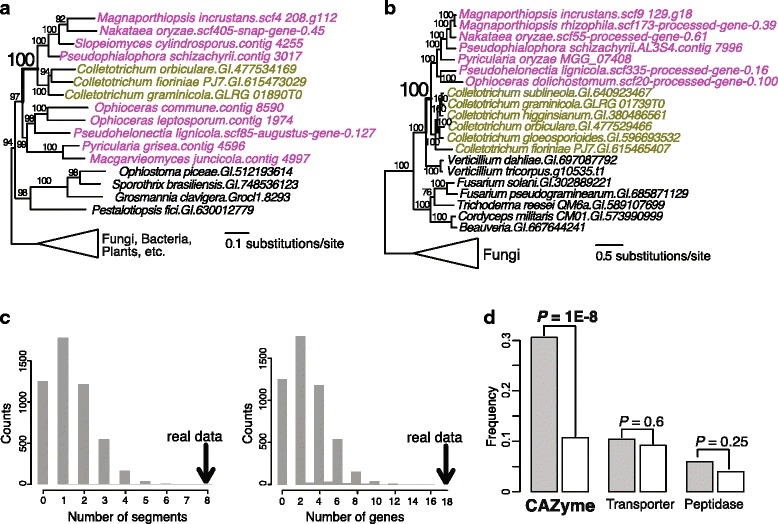
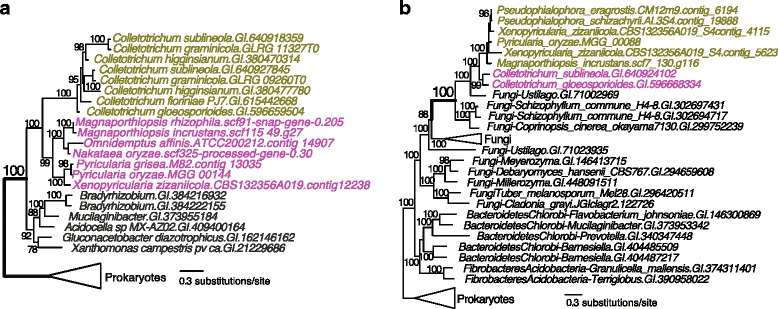
Using a conservative phylogenomic approach, we analyzed genomic data from the fungal pathogen Magnaporthiopsis incrustans in the order Magnaporthales and identified two instances of exclusive sharing of HGT-derived gene markers between Magnaporthales and another lineage of plant-pathogenic fungi in the genus Colletotrichum. Surprisingly, inspection of these data demonstrated that HGT is far more widespread than anticipated, with more than 90 genes (including 33 highly supported candidates) being putatively transferred between Magnaporthales and Colletotrichum. These gene transfers are often physically linked in the genome and show more than two-fold functional enrichment in carbohydrate activating enzymes associated with plant cell wall degradation.
Our work provides a novel perspective on the scale of HGT between eukaryotes. These results challenge the notion that recognized HGT plays a minor role in the evolution of fungal lineages, and in the case we describe, is likely implicated in the evolution of plant pathogenesis. More generally, we suggest that the expanding database of closely related eukaryotic genomes and the application of novel analytic methods will further underline the significant impact of foreign gene acquisition across the tree of life. Major lifestyle transitions such as those accompanying the origin of extremophily or pathogenesis are expected to be ideal candidates for studying the mode and tempo of HGT.
水平基因转移(HGT)在谱系适应不断变化的环境中起着重要作用。然而,这一过程在真核生物中的程度仍存在争议。最著名且引人注目的HGT形式是从内共生体到宿主核基因组的细胞内基因转移。这种转移事件通常涉及数百个基因,并且被认为仅在内共生情况下才有可能发生。
使用保守的系统发育基因组学方法,我们分析了来自Magnaporthales目真菌病原体Magnaporthiopsis incrustans的基因组数据,并在Magnaporthales和炭疽菌属另一个植物致病真菌谱系之间鉴定出两个HGT衍生基因标记的独家共享实例。令人惊讶的是,对这些数据的检查表明,HGT比预期的要广泛得多,在Magnaporthales和炭疽菌属之间推测有超过90个基因(包括33个高度支持的候选基因)发生了转移。这些基因转移在基因组中通常是物理连锁的,并且在与植物细胞壁降解相关碳水化合物激活酶中显示出超过两倍的功能富集。
我们的工作为真核生物之间HGT的规模提供崭新视角。这些结果挑战了公认的HGT在真菌谱系进化中起次要作用的观念,并且在我们所描述的案例中,可能与植物致病机制的进化有关。更普遍地说,我们认为不断扩展的密切相关真核生物基因组数据库以及新型分析方法的应用将进一步突显外源基因获取对整个生命树的重大影响。诸如伴随嗜极或致病起源的那些主要生活方式转变有望成为研究HGT模式和速度的理想候选对象。