Wyman Megan T, Locatelli Yann, Charlton Benjamin D, Reby David
Mammal Vocal Communication and Cognition Research, School of Psychology, University of Sussex, Falmer, BN1 9QH UK ; Department of Wildlife, Fish and Conservation Biology, University of California, 1331 Academic Surge Building, One Shields Ave., Davis, CA 95616 USA.
Muséum National d'Histoire Naturelle, Réserve de la Haute Touche, 36290 Obterre, France.
Evol Biol. 2016;43:227-241. doi: 10.1007/s11692-015-9357-0. Epub 2015 Nov 23.
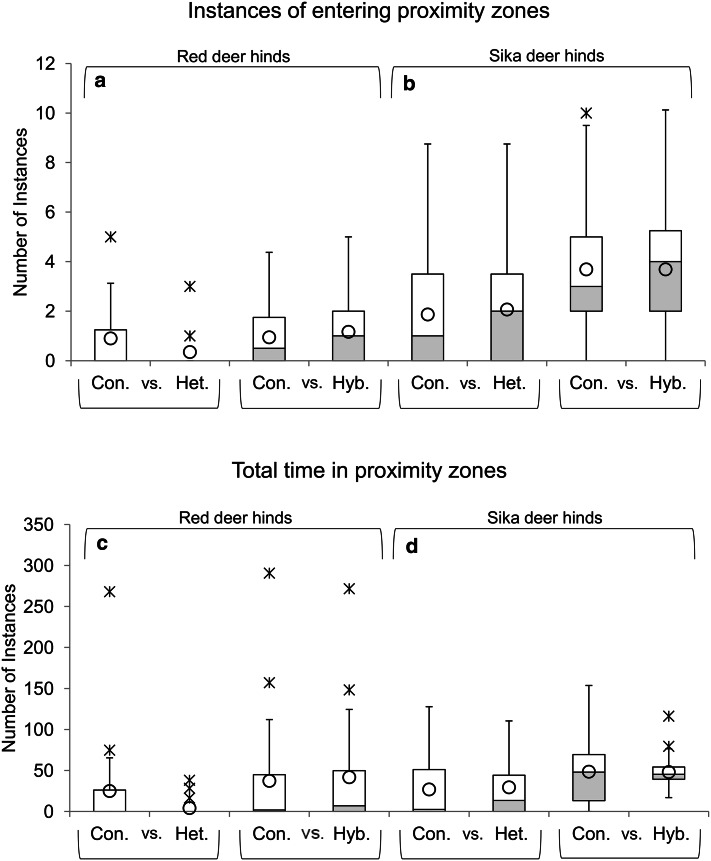
The behavioral processes at the basis of hybridization and introgression are understudied in terrestrial mammals. We use a unique model to test the role of sexual signals as a reproductive barrier to introgression by investigating behavioral responses to male sexual calls in estrous females of two naturally allopatric but reproductively compatible deer species, red deer and sika deer. Previous studies demonstrated asymmetries in acoustic species discrimination between these species: most but not all female red deer prefer conspecific over sika deer male calls while female sika deer exhibit no preference differences. Here, we extend this examination of acoustic species discrimination to the role of male sexual calls in introgression between parent species and hybrids. Using two-speaker playback experiments, we compared the preference responses of estrous female red and sika deer to male sexual calls from conspecifics versus red × sika hybrids. These playbacks simulate early secondary contact between previously allopatric species after hybridization has occurred. Based on previous conspecific versus heterospecific playbacks, we predicted that most female red deer would prefer conspecific calls while female sika deer would show no difference in their preference behaviors toward conspecific and hybrid calls. However, results show that previous asymmetries did not persist as neither species exhibited more preferences for conspecific over hybrid calls. Thus, vocal behavior is not likely to deter introgression between these species during the early stages of sympatry. On a wider scale, weak discrimination against hybrid sexual signals could substantially contribute to this important evolutionary process in mammals and other taxa.
陆地哺乳动物杂交和基因渗入背后的行为过程尚未得到充分研究。我们使用一个独特的模型,通过调查两种自然分布异域但生殖上兼容的鹿种(马鹿和梅花鹿)发情期雌性对雄性求偶叫声的行为反应,来测试性信号作为基因渗入生殖屏障的作用。先前的研究表明,这些物种在声学物种辨别方面存在不对称性:大多数但并非所有的马鹿雌性比起梅花鹿雄性叫声,更喜欢同种雄性叫声,而梅花鹿雌性则没有偏好差异。在这里,我们将这种声学物种辨别的研究扩展到雄性求偶叫声在亲本物种和杂交种之间基因渗入中的作用。通过双扬声器回放实验,我们比较了发情期雌性马鹿和梅花鹿对同种雄性与马鹿×梅花鹿杂交种雄性求偶叫声的偏好反应。这些回放模拟了杂交发生后先前异域分布物种之间的早期二次接触。基于先前的同种与异种回放实验,我们预测大多数马鹿雌性会更喜欢同种叫声,而梅花鹿雌性对同种和杂交种叫声的偏好行为不会有差异。然而,结果表明先前的不对称性并未持续,因为两个物种对同种叫声和杂交种叫声都没有表现出更多偏好。因此,在同域分布的早期阶段,发声行为不太可能阻止这些物种之间的基因渗入。在更广泛的范围内,对杂交性信号的弱辨别可能会极大地促进哺乳动物和其他分类群中的这一重要进化过程。